
 E-Paper



Oui Transfer: An archive turns playful in Puducherry

 Prefer HTon Google


Walk into a mock office, open up cupboards, look through photographs… as an exhibition (now also a film) seeks to reframe how we interact with archives.
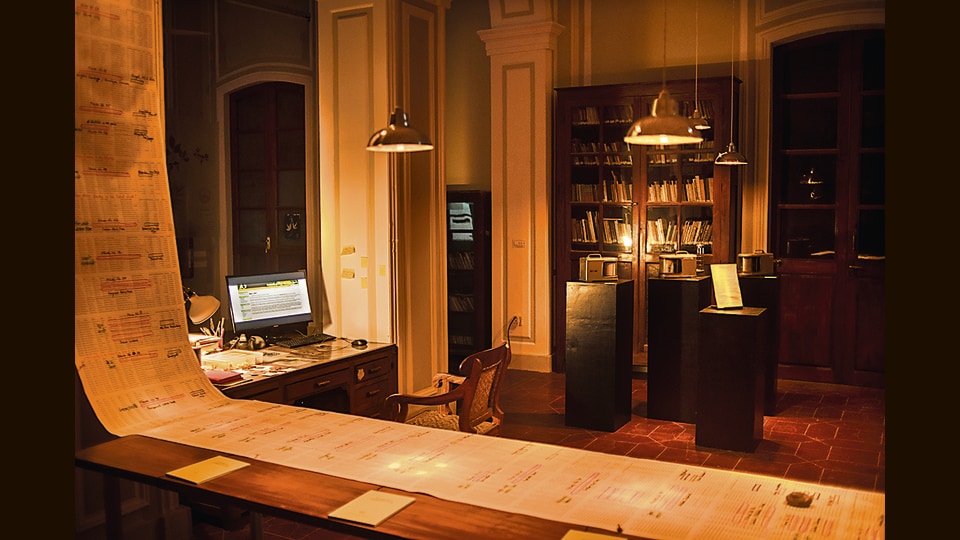
It looks like someone has hurriedly left their office.
On a wooden desk in a lamplit recess, an animated computer screen stands mid-scroll. Books, a set of keys and tasteful knick-knacks sit on nearby end tables.
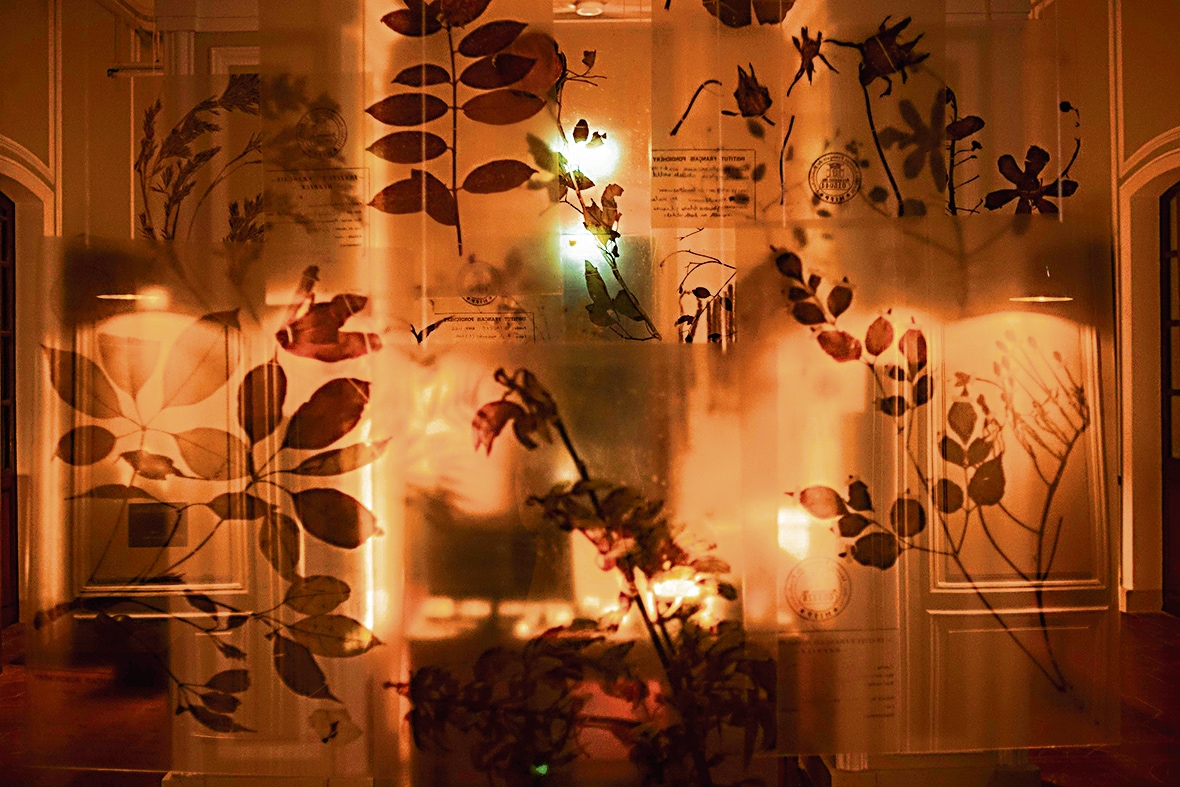
Then one notices an unusual element of décor: a translucent parchment screen above the desk. Pressed into it are replicas of plant specimens. A 10-metre scroll unrolls from ceiling to floor nearby, holding rows and rows of entries (more on this in a bit).
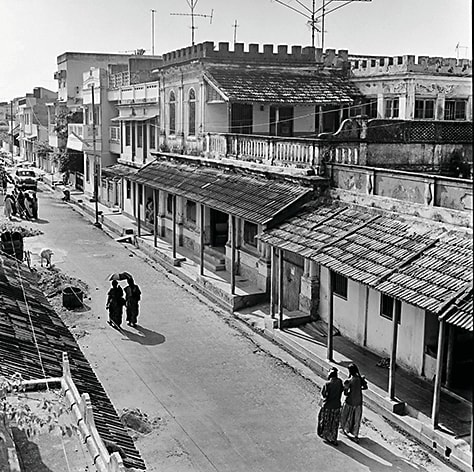
One of the books on the desk turns out to hold Sangam-era poetry in the original Tamil. A cabinet nearby turns out to be a repository of images drawn from a long-gone Pondicherry.
Past and present, history and lore, art and archive merge in the exhibition titled Sleepwalker Archives, hosted by the French Institute of Pondicherry (IFP) to mark its 70th anniversary.
The institute’s yellow-and-white structure, typical of Puducherry’s White Town, and its stained-glass windows, vintage furniture and teak bookcases were roped into the interactive exhibition too.
But the star of the show was the institute’s extensive archive, made up of tens of thousands of photographs, specimens and manuscripts, some dating as far back as the 2nd century CE, all focused on the cultures, people and ecosystems of south India.
Plants, poetry, love
Before we return to the exhibition, a bit about the French Institute. It was established, interestingly, in 1955, a few months after the colony of Pondicherry was transferred to Independent India, in 1954.
The institute was something of a goodwill gesture (if such a thing can exist between coloniser and colonised), meant to serve as a repository of all the information the French government had gathered in its time here.
The repository turned out to be vast: nearly 28,000 plant specimens, 160,000 pictures, over 11,000 manuscripts in Sanskrit and Tamil, and periodicals on France’s colonies in India, some of these dating back to 1823.
Data-gathering continued until the early 2000s. (The institute is now run by the French foreign ministry and French National Centre for Scientific Research).
In deciding how to help visitors engage with this trove, the curators of the exhibition — photographer Karthik Subramanian, 40, writer Devarati Chakrabarti, 28, and historian Sujeet George, 40 (aided by a grant from the Bengaluru-based not-for-profit India Foundation for the Arts) — decided to focus on engagement and interactivity.
“The project was an attempt to answer the question: How can we make an archive more playful than pedantic,” Subramanian says.
Some of the manuscripts and periodicals are, accordingly, accessible to visitors, in an extended library made up of bookcases spread out across parts of the two-storey structure. The institute and the exhibition also feature in a film by Subramanian, titled Sleepwalker Archives, with screenings scheduled in Kolkata in September and October.
“Since about 90% of the plant specimens had been digitised, that gave us the idea for public access via an Excel sheet,” Subramanian says. In the mock office, the scroll let visitors read through details of plant species documented in the region, and match these with some of the renderings traced by George and his team onto parchment screens.
In the wooden index-card cabinet, 66 drawers hold images that spill out like tongues, in accordion folds. This part of the exhibition, curated by Chakrabarti, features photographs of prehistoric rock art, ancient temple architecture, carvings on temple chariots, palaces, cityscapes, jewellery, and sculptures in stone, bronze, wood and ivory.
“The aim is for visitors to explore the links between the idea and the object. Open a drawer labelled ‘Threshold’, for instance, and one finds archival images of the thinnai or courtyards seen in traditional south Indian architecture,” Chakrabarti says.
Look closely and a connection also emerges between the 10-metre scroll and one of the Sangam-era verses in the book on the desk. Kurinjipattu (Song of the region of Kurinji) is a love poem that lists 99 flowers that the protagonist collects for her lover. “This is empirical data as well,” Subramanian says. “The poem too is essentially an archive.”


