
 E-Paper



The quantum leap: How a weird reality at subatomic scale has changed our world

 Prefer HTon Google


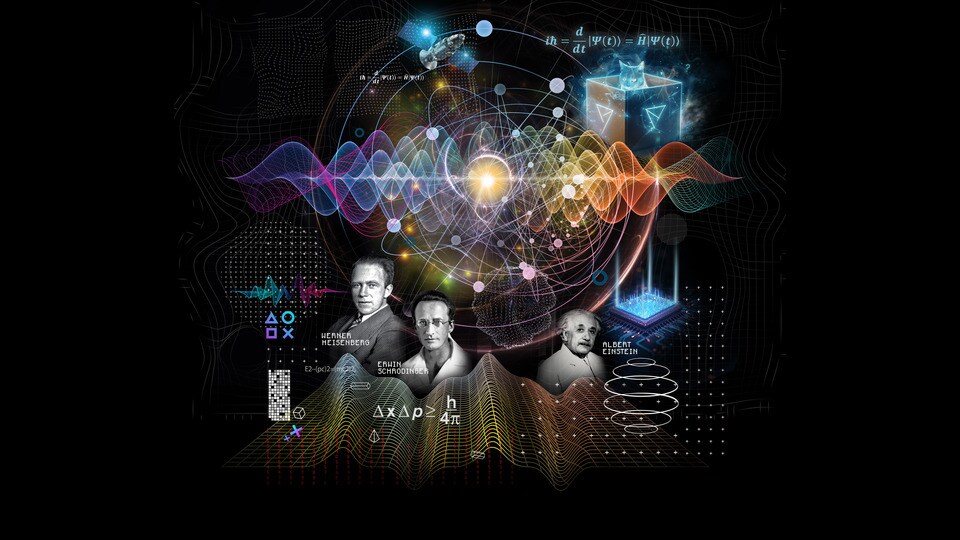
It’s been 100 years since a young German unlocked the mysteries of quantum mechanics. See how that gave us smartphones, GPS, MRIs. See what’s next.
Late one summer morning in 1919, a young student at the University of Munich sat on the roof of its Training College with a copy of Plato’s Timaeus.
The short but bloody reign of the Bavarian Soviet Republic had just ended, and the city was limping back to normalcy. The 17-year-old, whose name was Werner Karl Heisenberg, was reading Plato’s ideas about the smallest units of matter: the Greek philosopher had thought all matter was made up of tiny right-angled triangles, which combined to form more complex shapes. This seemed like utter nonsense by the 20th century, but the idea that the smallest units of nature could be reduced to mathematical forms gripped the young Heisenberg.
At this time, physics was the thrilling science, with every discovery opening up new frontiers. Even World War 1 could not dampen the feeling among physicists that they were living in an age of discovery, where old truths were being swept away, and a new understanding of the world was dawning.
Albert Einstein had published his theory of general relativity in 1915. In May 1919, Frank Watson Dyson and Arthur Eddington had organised a successful observational test of the general theory of relativity.
For Heisenberg, it seemed that mathematics was the key to unlocking the mysteries of the atom. He had devoured Hermann Weyl’s 1918 text Space, Time, Matter, a mathematical account of Einstein’s relativity theory. “The difficult mathematical arguments and the abstract thought underlying that theory both excited and disturbed me, and, in addition, confirmed me in my earlier decision to study mathematics at the University of Munich,” he later wrote in his autobiography.
Given this interest, the young student’s father, August Heisenberg, a professor of Greek with extensive contacts within academia, arranged for his son to meet the mathematician Ferdinand von Lindemann. The moment von Lindemann heard that Heisenberg was fascinated by Weyl’s book, he closed the conversation, saying: “In that case you are completely lost to mathematics”.
Lindemann’s rejection would turn out to be the best thing that could have happened, because Heisenberg’s father next arranged a meeting with Arnold Sommerfeld, a man who would go down in history as one of the great mentors of physicists, serving as research advisor to no less than seven Nobel prize winners.
Heisenberg and Sommerfeld hit it off immediately.
And so it was that, in 1922, when Niels Bohr visited the small German town of Gottingen to give a series of lectures, Sommerfeld, who had been invited, asked Heisenberg if he would like to accompany him.
The Danish physicist Bohr had already, by this time, released his model of the atom. His model was inspired by a theory first put forth by Max Planck in 1900: that energy is emitted or absorbed as discrete packets, rather than continuously.
Planck called these packets quanta, derived from Latin for “how much”.
The links that connected the idea of quanta, Bohr and Heisenberg make up the story of quantum mechanics. Which in turn would change our world, ushering in the age of electronics.
***
Back to the lectures in Gottingen, at the third talk, Heisenberg posed a question to Bohr. Impressed, Bohr went up to him after the talk and asked if he’d like to join him for a trek to the nearby Hain mountain. Towards the end of the walk, Bohr said: “You must pay us a visit in Copenhagen; perhaps you could stay with us for a term, and we might do some physics together.”
Heisenberg did visit Bohr, two years later, and the two engaged in deep discussions about the challenges facing atomic theory. Bohr’s insights into the philosophical and physical aspects of quantum theory had a profound influence on the young man.
Heisenberg, now a physics graduate living in Gottingen, returned home in the winter of 1924, and began working on a mathematical representation of the line intensities of the hydrogen spectrum. Think of the spectrum as a kind of ISBN barcode that is emitted when atoms are subjected to energy. After following the maths through several blind alleys, he decided to ignore such concepts as electron orbits, and just focus on what was observable.
Gottingen was a beautiful town, with greenery and gardens everywhere. For Heisenberg, the flowers of summer triggered an attack of hay fever so intense that he fled for the treeless island of Heligoland. There, far from the madding crowd, he finished work on his model.
In 1925, almost six years to the day since he sat on a rooftop reading Timaeus, Werner Heisenberg found that the model he developed would explain the behaviour of atomic spectra not just for hydrogen, but for all elements. He was 23 years old.
His model showed that, at subatomic levels, a multiplied by b was not the same as b multiplied by a. In other words, commutation, a cornerstone of classical mathematics, did not hold true.
This laid the groundwork for the probabilistic interpretation of quantum theory — which is the remarkable and revolutionary idea that, at this infinitesimal level of matter, physical reality is defined by probabilities rather than by definite, predictable outcomes.
***
Heisenberg returned to Gottingen, where he gave a copy of his proposed paper to Max Born, who was to the University of Gottingen what Sommerfeld was to Munich.
Born immediately recognised the importance of Heisenberg’s model, and worked with him and fellow physicist Pascual Jordan, to refine and further develop the work.
Heisenberg’s paper, titled On the Quantum-Theoretical Reinterpretation of Kinematic and Mechanical Relations, was published in Zeitschrift für Physik (Journal for Physics) in 1925. Quantum mechanics had entered the popular lexicon.
Four months later, Erwin Schrodinger published his famous equation, which described electrons as wave functions. Schrodinger’s mathematical work was able to make the same predictions as Heisenberg’s model, making them different but equivalent representations of the behaviour of electrons.
For Einstein, Heisenberg’s model was deeply troubling both from a physics and a philosophical point of view. He followed the mathematical model further, and along with Boris Podolsky and Nathan Rosen, presented a paper that indicated that quantum mechanics was incomplete. He disputed the idea that the world ran on probabilities, famously saying: “(God) does not play dice.”
***
Meanwhile, Heisenberg continued his work. In 1927, he refined and presented his “Uncertainty Principle”, which essentially states that it is impossible to accurately determine both the position and momentum of a subatomic particle.
By 1932, the 30-year-old had won the Nobel Prize in Physics.
The following year, Adolf Hitler came to power.
The Nazis hated quantum physics. They called it the “Jewish science”, as many of its leading lights were Jews. Heisenberg found himself the target of an organised campaign.
Das Schwarze Korps, the official newspaper of Heinrich Himmler’s Schutzstaffel or SS, denounced him as a “White Jew” (the term for an Aryan who acted “like a Jew”), and said he should be made to disappear.
It would take a visit from the physicist’s mother, Annie Heisenberg, to Himmler’s mother, Anna Maria Himmler, to smooth things over. In 1938, Himmler sent out letters saying Heisenberg was a useful asset, and warned the physicist to “refrain from the politics” of his fellow scientists.
During the tumultuous time, Heisenberg met and married Elisabeth Schumacher, the daughter of a senior professor of economics in Berlin (and sister of EF Schumacher, the German-British economist and author of the seminal “eco-bible” Small is Beautiful.)
Heisenberg visited the US in 1939, but refused an offer to emigrate there. He returned to Germany, where he became part of the German nuclear weapons programme. Towards the end of the war, he was extracted to the UK by the Allies. It was from there that he watched, with the rest of the world, the stunning, destructive capabilities of the atomic bomb.
***
Heisenberg remains a fascinating figure in 20th-century science. Fittingly, there is an uncertainty about him. He was close friends with Jews, expressed contempt for the Nazis, and yet worked for them. He was a gifted musician, a pianist who loved Mozart and Bach, but this turned tone-deaf when it came time to take a stand.
He was never a member of the Nazi party, but he did not leave Germany before the war, like many of his counterparts did. Nor did he move to the US under that country’s Operation Paperclip, an intelligence programme that took German scientists, engineers and technicians to the United States after World War 2, aiming to exploit their knowledge for military and industrial purposes. Instead, Heisenberg returned to Gottingen as soon as he could, and began promoting scientific research in Germany.
This ambiguity — perhaps fittingly, the uncertainty — has made his legacy a complex one. It’s the reason Walter White, the teacher turned drug dealer and protagonist of the series Breaking Bad, adopts the name Heisenberg. It’s the reason the atomic bomb is called the Heisenberg Device in the TV adaptation of Philip K Dick’s The Man in the High Castle. It’s the inspiration for Michael Frayn’s Tony Award-winning play Copenhagen, which centres on Heisenberg’s visit to the eponymous city in 1941, to meet his old mentor, Niels Bohr.
Today, to most of us, quantum mechanics calls to mind the Uncertainty Principle, Schrodinger and his cats in boxes, and vaguely remembered formulae. The popular excitement around the atom dissipated with Hiroshima. But practical quantum mechanics is all around us, driving our cameras, GPS systems and latest computers. Click here to see just how Heisenberg’s work has shaped our world.
[With input from Paul Ramesh Thangaraj, adjunct faculty at the Indian Institute of Technology-Madras (IIT-M)]


