
 E-Paper



UV vision, fire sensors, a QR code for love?: A quick look at how animals see the world

 Prefer HTon Google


Sight and sound are perhaps the biggest standouts. But there are also strange tales here of reindeer, shrimp, and a bug that seeks out fire.
It’s easy to make the mistake of assuming that all animals experience the world as we do.
The truth is that, beyond our version of reality lies a world of eyes that see differently, sounds we cannot hear, and colours we can barely imagine.
Reindeer, for instance, can see ultraviolet light. (Imagine what the Aurora Borealis looks like to them.)
They actually rely quite heavily on this ability. Because both animal urine and lichen absorb UV light, the reindeer can use their special receptors to detect the former, which helps them avoid predators and court potential mates, and find the latter, so they can stay alive in winter.
Both appear as sort of anti-beacons: dark blotches against bright, reflective snow.
Birds and insects use ultraviolet light to feed and find the right mate too. But here there is a flip side: their ability to see UV affects how they are hunted. Spiders, for instance, spin UV-reflecting webs that double as prey magnets. Insects fly straight to them, possibly mistaking them for the natural bright spots on nectary flowers.
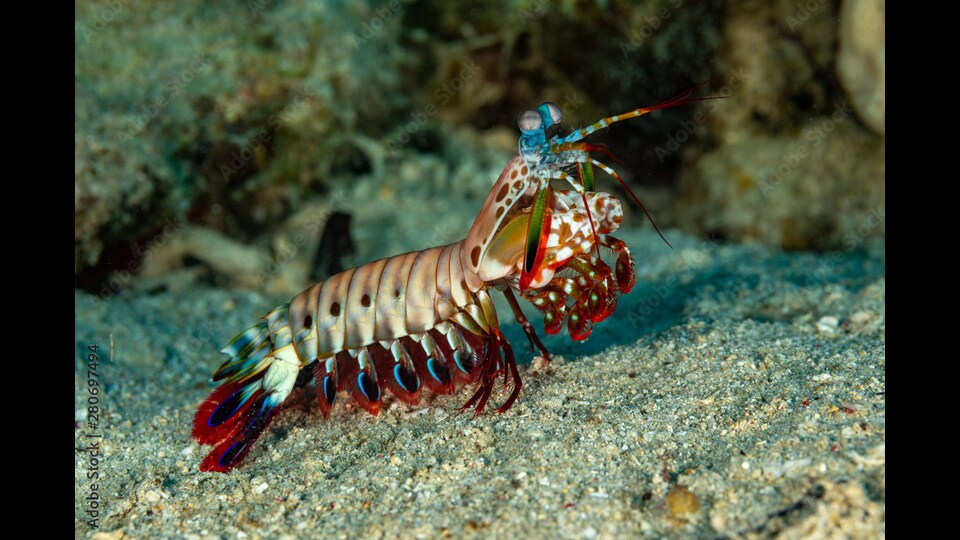
Out in the oceans, meanwhile, the mantis shrimp is seeing its coral world in colours so rich, it has 16 to 21 different photoreceptors (for our three).
These photoreceptors are vital because of how colour is lost in water. Even as little as two metres under the surface, the reds vanish first, their wavelength absorbed most easily. They are followed by the yellows and greens. This is why coastal waters often appear blue. Amid all this, the mantis shrimp’s unusual eyes help it see its way to food and away from predators.
Birds, meanwhile, would appear to have among the most vibrant views of the world.
European starlings and hummingbirds let ultraviolent light guide social interactions and courtship to such a degree that they are believed to choose their mates based on patterns in plumage that we will never see. A sort of QR code, almost, for love.
From vision on to sound, the insect world is full of bizarre and brilliant adaptations in this arena. Grasshoppers, crickets and locusts, for instance, have some of the tiniest ears on the planet.
These, as you may remember from school, are perched on their knees. (Some insects have ears on their antennae, some on their abdomens. Hearing is so crucial to survival among these creatures that they have evolved to essentially put the ears wherever they can best do their job.)
Perhaps the strangest “extra-sensory” ability I’ve ever heard of, though, is the heat-detection organ in fire-chasing beetles. These black bugs that look like something out of an Egyptian tomb are found in Central and South America, South-East Asia and the Caribbean.
They can sense high heat (as from a forest fire) from more than 100 km away. They do this using specialised infrared sensory-pit organs on their chests.
Snakes have such organs too, and it helps them frame thermal images of their surroundings, and find warm-blooded prey in the dark.
The beetle, however, is cast in a different mould. It doesn’t track forest-fire signals so it can fly in the opposite direction (as surely anything should?). No. It — and tell me this isn’t straight out of a horror movie — tracks these signals so it can fly straight to them.
Nathan Schiff, an entomologist and researcher with the US Department of Agriculture’s Forest Service, says he has often turned up to the scene of a blaze to find thousands of these beetles already there. “I never see a swarm making their way to a fire. I have walked 2 km to a fire and not seen a single beetle along the way. But got to the burnt and there are thousands,” he says.
There’s more. They make their way to flames in this manner because they prefer to mate and lay their eggs in the charred remains of scorched trees. This way, they can be reasonably sure the eggs will be safe from predators, and from plant defences. Adults die after mating. The eggs hatch as larvae, pupate a year later, and a new generation of the beetles eventually leaves the charred forest.
And so what seems absurd, unnatural even, turns out to be just another way of being. There’s a lesson in there somewhere, for our own vast and varied species.
(Rupsy Khurana leads science communications and outreach at the National Centre for Biological Sciences, Bengaluru)


