What’s your Plan B, your side hustle? Life Hacks by Charles Assisi
Most careers will likely follow an S-curve. Which means that each of us must periodically ask ourselves: “How am I currently defining success?” and “What must my next steps be in order to achieve it?”
I’m going to stick my neck out and argue that the office is either dead or dying. If you’re among those hoping to go back to it sometime soon, I’d say don’t hold your breath. If you’re among those who’ve been called back to it, I’d be willing to bet the place will soon be a relic.
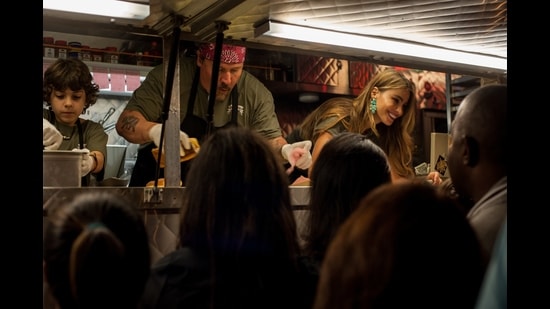
Much like Jon Favreau’s character in Chef, employees are coming around to the idea that a career path isn’t always a straight road. Sometimes a side step is more rewarding. Sometimes it’s not optional. In either case, it’s a good idea to define what you would do for a living if you couldn’t continue to do what you do now. (Image courtesy Fairview Entertainment)
Most work will get done remotely. This, because much has changed over the last 16 months. People have started getting used to being dispersed and have found ways to continue to bond and work together while separated by distance and even altered schedules. Many have found this format far preferable. They can live where they please, order their day much more to their liking, reclaim parts of their lives they’d forgotten about (like exercise or family meals).
As the months have stretched out, there have been fewer and fewer reasons for either employer or employee to aim for a return to the way things were.
With those at the helms of organisations finding that most work can be done out of anywhere, investments in real-estate and the other paraphernalia that go with the office format don’t make sense any longer. That money could be invested to help expand the footprint of the business instead, a crucial factor in today’s challenging economic climate.
People who have experienced working away from the office now know what an escape from the drudgery of daily commutes and meaningless rituals feels like. It is inevitable that both sets of people will ask, do we really need to congregate in one place?
Most arguments in favour of the office hinge on the fact that homes in Indian metros are overcrowded and infrastructure such as wifi expensive and unpredictable. The latter issue is easy enough to address; most large companies now offer broadband and power supply backup to employees.
As for the former issue, an unusual solution has begun to take shape. Indians are migrating away from large cities, to smaller places where they can live more like they would choose to live. Some have moved to the coastlines or the mountains; others have returned to large cities near their hometowns, where they have the added benefit of being close to their own parents and extended families.
The question likely to occupy employers in the coming months, then, isn’t “Should we return to the workplace”, but “How can we work optimally without it?”
Consider the culture of meetings and presentations. Initially this was one area that seemed to get worse with remote working, as the irksome things moved to screens and this became both exhausting and invasive, with people from our professional lives entering our personal spaces, sometimes every day.
Now, my day job involves working in proximity with leadership teams at various organisations to scan for best practices in the world of work. One of the most effective ones I have witnessed is Amazon’s “No PowerPoint Rule”. While this policy was implemented a few years ago, the pandemic has highlighted just how necessary it was. Instead of presentations, the rule requires that people write memos no longer than six pages, about any plan or proposal. This dramatically cuts the time spent on meetings. It also forces the author to clarify their own thinking.
The merits of this practice have been well documented and are being adopted by entities around the world, including in India. But, as with all change, it requires the learning of a new skill. It is infinitely more difficult to craft concise notes than it is to throw everything you want to say onto slides. Senior leadership at Amazon say they have all had to work hard to acquire this skill.
That brings me to another shift we are witnessing at work. We were fed, since childhood, the idea that the career ladder is something we must aim to climb. With industries merging, collapsing and colliding, we must now adapt to the idea that it’s not about ladders. Most careers will likely follow an S-curve. Which means that each of us must periodically ask ourselves two questions: “How am I currently defining success?” and “What must my next steps be in order to achieve it?”
After the travel and tourism business went bust, a friend who had spent three decades in it was compelled to ask these questions. Since then, he has gone back to college for a degree in teaching. That is the life he would like for himself. Getting there will take a while. Right now, it is tough on the family and on him. This is the new normal.
I know that I am always scanning the horizon for ways to upskill to stay relevant. As a pragmatic journalist who covers business put it the other day: “I’m among the privileged ones to have received a paycheque for all of the last 15 months.” But that could change, for any of us, overnight. And what would we do then? That’s a question one must now always have an answer to.

 E-Paper