
 E-Paper



“Grand Theft Auto VI” may mark the end of an era in gaming


 Prefer HTon Google


Studios face shrinking incentives to make top-tier titles
IT IS NIGHT-TIME in Vice City, Leonida, a raucous digital replica of Miami, Florida. Jason and Lucia, two small-time crooks, have an inauspicious first encounter: they meet while trying to steal the same car. The relationship has a rocky start—Lucia introduces herself to Jason with a baseball bat—but soon the pair are on the run together in the stolen vehicle: partners in life and partners in crime.
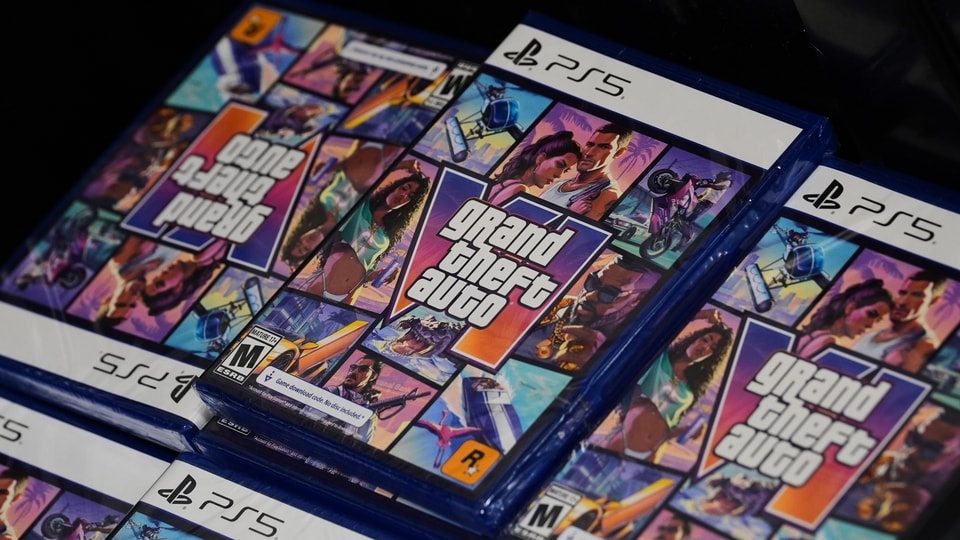
So begins the most eagerly awaited video game in history, which launches on November 19th after 13 years of rumours, leaks and missed deadlines. Some analysts predict that “Grand Theft Auto VI” (“GTA VI”) will take more than $3bn worldwide in its first week. That would make it not just the highest-grossing game launch in history, but the biggest entertainment debut of any kind (overtaking “Avengers: Endgame”, a Marvel superhero movie which, by most measures, has held the title since 2019).
Players who had stayed up until midnight to play the game said it was worth the wait. (Some had registered accounts in New Zealand in order to get access a few hours earlier.) “GTA VI” combines the action and irreverent humour of previous titles in the series with an improbably touching love story, played out in an astonishingly lifelike world. It is already the joint-highest-rated game in history on Metacritic, a review aggregator. Employers expect an epidemic of “GTA flu”, as workers call in sick to stay at home playing it.
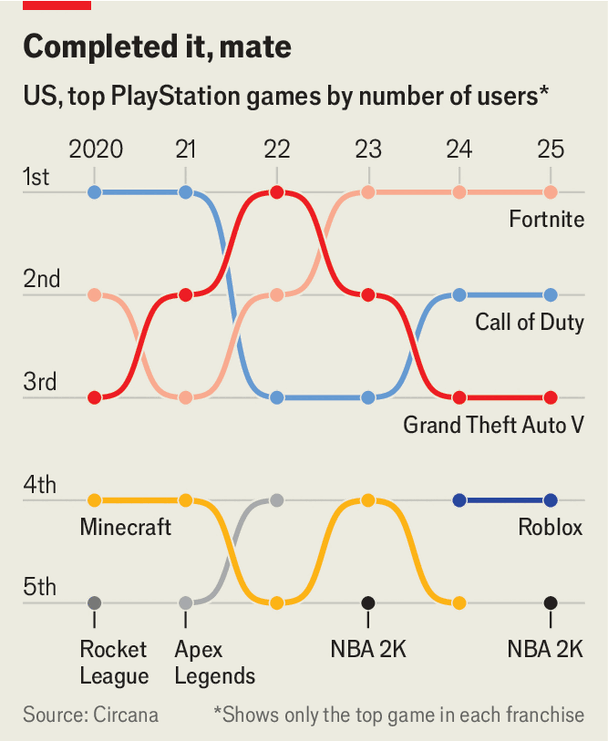
The hype around “GTA VI” is deserved—but it conceals a problem. Despite the game’s likely commercial success, developers face shrinking incentives to make anything like it again. A look at the charts suggests that something is wrong in the industry (see chart). Since 2020 the five most popular PlayStation games in America each year have come from only eight franchises. The top three have hardly changed at all. “Fortnite” is a relative newcomer at nine years old. The “Call of Duty” franchise is 23. “GTA” is 29, older than many of its players.
It is not only on consoles that gaming culture has ossified. In 2025 only 14% of playing time on PCs was spent on games released that year, according to data from Steam, a games store. In recent years the top ten PC franchises have racked up nearly as much play time as the next 100,000 combined. This concentration at the top represents “the biggest threat to gaming as we’ve known it for 30 to 40 years”, says Mat Piscatella, a former industry executive now at Circana, a market-research firm.
How did gaming get so stuck? Playing “GTA VI” makes clear the formidable barriers faced by new entrants to the industry. The game’s map stretches from the thumping nightclubs of Vice City to alligator-infested swamps, all of it painstakingly populated with a cast of eccentric characters. Leonida has a public transport system and in-game radio stations; Jason even has a console on which you can play games within the game. Every inch is rendered with near-photographic realism.
As technical possibilities have expanded, developing a video game has become a task that makes producing a Hollywood blockbuster look quick and cheap. As games get bigger and graphically richer, making them needs more manpower. The first “Call of Duty” (2003) names 261 people on its closing credits. The latest, released last month, credits 7,060 (more than any “Avengers” film).
Raph Koster, a game-industry veteran, estimates that the cost of developing a top-quality game has risen tenfold every decade since the mid-1990s. “GTA VI” reportedly cost over $1bn—and it shows in every detail, from the swish of Lucia’s ponytail as she flees across rooftops, to the wake of Jason’s speedboat as he chases a seaplane. One developer has compared making the game to building “a pyramid on Everest”. (As budgets have swollen larger than Hollywood’s, apparently so have egos.)
Companies are responding by making fewer, bigger bets. Xbox, Microsoft’s gaming division, has jettisoned some of its smaller studios to focus on reliable performers like “Call of Duty” and “Minecraft”. Rather than gamble on new titles, publishers are turning existing hits into constantly evolving “live service” games, notes Niko Partners, a research firm. Whereas “GTA IV” (2008) was mainly a single-player game, selling 25m copies in five years, “GTA V” (2013) has become an open-ended online experience, selling 230m copies over more than a decade. Despite its age, the franchise made more than $800m last year.
Even for companies with deep pockets, breaking into gaming’s top tier has become tough. In 2024 Sony launched “Concord”, a live-service shooting game with a reported nine-figure budget—only to shut it down after two weeks, amid weak demand. Earlier this month Sony cancelled another shooter, “Fairgames”, after lukewarm feedback. Players have invested so much time and money in titles such as “GTA” and “Fortnite”—honing expertise and buying in-game items—that moving to another game represents a steep cost. The top live-service titles have earned the nickname “black-hole games”, from which players cannot be dragged away.
Some believe that artificial intelligence could shake up the market by allowing developers to generate code, graphics, music and so on more quickly and cheaply. Tim Sweeney, head of Epic Games, which makes “Fortnite”, has said he expects AI to bring forth “a new golden age of gaming”.
Yet even if AI reduces the cost of making software, it is pushing up the price of hardware. Soaring demand from data centres for computer memory has caused a cost surge dubbed the “RAMageddon”. Earlier this year PlayStation and Xbox raised their prices; both consoles now cost more than when they launched six years ago. Analysts believe the next generation of consoles may cost over $1,000. Xbox is laying off thousands of workers. “The future of Xbox itself is now an open question,” argues Gareth Sutcliffe and colleagues at Enders Analysis, a research firm.
All this could mean that the future of gaming looks more like the past. In a world of $1,000 consoles, consumers will shift to lower-spec devices, such as cheap PCs and mobiles, says Mr Piscatella, who notes that games like “Fortnite” and “Minecraft” have been designed to run “on a toaster”. Nintendo has struck gold with its Switch console, which lacks the computing muscle to run games like “GTA VI” but has been a hit thanks to its portability and low price.
Youngsters are gravitating towards Roblox, a free platform featuring millions of basic games made by users. AI is making it easier for tiny development teams to turn out cheap and cheerful experiences for the platform. Roblox recently said that two games in its top 20, “Break and Steal an Egg” and “Huss Valley”, had been created “almost entirely” with AI.
To hardcore gamers, such titles will feel like a step back. Most of the top games on Roblox look like titles from 20 years ago. Nintendo’s latest Switch has the computing power of a console from the 2010s. Yet as the economics of launching new top-tier games get harder, and audiences shift to lower-powered devices, these will be the games that most people play. The decade-long gestation and billion-dollar budget behind “GTA VI” have created a one-of-a-kind piece of entertainment. As one in-game character reflects: “Enjoy this, dude. If this right now was all that there is, all the time—it’d be perfect.”
For more on the latest books, films, TV shows, albums and controversies,sign up to Plot Twist, our weekly subscriber-only newsletter


