
 E-Paper



This CT scan belongs to 44 year old French man ‘who lived normal life despite missing 90% of brain’, baffled scientists

 Prefer HTon Google


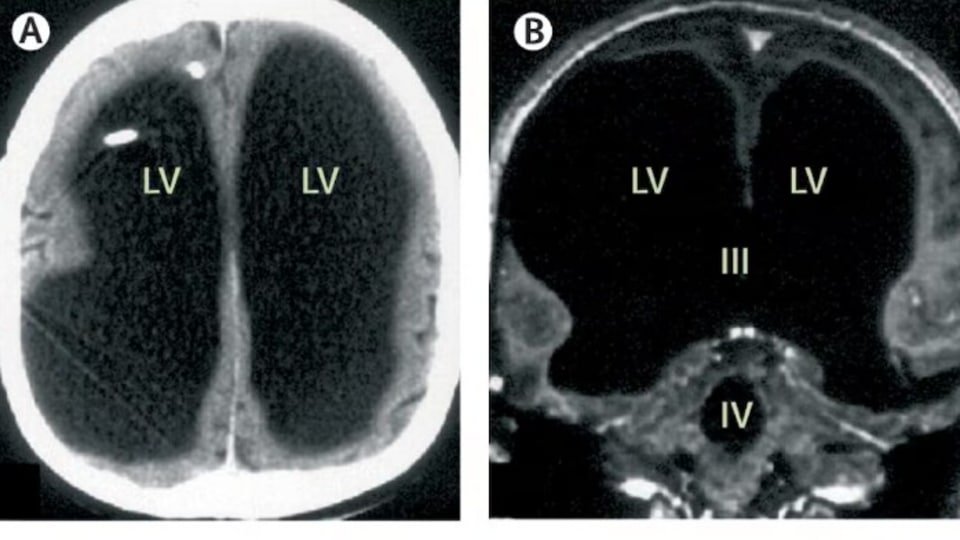
Scans of a French man's brain were published in The Lancet in 2007. This case has puzzled researchers as it challenges traditional theories of brain function.
A rare medical case, first described in The Lancet in 2007, highlights the brain's remarkable adaptability and neuroplasticity. Despite losing 90 percent of his brain, the then 44-year-old French man was reportedly able to lead a relatively normal life, challenging traditional theories about consciousness and brain function. Also read | This CT scan belongs to ‘a 73 year old woman in whom doctors discovered a 30 year old calcified fetus’ aka stone baby
All about the case
Cognitive psychologist Axel Cleeremans' insights — shared in a July 14, 2016 report by CBC Radio — suggest that the brain's ability to learn, adapt, and reorganise itself plays a crucial role in sustaining consciousness and functionality, even in the face of significant damage.
As per the report: when a 44-year-old man from France started experiencing weakness in his leg, he went to the hospital. That's when doctors told him he was missing most of his brain. The man's skull was full of liquid, with just a thin layer of brain tissue left. The condition is known as hydrocephalus.
‘Father of two and worked as a civil servant’
Here's what The Lancet said: “A 44-year-old man presented with a 2-week history of mild left leg weakness. At the age of 6 months, he had undergone a ventriculoatrial shunt, because of postnatal hydrocephalus of unknown cause. When he was 14-years-old, he developed ataxia and paresis of the left leg, which resolved entirely after shunt revision. His neurological development and medical history were otherwise normal. He was a married father of two children, and worked as a civil servant.”
It added, “On neuropsychological testing, he proved to have an intelligence quotient (IQ) of 75: his verbal IQ was 84, and his performance IQ 70. CT showed severe dilatation of the lateral ventricles (figure); MRI revealed massive enlargement of the lateral, third, and fourth ventricles, a very thin cortical mantle and a posterior fossa cyst. We diagnosed a non-communicating hydrocephalus, with probable stenosis of Magendie's foramen (figure). The leg weakness improved partly after neuroendoscopic ventriculocisternostomy, but soon recurred; however, after a ventriculoperitoneal shunt was inserted, the findings on neurological examination became normal within a few weeks. The findings on neuropsychological testing and CT did not change.”

'It is incredible the brain can continue to function'
Calling the man's case a medical miracle — but also a major challenge to theories about consciousness — Axel said, “He was living a normal life. He has a family. He works. His IQ was tested at the time of his complaint. This came out to be 84, which is slightly below the normal range… so, this person is not bright — but perfectly, socially apt.”
He reportedly also spoke about this 'extremely rare case' at the Association for the Scientific Study of Consciousness conference in Buenos Aires in 2016. Asked 'what kind of a larger lesson this case offers about our brains', Axel said, “One of the lessons is that plasticity is probably more pervasive than we thought it was … It is truly incredible that the brain can continue to function, more or less, within the normal range — with probably many fewer neurons than in a typical brain. A second lesson perhaps: if you're interested in consciousness — that is the manner in which the biological activity of the brain produces awareness... one idea that I'm defending is the idea that awareness depends on the brain's ability to learn.”
Note to readers: This article is for informational purposes only and not a substitute for professional medical advice. Always seek the advice of your doctor with any questions about a medical condition


Catch your daily dose of Fashion, Taylor Swift, Health, Festivals, Travel, Relationship, Recipe and all the other Latest Lifestyle News on Hindustan Times Website and APPs.


