
 E-Paper



A garbage cart for a ride, surviving on biscuits & miles from home
May 1 Labour Day Special


May 1 Labour Day Special
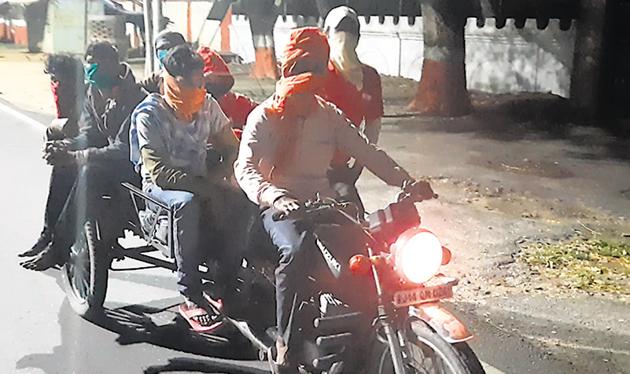
A makeshift motorised cart chugs down the roads of Lucknow at night. Lallan Pandit is steering the modified bike in front of the cart as it moves with a low-pitch rattle. Behind, in the open cart, are six men, their backs to each other, legs hanging over the cart, as they move along the deserted road, trying to reach home.
“Yahan kahin paani mil jayega, hamare pas pani khatam ho gaya hai (Can we get water some place here),” said Pandit, as he stops the rickshaw at a crossing on the Lucknow-Sultanpur highway.
Just a month earlier, the men, all hailing from Madhubani, Bihar, were doing different jobs in Jaipur, 1,200 kilometres from home.
Pandit drove the cart which was used to carry municipal garbage. Randheer Patel, 42, the eldest of the group packed food in a restaurant. The youngest, 20-year-old, Manish, was an assistant at a tailor’s shop along with Rakesh, 24, who sat behind him in the cart. Keval Yadav, 40, drove a pedal rickshaw on which he carried tourists around the Pink City. Manish, 35, worked as motor mechanic, while Nagendra, 30 worked as a waiter. They all lived nearby.
“Humlog 14 April ka intezar kar rahe they, ki lockdown khule aur hum ghar jaye. Par fir lockdown badh gaya aur ham niklne ka sochne lage (We had been waiting for the lockdown to get over on April 14. But when it got extended we began thinking of leaving the place,” said Pandit.
The lockdown which was put in place on March 25 was extended till May 3 on April 14.
The men first planned to walk back home but the distance was too much. Then they planned renting bicycles but eventually decided to travel on the makeshift rickshaw. They put in Rs 2,500 each from their meagre savings to buy the motorised cart and put on new tyres. Rs 1,500 were kept aside for fuel. They tied their bags on the side of the cart and left Jaipur on the night of May 25.
Lallan and Nagendra shared the driving. The group drove for around five hours every day to avoid straining the engine. They drove in the night and slept and washed during the day. “Din mein har jagah police wale rok lete hain. Marte hain, pareshan karte hain, isiliye hum log rat main chalte hain (We travel only during the night because during the day, policemen trouble us. They stop us and even beat us),” Ranjit said.
But with almost all their money spent on buying the rickshaw the men hardly had anything left to buy food. Packets of glucose biscuits was all they could buy.
In the four-day long journey they only ate biscuits, some which they bought, others which they got from people along the journey. “Kabhi socha nahi tha biscuit kha ke guzara karna padega. Par nahi khayenge to mar jayenge, humko pochhne wala kaun hai (Never had we thought that we will have to survive on biscuits. But we will die if we don’t eat it. Who is there to ask about us),” said Yadav, the pain and despair apparent in his voice.
Yadav had to pay back a loan of 2 lakh taken from local money lender for the marriage of his sister. Randheer is saving for his daughter’s marriage scheduled next year. Pandit has a family of seven to feed. Manish and Nagendra don’t have any farm to survive upon and Rajesh can’t find a job in the village or in Bihar.
Each of them has a reason for working far from home and no matter how much they hate it, the same reason will make them leave their houses again, soon. “Gaon main kuch kam nahi hai. Wahan bhooke mar jayenge. Wapas kam par to jana hi padega (There is no work in the village. We will die of hunger there and will have to return to our jobs)” Nagendra said.
In Lucknow, the group drank water from a tap near a roadside mosque. They filled their bottles and hopped back on the cart. Patel kick-started the engine and the overloaded cart moved, slowly melting into the darkness.


