
 E-Paper



Mumbai infra: Autos and taxis are lagging behind in this race
While poor service and lac of comfort have commuters opting for alternatives, last-mile connectivity helps autos and taxis stay relevant


Travelling in the city without an autorickshaw or taxi is almost next to impossible.
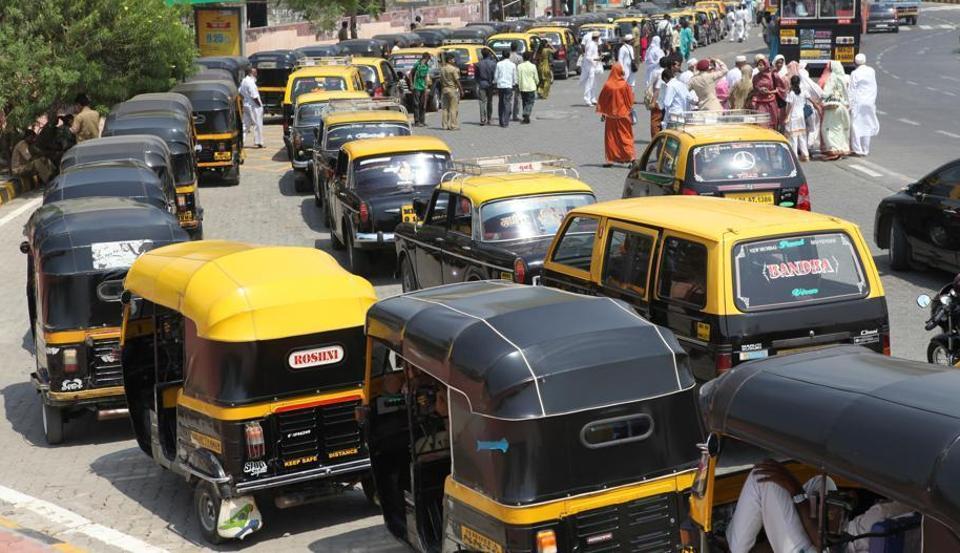
Taxis were introduced in 1911, and autorickshaws came to the city in the 1970s. While they have been providing last-mile connectivity, experts feel they lack quality and efficiency, and need a governing body to come up with stricter rules considering the increasing number of vehicles.
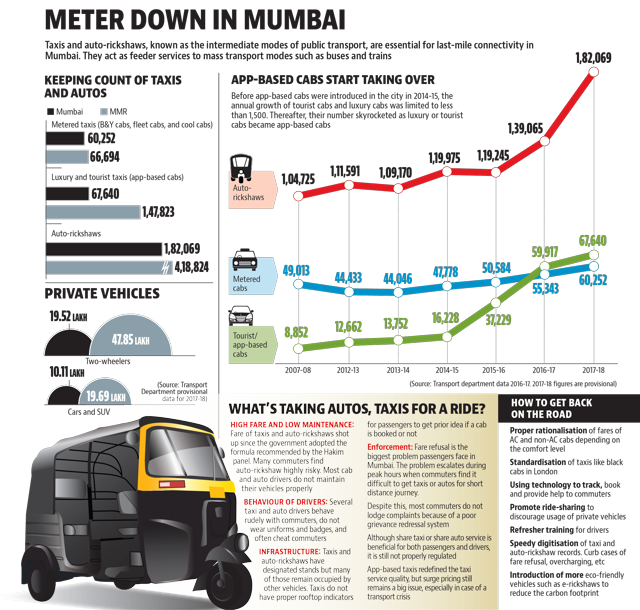
Almost three decades after Dodge, Chevrolet and Plymouth ran on the city’s streets as taxis, they got meters and their characteristic black-and-yellow colour in 1952. Mumbai got the iconic Premier Padmini taxis in the late 1960s, and got more than 60,000 cabs, including the blue-and-silver air-conditioned ones, by 2000. App-based Ola and Uber, according to experts, restricted their growth. Even the 5,000 AC fleet cabs, introduced in 2005, have almost vanished from the city roads.
Elaborating on the history of autorickshaws, AL Quadros, veteran taxi union leader, said only two vehicles were registered in Mumbai in 1958, but their number increased around 1970. Most of these autos were plying illegally, till the government restricted their movement to the suburbs in 1977. The number of vehicles has gone up over the years, especially after two lotteries to reissue cancelled permits and the government decision of removing the cap on autorickshaw permits. From 1.05 lakh autorickshaws five years ago, the number of vehicles now stands at 1.8 lakh.
Taxis and autorickshaws, the intermediate modes of public transport, mainly provide feeder services to mass transport modes such as buses and trains. They control the number of private vehicles and help curb vehicular pollution.Sharing rides on taxis and autorickshaws bring down the cost of travel.
App-based cabs became popular among citizens since 2014. Commuters switched to these cabs as they seemed a cheaper, better and comfortable alternative to conventional cabs and autos. They are easy to book, well-maintained, with easy payment options and well-behaved drivers, compared with taxi and auto drivers’ refusal of fares for shorter distances, overcharging, rigging of meters and fights. Moreover, the pick-up from doorstep seemed like an added advantage.
App-based taxis, however, are considered illegal as they don’t have the permit to ferry city commuters. Taxis have tourist permits. As such, these cabs face strong opposition from drivers of conventional cabs and autorickshaws. After the initial years, when taxi aggregators offered major discounts, commuters have started to oppose surge pricing – rise in prices based on the demand. Under pressure from the driver’s union and general public, the state has been forced to frame new rules to regulate surge pricing.
To regulate app-based cabs, the state brought in City Taxi Rules in 2015, later amending it to Maharashtra City Taxi Rules 2017. Through these rules, the government has set a minimum and maximum fare for app-based cabs. Also, compressed natural gas (CNG) based fuel and new permits have been made mandatory. Several months have passed, but app-based taxis are still unregulated. As the aggregators have challenged the rules in the Bombay high court, operators continue to charge surge fare. Meanwhile, the opposition to these services has reduced.
The state had appointed a four-member panel, led by former IAS officer BC Khatua, to decide the fare for taxis and autorickshaws. After several months of study, the panel submitted its report in October 2017. In the report, the panel suggested introducing happy hours (low fare during non-peak hours) and telescopic fare (reduction in fares with increasing distance) to attract commuters. The committee also decided a formula to come up with maximum and minimum fare for app-based taxis, besides suggesting amendments to the City Taxi Rules 2017, to make it more effective. The state, however, has not taken any decision on implementation of the report.
Last year, the state abruptly removed the restriction on the number of permits that was put in place in 1997. Taxi and autorickshaw unions welcomed the decision, but experts said it lacked vision. People were expecting the quality to improve, but the government increased quantity.
The government should make sure the permit-holder drive the vehicle. Drivers should be trained in customer service. There should be better and quicker redress mechanism,” said Ashutosh Atray, an expert. Quadros said there more than 1,600 taxi stands for cabs in Mumbai, but almost half of those missing. “Interchange points can help reduce fare refusals,” he said.
Presently, the railway authorities have undertaken several projects for expansion of suburban network, besides improving carrying capacity and improving passenger comfort. More air-conditioned local trains are likely to be introduced on the suburban corridor. Even, a couple of metro corridors are likely to be operational in the next few years, making the competition tougher for taxis and auto rickshaws. Shashank Rao, leader of Mumbai Autorickshawmen’s Union, said they will sustain even after the Metro starts running on all corridors. “They provide last-mile connectivity. Their demand will always be there,” he said.
Datar said, “The number of app-based taxis less likely to increase in the future. However, the number of taxis using the app for booking will go up. Even the growth of the vehicles will slow down. It is not because they cannot afford cars, but owing to the traffic congestion.”
GPS, panic buttons to be installed in vehicles in ’19: transport secy
In an interview, Manoj Saunik, transport secretary of Maharashtra, talks about regulation on app-based cabs and installation of GPS and panic button in public vehicles. Excerpts:
There has been a positive change as the old fleet has been replaced by the new one. In the first seven to eight months, the quality and the service of autorickshaws and taxis have improved.
The city taxi scheme is the best bet to regulate these cabs. There is a high court order that no action on the city taxi scheme will be taken till a petition is disposed of.
The Centre has stayed the implementation for some time. It has issued a clarification that when there is a sufficient number of suppliers, the implementation will begin. The implementation has been postponed for six months. All transport vehicles, including black-and-yellow taxis and autorickshaws, will be installed with GPS and panic buttons next year.


Stay updated with all the Breaking News and Latest News from Mumbai. Click here for comprehensive coverage of top Cities including Bengaluru, Delhi, Hyderabad, and more across India along with Stay informed on the latest happenings in World News.


