
 E-Paper



Stubble burning in north India pollutes central and southern states too, says NASA study
Researchers attribute the dispersal of pollutants to distant places to mechanised harvesting practices, as it leads to crop residue burning.

 Prefer HTon Google


Pollution from burning agricultural waste or crop residue by farmers in the north-western states of India not only impacts air quality in Delhi and the neighbouring areas but also affects central and southern Indian states and the eastern parts of the Indo-Gangetic Plains (IGP), a new study has revealed.
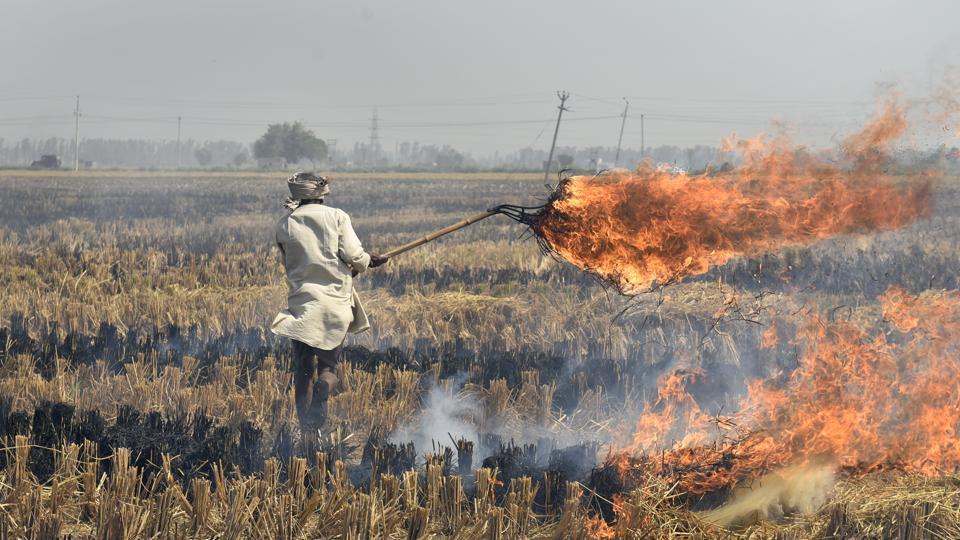
The study, led by NASA’s Goddard Space Flight Center, has found that fine black carbon particles released from biomass burning in Punjab, Haryana and western Uttar Pradesh between October and November reaches parts of Maharashtra, Madhya Pradesh, Telangana, Chhattisgarh, and Odisha in the post-monsoon and winter seasons, with the highest impact being observed in the first and second weeks of November.
Researchers attributed the rise in and dispersal of pollutants far from the source to mechanised harvesting practices, which leave 10-30cm-high stubble in the field, and prompt farmers to burn what’s left.
“Mechanised harvesting leaves more residue in the field, in the form of stalks, stubbles, and straws that are burnt by farmers to clear the field for the next crop,” said RP Singh, co-author and professor at the School of Life and Environmental Sciences, Schmid College of Science and Technology, Chapman University, US. “An increase in crop residue burning is the result of increased shift towards mechanised harvesting, which has spread gradually to other states, including the foothills of the Himalayas.”
Black carbon, commonly known as soot, is emitted during incomplete biomass burning and vehicular combustion, and has a negative impact on health, climate, rainfall, and soil productivity. These particles are so fine (0.1 to 1 micron) that they can disperse over large distances; in humans they can cross cell walls and affect health. Their ability to absorb heat from sunlight also makes these pollutants the second-most warming agent in the atmosphere, after carbon dioxide.
Previous studies have shown that pollution caused by burning crop residue in these states has had an impact on the Indo-Gangetic Plains, an area also affected by brick kilns and coal-based power plants.
The new findings, based on satellite observations, ground stations and global climate models to examine the impact of crop residue burning between 2013 and 2017, have found that the presence of black carbon particles and greenhouse gases such as methane have increased since 2010.
Burning of crop residue began around 1986, with mechanised harvesting techniques being used for wheat during April-May, and rice in October-November. The study states that the surge in burning crop residue after 2010 has seen two phases: the first from 2010 to 2013, and second from 2014 onwards, which indicates an increasing shift towards mechanised harvesting.
The expansion of irrigation network in India’s north-western states, an increase in agricultural land, and the short time gap between summer and winter crops have prompted farmers to burn crop residues.
Last year, for instance, biomass burning in Punjab, Haryana and western Uttar Pradesh severely impacted air quality and visibility in Delhi and IGB, with schools being forced to stay closed on some days to prevent children from being exposed to toxic pollutants.
Every year, an estimated 35 million tonnes of stubble is burnt in Punjab and Haryana alone, to clear land for the winter crop. In November 2015, the National Green Tribunal banned crop residue burning in five states — Punjab, Haryana, Rajasthan, Uttar Pradesh and Delhi. In December 2017, the Union environment ministry approved ₹100-crore project to tackle crop burning in the northern states, allocating funds from the National Adaptation Fund for Climate Change.
“Despite the ban, farmers continue to burn crop residue, especially at night, as it is economical. The government should either implement the law stringently, or provide farmers with machines to cut the stalk from the roots,” Singh said.
FIRES, WIND, METHANE AFFECT AIR QUALITY
The study found that winds originating from north and north-western regions after monsoon and in winter lift black carbon aerosols that are within 500 metres of the Earth’s boundary layer and transport them as far as to south and central India. In some central regions, these fine particles were found 500-800 metres above the planet’s boundary layer.
“This suggests that black carbon aerosol-laden winds can travel longer distances at higher altitudes and impacts far-off places. Of course, the intensity and extent depend on wind direction and wind speed,” said Singh.
From annual fire counts measured by two multi-national NASA scientific research satellites (AQUA and TERRA) during the study period, researchers found that a growing number of farmers are burning crop residue in the post-monsoon months of October-November.
The satellites captured an increasing trend in the number of fire counts during 2010-2011, but this occurrence peaked in 2016. However, the count of fire pixels was higher in AQUA compared to TERRA, which is consistent with the results of a 2014 study that showed the fire count captured by AQUA over Punjab was 10 times more than that by TERRA. TERRA is a morning satellite with local overpass time of 10.30am, while AQUA has an overpass time of 1.30pm.
“We conjecture that because of this difference in observation time, AQUA can detect more fires as residue burning picks up with the progression of the day. It is a common practice for farmers to begin burning in the morning and end by evening,” the study states.
Increase in fire counts since 2010 logged by the AQUA satellite also matched with an increase in methane emissions from crop residue burning over north-western India during the post-monsoon season for the same year.
A 2013 study found anaerobic conditions in submerged paddy fields after the burning of residue, which can emit methane in the region.
Based on the Emissions Database for Global Atmospheric Research, the team compared methane emissions from enteric fermentation, agricultural soils, agricultural waste burning, fossil fuel combustions, manures, road transportation and solid wastes in central-south regions. Results showed the highest increase in methane emissions from agriculture waste-burning from source areas located in north-north-western India over IGB and central-southern regions, as compared to other sources.
“Deterioration of air quality is of great concern especially over the Eastern IGB that is already riddled with increasing pollution from various other sources like coal mining, fossil fuel combustion, industrial outputs and increased vehicular traffic, all of which are contributors to black carbon and brown carbon,” states the study.
The paper ‘Crop Residue Burning in Northern India: Increasing Threat to Greater India’, co-authored by Sudipta Sarkar from NASA Goddard Space Flight Center, Akshansha Chauhan from the School of Engineering and Technology, Sharda University, Greater Noida, and Singh, was published in the American Geophysical Union in June.


