
 E-Paper



Da Vinci's instrument: the sound of genius comes to life
A musical instrument, the Viola Organista, dreamt up by the Italian Renaissance genius Leonardo da Vinci, has been brought back to life thanks to a Polish concert pianist with a flair for instrument-making.

 Prefer HTon Google


With elegant black and tan keys it looks like a baby grand piano, but when tinkled they release the voluptuous tones of a cello.
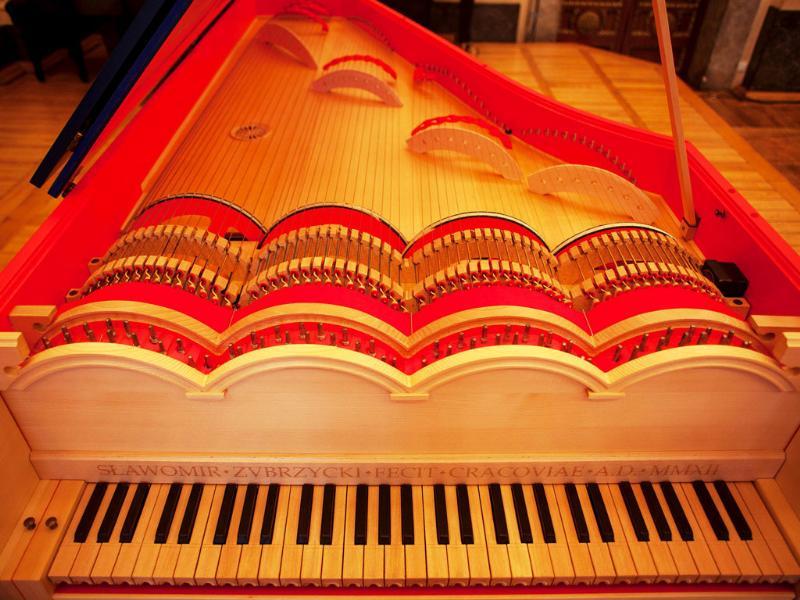
Painter of the Mona Lisa, Italian Renaissance genius Leonardo da Vinci also dreamt up the Viola Organista in the late 15th century as a marriage of keyboard and string instruments. But he never built it, experts say.
Virtually forgotten, it has come to life thanks to a Polish concert pianist with a flair for instrument-making.
Full of steel strings and spinning wheels, Slawomir Zubrzycki's creation is a musical and mechanical work of art.
"This instrument has the characteristics of three we know: the harpsichord, the organ and the viola da gamba," Zubrzycki told AFP recently as he debuted the instrument at the Academy of Music in Poland's historic southern city of Krakow.
"Leonardo da Vinci invented it around 1470-80," said the tall, thin, bespectacled 50-year-old as he rummaged in a briefcase full of tools picking one for a final tuning.
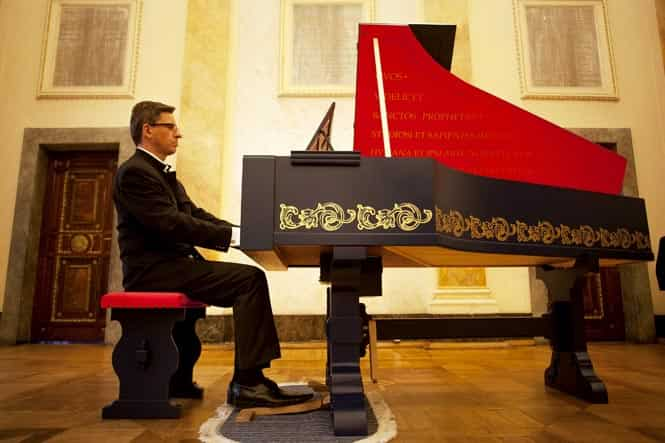
The instrument's exterior is painted in a rich hue of midnight blue adorned with golden swirls painted on the side. The inside of its lid is a deep raspberry inscribed with a Latin quote in gold leaf by 12th-century German nun, mystic and philosopher, Saint Hildegard.
"Holy prophets and scholars immersed in the sea of arts both human and divine, dreamt up a multitude of instruments to delight the soul," it says.
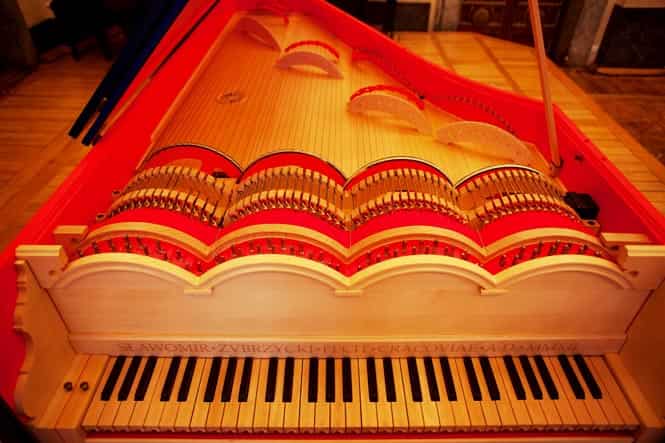
The flat bed of its interior is lined with golden spruce. Sixty-one gleaming steel strings run across it, similar to the inside of a baby grand.
Each one is connected to the keyboard complete with smaller black keys for sharp and flat notes. But unlike a piano, it has no hammered dulcimers.
Instead, there are four spinning wheels wrapped in horse tail hair, like violin bows. To turn them, Zubrzycki pumps a peddle below the keyboard connected to a crankshaft.
As he tinkles the keys, they press the strings down onto the wheels emitting rich, sonorous tones reminiscent of a cello, an organ and even an accordion.
The effect is a sound that da Vinci dreamt of, but never heard; there are no historical records suggesting he or anyone else of his time built the instrument he designed.
A sketch complete with notes in da Vinci's characteristic inverted script is found in his Codex Atlanticus, a 12-volume collection of his manuscripts and designs covering everything from mathematics to botany, weaponry to flight.
"I have no idea what Leonardo da Vinci might think of the instrument I've made, but I'd hope he'd be pleased," said the mild-mannered Zubrzycki with just a hint of pride.
Bringing da Vinci's dream sound to life was a three-year-long labour of love for Zubrzycki, on which he spent at least 5,000 hours and 30,000 zloty (7,000 euros, $9,700).
The "Geigenwerk" -- "fiddle work" in English -- built in 1575 by German Hans Haiden is the first known instrument based on da Vinci's design, according to experts at the Musical Instruments Museum (MIM) in Brussels.
Its collection contains another built in 1625 by Spaniard Truchado Raymundo.
"It's the only wholly preserved example of this instrument" from the past, MIM expert Pascalle Vandervellen told AFP.
Japan's Aiko Obuchi built a compact table-top model a decade ago, but information about any others is hard to come by.
Contemporary examples are "very rare," Vandervellen said.
'Gives you goose bumps'
It was standing room only for the recent world premier of Zubrzycki's Viola Organista in a gilded concert hall complete with twinkling crystal chandeliers at Krakow's prestigious Academy of Music.
Gabor Farkas, an award-winning Hungarian concert pianist and a teacher at the Ferenc Liszt Academy of Music in Budapest, fell in love with what he heard.
"It's a keyboard instrument but it sounds like someone is playing it with a bow like a violin or a cello – a very warm sound, very velvety, very beautiful," an astonished Farkas told AFP during the intermission as concert-goers crowded around the instrument to peer under its lid.
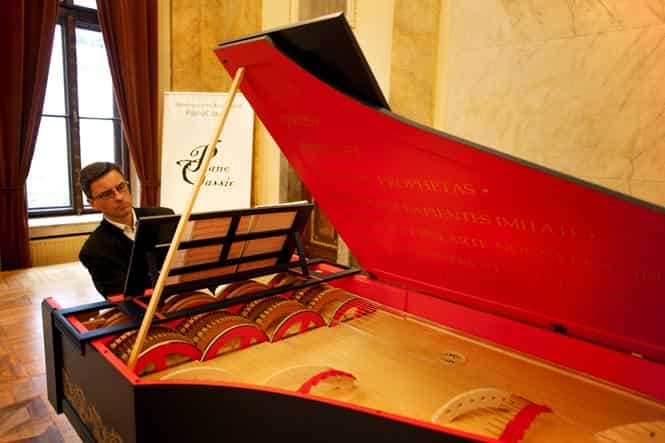
"One thing the piano is missing is that as soon as you hit one note, it dies. Here you can make a crescendo. It's the dream of all pianists!", Farkas said.
Polish concert pianist Marian Sobula agreed.
"I've fallen in love with this sound," he said after Zubrzycki playing his Viola Organista received a standing ovation.
"All pianists and string players yearn for it, for these long, never-ending notes which you can't play on the piano. It just gives you goose bumps."
Krakow musician Kazimierz Pyzik who plays the thick-necked, seven-stringed viola da gamba - a precursor of the cello -- was also a huge fan.
"Now that Poland's been eliminated (from the World Cup) in football and everyone's kind of depressed about it, suddenly we have a man who's created an instrument which is a one of a kind, the world over. It's sensational!".


