
 E-Paper



An early ceasefire, talks and diplomacy can end the war in Ukraine
Humanitarian operations are aimed at alleviating some of the distress, but will not stop the incalculable human suffering in Ukraine. To this end, a massive diplomatic effort will be required


In his remarks to the United Nations (UN) General Assembly Emergency Special Session on Ukraine on February 28, UN secretary-general Antonio Guterres stated, “The attack on Ukraine challenges international law and the multilateral system rooted in the UN Charter”. He also noted, “We face what could easily become Europe’s worst humanitarian and refugee crisis in decades, with the numbers of refugees and internally displaced multiplying by the minute.”
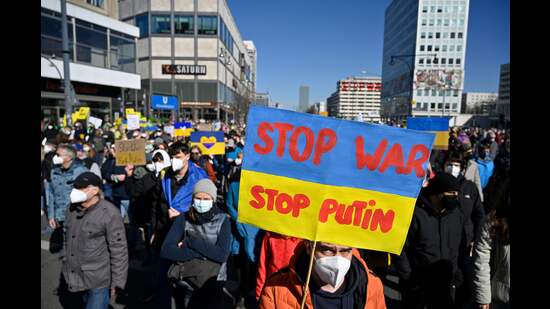
Besides the loss of innocent lives and the destruction of property, infrastructure and civilian facilities, Russia’s unprovoked military operation inside the sovereign territory of Ukraine is presenting two sets of challenges before the international community: The violation of the fundamental purposes and principles of the UN Charter and of the peremptory norms of general international law; the triggering of a catastrophic humanitarian crisis with an exodus outside Ukraine’s borders and the dispersion of people within the country in an attempt to seek refuge from the brutality of war.
The aggression on Ukraine is not only ravaging the country but also fuelling a regional crisis with disastrous global implications and ripple effects on the international community. Rising prices of oil and gas, with their consequences on the cost of living, or the shortage of grain exports, with their consequences in terms of food insecurity, are just the tip of the iceberg of the shock initiated by the Russian invasion. No matter how far people are from the epicentre of the conflict, its impact will be felt.
The material impact might be coupled with even bigger repercussions caused by the violation of the basic principles of coexistence within the international community. Silence towards the disregard of some fundamental values enshrined in the UN Charter — including refraining from the threat or use of force against the territorial integrity of any State — might be detrimental to peaceful relations wherever there are unresolved border disputes. This was also the concern 141 countries — including all the European Union (EU) member states — shared when they voted in favour of the Resolution on the Aggression of Ukraine.
As far as the humanitarian crisis is concerned, the United Nations High Commissioner on Refugees (UNHCR) has noted how, in just two weeks, the threshold of two million refugees fleeing Ukraine has already been crossed.
To escape violence and in search of hope and safety, those people chose the neighbours on Ukraine’s western borders, including four EU countries, whose remarkable efforts in this lifesaving endeavour are commendable.
The duty of the international community lies in assisting not only the ones who have left, but also the ones who remain and live in privation under the threat of violence. To those people, many countries are directing their humanitarian efforts. Italy is doing its part by supplying relief and housing goods for the Ukrainian population; as is India by sending medical and relief material to the people affected by the crisis.
Humanitarian operations are aimed at alleviating some of the distress, but will not stop the incalculable human suffering in Ukraine. To this end, a massive diplomatic effort will be required.
In a conversation on the developments in Ukraine that Italian foreign minister Luigi Di Maio recently had with India’s external affairs minister S Jaishankar, both reaffirmed the importance of an early ceasefire and the return to dialogue and diplomacy.
The gist of the discourse is that at this stage, all members of the international community who have a stake in global peace and stability need to concentrate their efforts on promoting greater international coordination aimed at an immediate ceasefire, at a mediated and sustainable solution through diplomacy, and respect for the basic tenets of international peace and security.
Vincenzo De Luca is ambassador of Italy to IndiaThe views expressed are personal


