Can Akhilesh respond to the BJP’s poll strategy of Mandal, Mandir, Market?
This election season, the SP is aware that the BJP has demolished the Opposition in the last three elections in UP. So, how can it respond to the BJP’s “all-encompassing” strategy?
The Samajwadi Party (SP) has traversed quite a distance — from its fight for social justice to emphasising development — in the transition from the leadership of Mulayam Singh to his son, Akhilesh Yadav, in 2012. This election season, the SP is aware that the Bharatiya Janata Party (BJP) has demolished the Opposition in the last three elections in Uttar Pradesh (UP). So, how can it respond to the BJP’s “all-encompassing” strategy — the politics of Mandal, mandir and market?
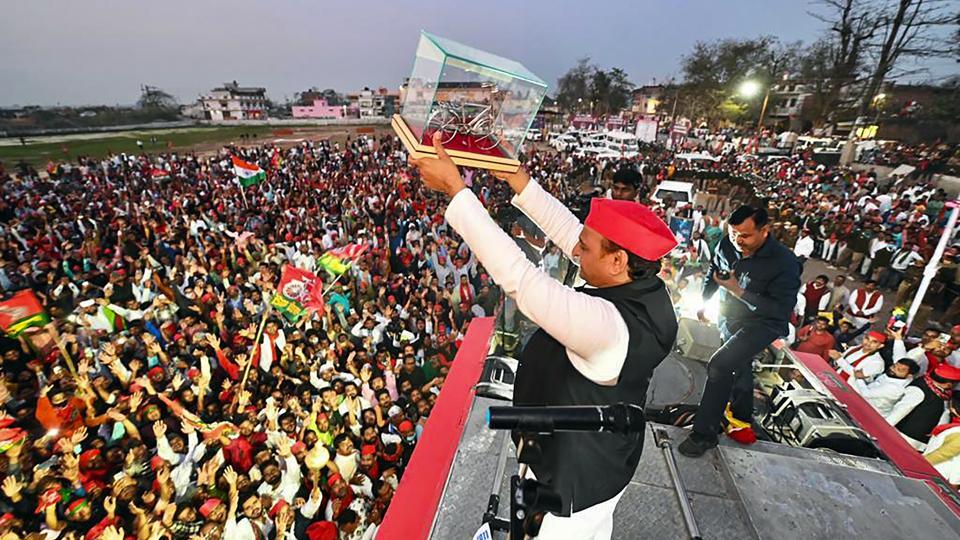
Maintaining a balance between his secular credentials and responding to the Hindutva juggernaut will be the toughest nut to crack. (PTI)
In the 1990s, Mandal politics engineered novel political alignments in north India. The rise of numerically strong, but politically marginalised, castes in UP and Bihar, such as the Yadavs and Jatavs, was unprecedented, with the vernacularisation of politics centred on leaders from these caste groups. This propelled leaders such as Mulayam Singh Yadav and Mayawati to the top.
The politics of mandir (temple) and Hindutva, in its attempt to unite Hindus against a perceived Muslim and Western threat, was a response to the Mandal narrative. In the next decade, with the rise of the politics of vikas (development), the BJP was able to exploit the weaknesses within Other Backward Classes (OBC) politics. Ultimately, the coming of the Narendra Modi-Amit Shah duo marked a concerted push to win the OBC and Dalit votes. In return, parties that emerged from the fight for social justice were forced to start invoking Hindu idioms.
When Akhilesh arrived on the scene in the 2010s, voters saw him as the harbinger of a new style of leadership. His emergence evoked high expectations. He sailed through the 2012 elections but his relatively weak control within the internal party organisation and the tussle with his uncle Shivpal harmed his image. Eventually, in the last year of his tenure, he was seen as having emerged from the shadow of his father and uncle, but it was too late to change his image in the public eye.
The experiments of allying with Congress and the Bahujan Samaj Party (BSP), in 2017 and 2019 respectively, did not pay dividends. And then, the troika of Modi, Shah, and Yogi Adityanath made things more challenging.
This is a make or break election for Akhilesh. This may be why he started a vijay yatra (victory march) from Kanpur which took in 12 districts of Purvanchal, Bundelkhand, and western UP. This gave the party a new lease of life. Many voters — who once argued that this election will be a cakewalk for the BJP — now admit that the SP is in the fight.
But reports from the field after initial rounds of voting suggest that the SP has not overcome its main challenges. Akhilesh still has to confront the perception that his party is biased towards Yadavs and Muslims, and is soft on corruption and criminality. In constituencies where conditions are favourable for the SP-Rashtriya Lok Dal (RLD) alliance, voters felt that they would still vote for the BJP. Jatav voters who lost faith in the BSP are more likely to trust the BJP than the SP. While Akhilesh has brought many small parties representing non-Yadav OBCs on board, he has also wooed a few non-Yadav OBC leaders from other parties, including the BJP. However, at the height of its popularity in the 2012 elections, the SP garnered only 29% of all votes. In this bipolar contest, will it be able to go past this?
Additionally, Akhilesh is finding it hard to shed the label of a “dynast” though he has not given tickets to his wife Dimple and other relatives this time. Maintaining a balance between his secular credentials and responding to the Hindutva juggernaut will be the toughest nut to crack. That he is trying was evident when he claimed Krishna appeared in his dream to bless him to become the CM.
Akhilesh represents a new generation of leaders, but faces a complex situation. He knows what the voter clubs under corruption and political opportunism. And as a still youthful politician, he must, deep down, be reluctant to fall back on the old ways of doing politics. The extent to which he can balance his political background with the present contingencies will determine his future.
Shashank Chaturvedi is at Tata Institute of Social Sciences, Patna; Sanjay Kumar Pandey is at the Jawaharlal Nehru University; and David N Gellner is at the University of Oxford

 E-Paper