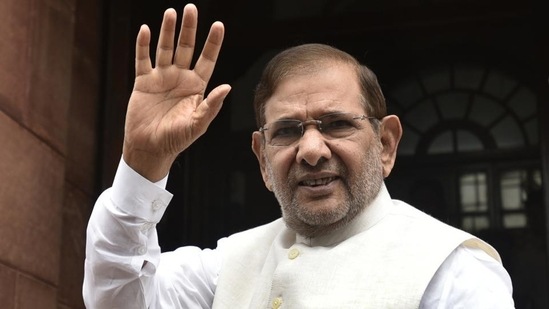
Distantly Close | Sharad Yadav, the quintessential ‘raised in India’ leader
In his demise, the social justice movement has lost its third lodestar — a rustic politician with an astute understanding of the heartland, who forever dreamt of seeing a united Janata Dal.
In Sharad Yadav’s demise, the social justice movement that rose to power with VP Singh’s National Front regime has lost its third lodestar after Ram Vilas Paswan and Mulayam Singh Yadav. As much in the twilight of their political life are Nitish Kumar and Lalu Prasad Yadav, their colleagues, co-travellers and fierce adversaries at different points in time. They’re comparable as they all came from the socialist stock, cutting their teeth in politics in Jayaprakash Narayan’s “sampoorna kranti (total revolution)” against Indira Gandhi’s emergency rule.
Anti-Congressism was his stock in trade like most socialist leaders of the time who repositioned their thoughts in later years in the face of an ascendant Bharatiya Janata Party. (Sushil Kumar/HT Photo)
A classic “raised in India” politician, Sharad did, at times, come across as rustic but was never short of an astute understanding of the Hindi heartland he traversed in a career spanning five decades. A seven-time member of the Lok Sabha, he had the unique distinction of entering Parliament from Madhya Pradesh, Bihar and Uttar Pradesh. A constituency from where he lost and won four times was Bihar’s Madhepura, the native place of Bindeshwari Prasad Mandal who authored the 1980 Mandal Commission report the VP Singh regime (1989-90) culled out from disuse to forever alter the politics of North India.
In 1999, Sharad entered the Lower House for the sixth time by defeating the seemingly invincible Lalu Yadav (who branched off to form his Rashtriya Janata Dal in 1997) in the Madhepura battleground referred to as the Yadav Papacy: “Rome Pope Ka, Madhepura Gope (Yadav) Ka.” But these familiar facts of history do not reveal the man who, as a student leader, rose to fame with his maiden 1974 victory in the Lok Sabha by-election from Jabalpur as a candidate chosen by JP himself.
Anti-Congressism was his stock in trade like most socialist leaders of the time who repositioned their thoughts in later years in the face of an ascendant Bharatiya Janata Party (BJP) whose Hindutva sought to encase Mandal in its politics of Kamandal. The religious Right’s temple thrust had compelled such respected voices in the Opposition space as Madhu Limaye and EMS Namboodiripad (the communist icon who died the day AB Vajpayee took oath as PM for the second time in 1998) to advocate the abandonment of anti-Congressism to fight communalism.
Cognisant of the threat the BJP posed to his brand of politics, Sharad paid heed to such advice, but was often stonewalled by his ambitious peers focused on preserving their fiefdom. He was in the thick of the United Front (UF) experiment that saw the Janata Dal he then headed, form governments with the Congress’s, outside support after the 1996 polls. When probed about Indira Gandhi in that period, he’d mince no words in praise, hailing Sikkim’s 1975 merger with India on her watch: “Akehli mard PM thei jo desh me zameen jod kar gayi hai.”
But the premature end to the UF experiment and the JD’s Lalu Yadav-led split turned the clock back, goading Sharad to the side of Lalu antagonist Nitish Kumar to team up with Vajpayee’s National Democratic Alliance (NDA). Of that ideological compromise, he was deeply regretful, often feeling like a square peg in the NDA’s round hole. What deeply hurt his native pride were the elitist jibes he faced as civil aviation minister who had no passport to travel to Dubai at the height of the 1999 hijack of an Indian Airlines flight to Kandahar. He had never travelled abroad till before he flew to the United Arab Emirates to receive a batch of passengers the hijackers set free before commandeering the plane to Afghanistan.
Quite logical from his ideological commitment to equity for women from weaker sections, his opposition to the Women’s Reservation Bill had its share of lows. In June 1997, he challenged his own party’s Premier, IK Gujral in the Lok Sabha: “Do you think these women with short hair (parkatis) can speak for women, for our women.”
The maelstrom Sharad’s comment triggered dented his ties with Gujral who had good reasons to object to the language he deployed. The class bias the JD chief saw in the women’s bill wasn’t lost on other members with his social background. The PM known for his gentle ways legitimately aggrieved and unwilling to reach out, the archetypal tactician in Sharad came into play. He had Gujral rush to him for an early-morning powwow with reports leaked to a section of the media that the JD leader was contemplating the PM’s ejection from the party. The trial balloon worked!
Like other big names that figured in the infamous Jain Hawala diaries, Sharad was eventually acquitted in the case. He nevertheless had his share of punishment for admitting in TV interviews to receiving ₹300,000 in party funds from people brought to him by Gujarat’s Chimanbhai Patel. The taint prevented him from being a minister in the government of the very party he headed. He never said it in as many words, but it perhaps was out of that sense of denial that he acquiesced to become a minister in the Vajpayee dispensation that succeeded the UF.
Sharad believed that the social justice movement’s survival in the face of forces undermining the constitutional non-denominational secular construct was in regrouping and reaching out to like-minded parties including the Congress and the Left. He was at work always to reunite the impossibly amoebic Janata Dal; his plans frustrated by players chronically distrustful of each other. For instance, Mulayam Singh was a stumbling block to his efforts to get the Bahujan Samaj Party on board the UF after the 1996 general elections. The SP leader would have none of it as Mayawati then was his main competitor in UP.
Not the one to give up easily, Sharad requested this writer over to his residence one Sunday morning. The surprise invite was to help him draft a letter in English making a strong case for the BSP’s induction with the CPI-M’s H S Surjeet, then an influential figure in the coalition arrangement. The effort came a cropper on account of Surjeet’s barely concealed soft spot for Mulayam. But that didn’t dissuade Sharad from trying.
Before the 2015 Bihar polls, he had initial success in mediating the JD-U and RJD’s merger with the Samajwadi Party (SP). Even the election symbol of the proposed entity under Mulayam Singh’s leadership was to be the SP’s bicycle. The deal loaded heavily in the SP’s favour fell through when members of Mulayam’s extended family threw a spanner in the works. They incredulously argued that the number of seats offered to them in Bihar was minuscule and therefore unacceptable.
The SP’s U-turn did not prevent the Mahagathbandhan (grand alliance) which eventually swept the 2015 Bihar polls. Sharad again was at pains to discourage Nitish when he chose to revert to the BJP after a two-year gap for lack of a respectable working arrangement with Lalu Yadav and his son Tejasvi. He failed but refused to follow in Nitish’s footsteps, losing in the process his Rajya Sabha membership and the bungalow he had in the heart of Lutyens’ Delhi.
The year 2022 saw the restoration of the status quo ante in Bihar. Nitish teamed up again with the Lalu-Tejashwi duo but not before the BJP successfully got Paswan’s son Chirag to play the hatchet man to rob the JD-U of its primacy in the 2020 polls. He’d have been better off had he allowed himself to be persuaded in the first instance by Sharad against regrouping with the BJP.
Between the feuding social justice mascots, the departed leader played a durable bridge. Often exasperated by their unpredictability, he harboured no ill will for them. The stories he related about their early years were dipped in deep affection. When Chirag Paswan briefly tried his hand in the film industry, he recalled his father Ram Vilas’s early dreams of being a matinee idol surrounded by swanky cars and fashionable women. About Lalu Yadav, he’d say that when in a crisis, he’d have sun-downers with a sumptuous meal to go to bed contented that all will be fine the next day.
For his part, Sharad essentially was a family man. So rooted was he in his austere past that he had no qualms plonking on a journalist friend’s two-wheeler for a ride to Parliament House. The much-venerated socialist thinker, Surendra Mohan was the other leader known for such simplicity.
HT’s veteran political editor, Vinod Sharma, brings together his four-decade-long experience of closely tracking Indian politics, his intimate knowledge of the actors who dominate the political theatre, and his keen eye which can juxtapose the past and the present in his weekly column, Distantly Close

 E-Paper