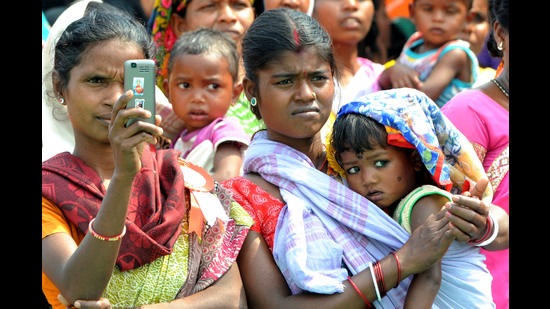
A metamorphic change in attitude and mindset, which are deeply embedded in patriarchal traditions, both in women and men, can bring about fundamental transformation
The National Family Health Survey (NFHS)-5 data reveal positive trends in women’s educational attainments, reproductive health, sex ratio, financial inclusion, and access to mobile connectivity. But have these gains led to fundamental changes in women’s lives, social relationships, or choices?
In terms of immovable property ownership, a touchstone of women’s economic empowerment, only 38% urban and 45.7% rural women own a house or land, alone or jointly, which was 38.4% in NFHS-4 (Hindustan Times)
For the first time, India’s overall sex ratio — women per 1,000 men — is now at a level seen in developed countries. For every 1,000 men, India has 1,020 women. But there is a cause for concern, too, since the sex ratio at birth (SRB) continues to be lower than what is naturally expected (952 girls per 1,000 men). This implies a continuing preference for a male child. SRB has only marginally improved from 919 in 2015-16 to 929 in 2019-21, while, in some states such as Maharashtra, Tamil Nadu and Odisha, there is a declining trend.
In terms of immovable property ownership, a touchstone of women’s economic empowerment, only 38% urban and 45.7% rural women own a house or land, alone or jointly, which was 38.4% in NFHS-4. However, by law, women and men, both, have an equal coparcenary right of inheritance. NFHS-5 indicates a nominal rise in married women’s decision-making power in household matters from 84% in NFHS-4 to 88.7%. However, a field study in 2017 in the rural and urban areas of West Bengal among married women (18–26 years) to assess their participation in household decisions noted that “although the NFHS-4 reported the decision-making power of women of about 84%, but, on ground, they don’t enjoy freedom up to that extent, as patriarchal norms over decision-making still continues, and hierarchies based on gender and generation play a dominant role”.
In a world where the internet wields enormous power, India has the widest gender gap in internet usage of 40.4% within the Asia-Pacific region. In urban India, 59% of women, while 64% of rural women cannot get online. Indian women endure triple handicaps: A rural-urban divide, income-based divide, and intra-household discrimination, which cut them from accessing online facilities of health care, education, job-seeking resources, banking, and other enabling platforms. In the rural hinterland, women’s mobile use is also considered “as a risk to her reputation and an interruption in her care giving responsibilities”. Nevertheless, NFHS-5 data revealed that 69.4% urban women now own a mobile phone for their use, compared to 46.6% for rural women, a rise from an average of 45.9% in 2015-16.
But, what rings an alarm bell is the revelation that a large percentage of women and men supported a husband’s right to physically assault his wife for reasons such as “disrespect to in-laws, neglecting the house or children, etc”, which reaffirm the prevalence of deep-rooted gender beliefs. Of the women surveyed, Telangana led with 83.8%, and among men, Karnataka surges ahead with 81.9% of the respondents saying that such behaviour is reasonable. The NFHS-5 data confirmed that about 29.3% ever-married women (18-49 years) experienced spousal violence, as against 31.2% in the previous report.
Recent studies in rural areas of Uttar Pradesh (UP), Odisha, and Uttarakhand, reveals women’s extreme social isolation, said that “such seclusion severely limit their access to crucial information about informal credit, insurance, jobs”. A World Bank research in 2020, among more than 600 married women in Jaunpur (UP), revealed that the “absence of social relationships, forces women to bank upon immediate family members, more so, in case of private and stigmatised topics like family planning, and mother-in-law’s influence carries an outsized weight”. Nonetheless, a survey among urban women (20-35 years), by a women’s social networking platform with about two million members, found that the majority “craved for selfhood, freedom of living life on their own terms, meaningful work, supportive relationship, travel and beyond, and considered marriage, motherhood as conventional expectations”.
Sadly, empowerment, a facilitating process for a woman to take charge of her life, and fulfill her desires and rights, is yet to take firm root in India. Inclusive policies or legal reforms alone will not change the status quo. A metamorphic change in attitude and mindset, which are deeply embedded in patriarchal traditions, both in women and men, can bring about fundamental transformation.
Archana Datta is former director-general, Doordarshan, and All India Radio; and former press secretary, President of India

 E-Paper