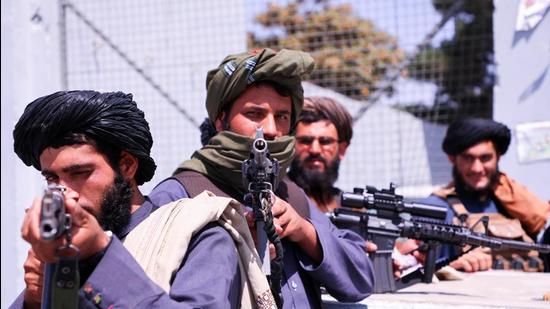
Afghanistan, today, represents a big conundrum. Most democratic countries, including India, are struggling to build a popularly acceptable and sustainable way forward in their relationship with the landlocked country.
Taliban forces stand guard in front of Hamid Karzai International Airport in Kabul, Afghanistan, September 2. (REUTERS)
But given our shared ancient history, and the geopolitical parking of the new Islamic Emirate, New Delhi has no option but to engage with Kabul — and Kandahar, too, where the Taliban supremo Mullah Hibatullah Akhundzada will reportedly continue to be stationed — one way or another.
This requires a four-step road map.
First, we must publicly distinguish between the 40 million women, men and children of Afghanistan and their new rulers. The country is on the verge of economic collapse and mass starvation. Roughly half of the country lives below the poverty line. This number is unfortunately only increasing by the hour.
India can — by early winter, if not now — seek ways to airlift their staple food, rice and wheat, for distribution among those who need it. If direct distribution is impossible, New Delhi can explore using non-governmental organisations of independent third countries. The aid should go on behalf of the people of India, not any government office or state agency. However, we should never ignore or forget the actual identity of the Taliban — they remain fundamentalists and terrorists, with no respect for the humans rights, other faiths, minorities, women and international laws and protocols.
Second, there should be absolutely no rush to recognise the new dispensation in Kabul. However, India should set up a liaison office in Kabul to keep a close eye on the developments, and to continue to build relationships with people, both political and non-political, who matter. The liaison office should have a strong consular section to issue visas to businessmen, students and medical tourists and others. You do not need to recognise a country or government to open a diplomatic liaison post in that country.
Third, stay on proactively in the international consortium, an incorporated entity, to build and operate the 1,814 KM Turkmenistan-Afghanistan-Pakistan-India (TAPI) gas pipeline. Both China and Pakistan would like India to exit the TAPI project. We should not. TAPI, with its visible physical appearance, has huge potential to help consolidate the goodwill that India has earned among 40 million Afghans by building power projects, roads, information technology (IT) centres, hospitals and even the majestic Parliament House over the past 20 years. It would also help the impoverished country earn over $800 million annually in transit royalty alone, besides generating thousands of new jobs.
Fourth, India should try to gradually resume work on all stalled development projects in Afghanistan as soon the security climate is conducive enough, roping in third country contractors, if required. India’s key asset in Afghanistan is the tremendous goodwill it has among the people, and we should do everything possible to keep augmenting it.
Many noted Western experts have argued that Afghanistan would sooner than later trip into a renewed civil war. There is merit in this analysis, given the inner, in some cases fundamental, contradictions and clashes within the various wings and arms of the Taliban. They were united as long as they were fighting, but they are unlikely to be equally united in the tasks of nation-building or governance, if that, indeed, is their agenda henceforth.
Many in Pakistan have already begun to look upon Afghanistan as their new province, which would not only be eventually rebuffed, knowing the Afghans, but also add to the historical suspicion in Kabul for Islamabad. This would open up further space for democracies of the world, including India, to push ahead with their engagements with moderates among the ruling classes in particular and civil society in general.
China is most likely to expand its China-Pakistan Economic Corridor to cover Afghanistan, with an eye on the Taliban-controlled natural resources such as rare-earth, cobalt, copper, lithium and even uranium. Beijing is investing $425 billion in Iran. A modern transit route to gas-rich southern Iran, and even beyond, through Afghanistan, is reportedly already on the drawing boards in cash-rich China.
India must not rush to recognise or give any benefit of doubt to the Taliban. At the same time, we can not afford not to be there on the ground for too long. As soon as things stabilise a bit, we should set up a liaison office in Kabul, preferably headed by a senior and experienced career diplomat. Afghanistan is too important a country to be left only to an emotional or moralistic judgment. We would need to be Chanakyan.
Narendra Taneja is an energy and geopolitical expert

 E-Paper