Hutong Cat | The Chinese are fed up with Covid restrictions & they're showing it
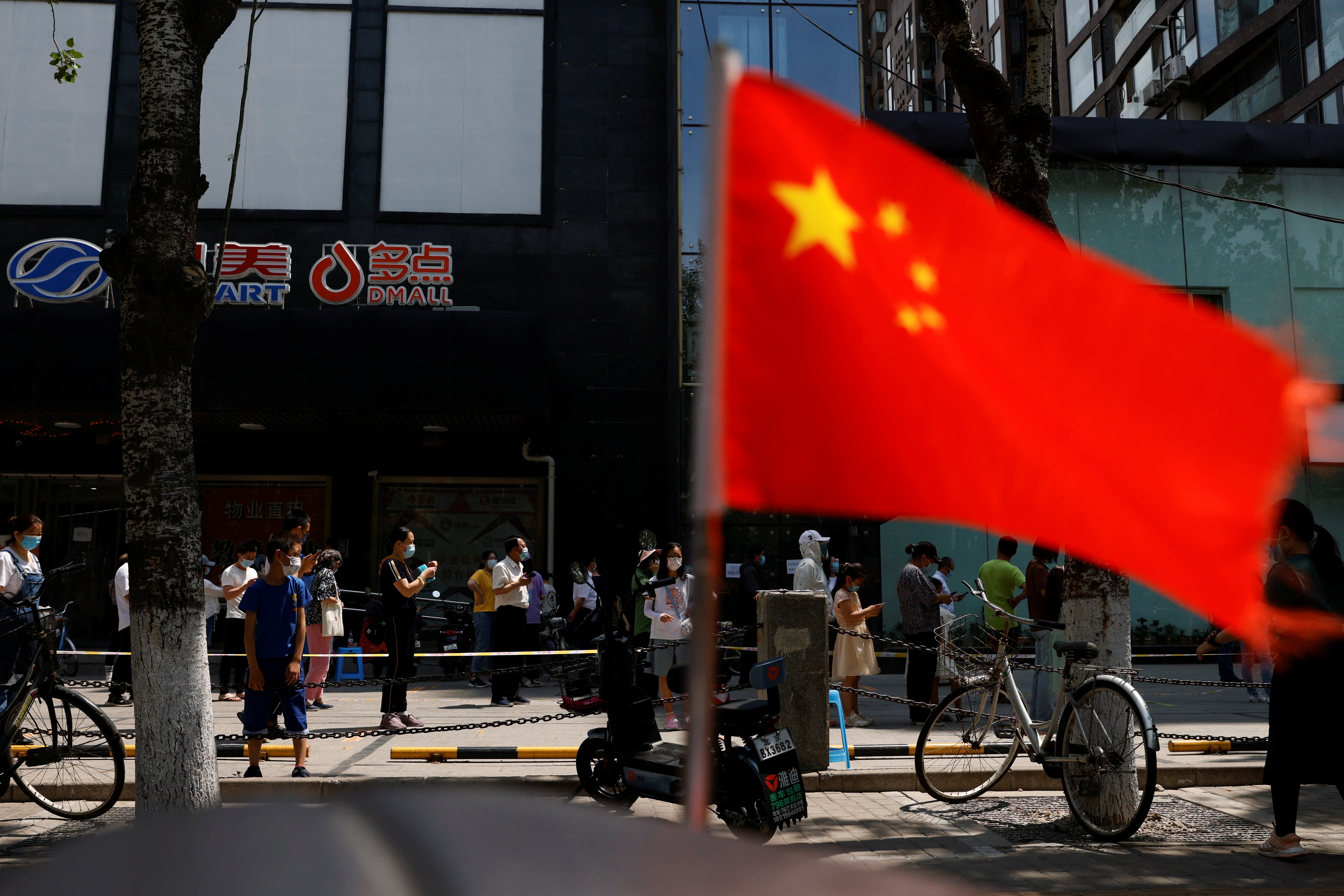
In a country that’s paranoid of protests and protesters, the frequency of anger and frustration fuelling public outbursts, even clashes, over stringent Covid-19 control rules is worth noting.
A lone man with a protest banner on a bridge in northwest Beijing; a group of angry residents in Haizhu district in the southern megacity of Guangzhou, toppling barricades, overturning a police vehicle; rare, large-scale protests, said to be mostly by ethnic Han Chinese migrant workers recorded in the Tibetan capital of Lhasa; residents clashing with government workers in the city of Linyi in Shandong province.
In many cases, it’s not the rules but the lack of sensitivity with which those locked down and barricaded are treated that have ignited people’s fury. (Reuters)
These are only a few recent instances of protests by Chinese citizens exasperated with Covid-19-related restrictions – and the way those restrictions are being implemented.
In a country that’s paranoid of protests and protesters – paranoid enough to even jail citizens keeping a count of public demonstrations – the frequency of anger and frustration fuelling public outbursts, even clashes, over stringent Covid-19 control rules is worth noting.
If anecdotal evidence is considered, the number of such protests is much higher: Photos and footage of demonstrations appear on China’s Twitter-like Weibo platforms like a blip before flatlining.
To be frank, the majority of Chinese citizens obediently follow all the rules related to China’s controversial “zero-Covid” strategy: They follow lockdown and quarantine norms, dutifully line up for Covid-19 tests, sometimes every day, always scan health codes when stepping into shops and public spaces and adhere to travel restrictions. Chinese citizens are aware that anti-Covid norms have kept Covid-19 infection numbers and deaths down in China when compared globally.
But in many cases, it’s not the rules but the lack of sensitivity with which those locked down and barricaded are treated that have ignited people’s fury.
Public resentment in Guangzhou, currently experiencing its worst Covid-19 outbreak with the single-day caseload crossing 9,000 on November 17, for example, had been building up for days because of the high-handed attitude of local authorities; apprehension of an impending Shanghai-style lockdown also fanned the frustration.
That simmering anger boiled over last week.
Videos widely shared on Twitter showed chaotic and noisy scenes in Guangzhou with people running down streets and getting into loud arguments with hazmat-suit-clad Covid-19 workers; footage of an overturned official vehicle was shared.
Sporadic incidents were recorded in Beijing too, most notably the “Sitong bridge” incident in October when anti-Covid and anti-Xi Jinping protest banners hung on a bridge in northwest Beijing fluttered briefly but long enough for the world to take notice.
In May, administrators at Beijing’s elite Peking University had to back down from plans to further tighten pandemic restrictions on students as part of China’s “zero-COVID” strategy after a weekend of peaceful campus protests.
The protests, according to an Associated Press report in May, were over the PKU administration’s decision to erect “a sheet-metal wall” to keep students further sequestered on campus, while allowing faculty to come and go freely.
(The university was locked down after a single Covid positive case was reported on campus last week.)
Citizens’ critical response in some cases was also shared widely before being censored.
“Hundreds of thousands of Weibo users criticised authorities over Covid-19 policies, using a hashtag linked to the arrest of a woman and her father in Dandong for resisting pandemic restrictions to travel to a hospital for treatment,” a Freedom House report on protests in China in 2022 released in November said.
Not every protest in 2022 cited in the Freedom House report was related directly to Covid-19.
“Despite increasingly repressive rule under the Communist Party of China (CPC), dissent in China occurs regularly and is geographically widespread…The China Dissent Monitor (CDM) recorded 668 instances of dissent in China from June to September 2022, as people spoke out against stalled housing projects, labour rights violations, fraud, Covid-19 policies, and state violence, among other grievances,” the Freedom House report said.
“Contrary to what the Chinese Communist Party wants the world to believe, individuals throughout China are standing up to Beijing’s machine of censorship and repression to make their voices heard,” Michael J. Abramowitz, president of Freedom House, said.
“More Chinese people are taking the courageous step of exercising their fundamental rights to free expression and assembly—even achieving some concessions from private companies and local officials—which is rightly troubling to the ever-more oppressive Party,” he said.
Unthinkable now, but the Chinese government published data on country-wide demonstrations until about 15 years ago.
In the 1990s and early 2000s, the Chinese government published statistics on the number of “mass incidents” of protest in the country, which increased from 8,700 in 1993 to over 87,000 in 2005.
The government stopped publishing official counts in 2005 but the protests didn't.
“The protests, often complaints about government action or inaction, but the grievances cover a wide range of issues involving labour disputes, rural land grabs, environmental damage or perceived threats, how women or minorities are treated, the actions of other nations, conditions for demobilised soldiers and policing practices,” the University of California’s US-China Institute said in a report last year.
It's also true that most protests including demonstrations against Covid rules target local authorities rather than China’s central leadership.
“While it’s not accurate to paint protest as uncommon in Xi’s China, it would also not be quite right to describe the typical protest as explicitly challenging the one-party regime,” Kevin Slaten, a senior programme officer at Freedom House who leads the China Dissent Monitor, wrote for The Diplomat.
While in some cases, the citizens’ demands have led to official responses including government-led investigations, the Freedom House report found that to the government, the threat perception of protests remained high.
“There is evidence of repression in a quarter of all dissent events in the CDM database, including 60 instances of state violence and 48 instances of detention or arrest, each often involving multiple people. And this is likely an undercount,” the report said.
Sutirtho Patranobis, HT’s experienced China hand, writes a weekly column from Beijing, exclusively for HT Premium readers. He was previously posted in Colombo, Sri Lanka, where he covered the final phase of the civil war and its aftermath, and was based in Delhi for several years before that

 E-Paper