Elections hold messages, singular or multiple, for winners and losers alike. They also serve as lessons that parties can draw from the choice of the sovereign, which the voter undoubtedly is in a democratic Republic such as ours.
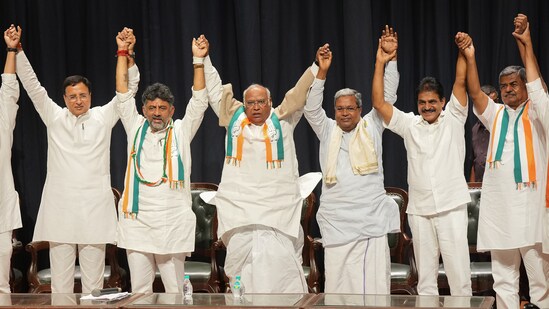
Congress President Mallikarjun Kharge with senior party leaders Randeep Singh Surjewala, Siddaramaiah, D.K. Shivakumar, K.C. Venugopal and B.K. Hariprasad during the celebrations after the party's win in Karnataka Assembly elections, in Bengaluru. (PTI)
For the Congress, the impressive electoral endorsement in Karnataka is guidance to a winning template for which it has struggled amid multiple defeats in the aftermath of its 2014 rout. Its victory in the key southern state is the sum of several attributes it lacked, or didn’t put to ingenious use, elsewhere: A strong party unit; effective regional faces force-multiplied rather than being overshadowed by the national leadership; and the native campaigners’ oratorical skills that carried the party’s “five promises” to a largely Kannada-speaking populace.
It wasn’t as much the national narrative as the vernacular that carried the day for the party, in a replication of its Himachal Pradesh victory. The message was simple: While in Karnataka, do as the Kannadigas do. In relative terms, the Bharatiya Janata Party (BJP) couldn’t encash its inherent organisational strength, which the Congress matched on the back of palpable anti-incumbency. One reason for that was the incumbent party’s over-dependence on the Narendra Modi-Amit Shah duo who hoped to woo voters the way they successfully do in the Hindi heartland. Their one-size-fits-all approach proved counterproductive in the only province where the party held power south of the Vindhyas.
The BJP’s apex leadership worked hard yet couldn’t earn among many Kannada speakers – driven by bread-and-butter issues – the kind of traction they have with those with a buying capacity. The party’s negative rhetoric – painting the Congress as a harbinger of doom – didn’t sell with people looking for hope.
The state stewardship on offer in the Congress camp was another determining factor against the BJP’s Basavaraj Bommai, widely seen as a weak chief minister (CM). The Congress’s front-line claimant to the CM’s chair, Siddaramaiah, won hands down in popular perception with his clean reputation and a decent administrative record as CM from 2013 to 2018. A utility politician of tremendous value, his in-house competition for the top slot, DK Shivakumar, shunned factionalism to play the perfect anchor as the state unit chief.
The odds favour Siddaramaiah. Yet it’s anybody’s guess who among the duo will get lucky in the leadership race. Hailing from southern Karnataka, they both meet the requisite subregional imperatives; Siddaramaiah, a Kuruba (who comprise 8-9% of the state’s population) and Shivakumar, a Vokkaliga (who make up 15%). The latter can buttress his bid as the party’s face in the Old Mysuru region that’s on the cusp of a political vacuum. A long-time Vokkaliga paterfamilias, HD Deve Gowda, 89, might not be at the helm of Janata Dal (Secular) in the next elections. His son HD Kumaraswamy is a former CM. Shivakumar, as a fellow caste leader, may insist on a curriculum vitae matching that of the Gowda legacy inheritor.
Visibly uncomfortable as a retired general on emergency detail, the BJP’s Lingayat strongman, BS Yediyurappa, couldn’t have tilted the scales, debilitated as he was by intraparty tensions set off by the sidelining of his time-tested clansmen.
In the internecine scramble for power, the BJP failed to do what it does best by way of filling such chasms. Retrospectively, it’s evident that what was achievable in Gujarat wasn’t doable in Karnataka’s distinctive milieu, where leaders across parties grew over time in stature and popularity.
From the Congress’s standpoint, the problems it initially faced in the state weren’t any different from its conundrum in the provinces up next for elections: Rajasthan, Chhattisgarh and Madhya Pradesh. The party’s faction-ridden outposts will find it harder to counter the BJP’s gauntlet in these Hindi-speaking areas. How it puts its house in order will be a test of the political acumen of its president, Mallikarjun Kharge, the Gandhi family, and other central functionaries. Rather than resting on its oars, the leadership will have to quickly follow the Karnataka model that clicked with state-specific improvisations – because a loss of power in Rajasthan and Chhattisgarh and a failure to form a government in Madhya Pradesh will weaken the party’s momentum considerably before the 2024 polls.
The BJP, therefore, will push for a no-holds-barred onslaught to avenge Karnataka in these states. The battle lines have been drawn.

 E-Paper