
 E-Paper



Keeping up with UP | Can INDIA afford to campaign without unifying under a leader?
Word on the ground is that INDIA may field Kharge from UP in 2024 to break the PM's stronghold in Varanasi. Till then, here's why the Opposition needs a face


The Indian National Developmental Inclusive Alliance (INDIA) faces two major challenges to take on the Bhartiya Janata Party-led National Democratic Alliance (NDA) in the general election slated for 2024.
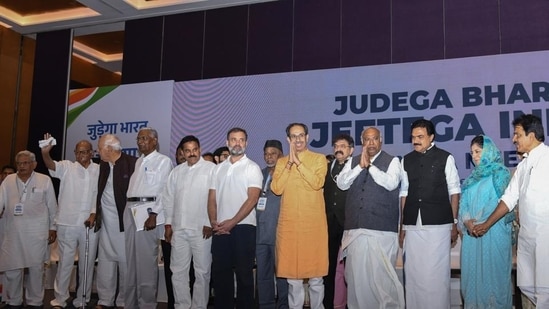
First, a candidate who could match up to Prime Minister Narendra Modi in mass appeal. The NDA owes its victories to Modi besides the work of BJP foot soldiers relentlessly spreading the party’s agenda even when there are no polls scheduled.
Second, INDIA needs potent public issues to serve as poll planks that can override the BJP’s emotional cocktail of religion, nationalism and a dose of welfarism.
The latest YouGov-Mint-CPR-Millennial Survey has indicated that the BJP is set to maintain its dominance with a leadership story centred around the PM and a lack of consensus on a viable alternative, as reported by Mint in August.
Political experts like Badri Narayan Tiwari feel that though INDIA will throw interesting contests in constituencies across the country, they lack an alternative who can dwarf Modi. "And in case they declare a face, the coalition will suffer fissures.”
Voices from the streets that favour a change in 2024 remain sceptical about INDIA's ability to find someone who can be a consensus leader.
History reminds us of the bitter experience of two major pre-poll coalitions, the Janata Party and Janata Dal, formed in 1977 and 1989 respectively, over the single poll plank of anti-Congressism. Both collapsed under the weight of the oversized egos of their leaders even before they could complete their five-year tenure. Despite the change in leadership, the Janata Party lasted till 1980 and the Janata Dal till 1991.
The two coalitions that have survived are the NDA and the Congress-led United Progressive Alliance (UPA) formed in 1998 and 2004, respectively. And the reason behind their success story is that both coalitions were led by a main dominant party.
INDIA, on the other hand, is a coalition of 28 small and big political parties and is likely to fight over leadership issues. The revival of the UPA under the Congress was unacceptable to major constituents of INDIA, but it would have been a better option.
Often political parties prefer to settle the contentious issue of leadership after the elections as the numerical formula helps them in settling such issues – both the leader of the house and the Council of Ministers are decided according to their numbers in Parliament.
However, a leader guiding INDIA in the elections would enhance its credibility, especially in a scenario where increasingly, people are voting for leadership, more than the party.
Does INDIA have a popular face?
INDIA's parties are popular in their own respective states or regions. Their leaders, many of them ageing and ailing, lack a nationwide mass appeal.
Two, a majority of these regional forces that sprung up across the country in the 1990’s, are either splinter groups of the Congress or have grown in anti-Congress boots. Ironically, the Congress happens to be the only party with a national presence.
The Nationalist Congress Party (Maharashtra), and the Trinamool Congress (West Bengal) are breakaway factions of the Congress formed in 1999 and 1998, respectively. The Socialist outfits, Samajwadi Party (Uttar Pradesh), Rashtriya Janata Dal and Janata Dal (United), both from Bihar, were born on an anti-Congress plank in 1991, 1997 and 2003 respectively. The Communists have always fought the Congress in West Bengal and Kerala.
The senior-most leader of the Nationalist Congress Party (NCP), Sharad Pawar, at 81, is ailing. Lalu Yadav (RJD), aged 75, is entangled in scams. Mamata Banerjee, aged 68, lacks national appeal and must defend her turf from an assertive BJP seeking to capture the once Communist stronghold. Nitish Kumar, aged 72, has lost much of his sheen for two reasons: he has long worn his ambition to become PM on his sleeves and is plagued by his frequent flip-flops in political affiliations. Akhilesh Yadav, the president of the Samajwadi Party (SP), is the youngest of the lot, but he is grappling to fill the shoes of his late father, Mulayam Singh Yadav, and though he has resolved family disputes, he faces a formidable challenge from a resurgent BJP. The Communist Party of India (Marxist) is experiencing a decline.
The Congress, while silencing the BJP’s accusation of dynastic politics by electing 81-year-old Mallikarjun Kharge as its national president in October 2022, is still facing an existential crisis.
Kharge has been a Congressman for 50 years but people came to know about his leadership acumen in the past year; he not only won elections in two states of Karnataka and Himachal Pradesh but also emerged as a successful backroom manager, the troubleshooter of the party.
Sanjay Kumar of the Centre for the Study of Developing Societies said, " First, I see only hits and no misses. The Congress looks more coherent, has better visibility, and he has put up a good team, managed internal power tussles."
In political circles too, Kharge is being considered as the opposition's best bet with his Dalit rootedness as well as his acumen to drive consensus in a group with conflicting interests. He is an asset to the coalition group.
Already, discussions are on to field him in the 2024 general election from Uttar Pradesh, to break the stronghold of the BJP. Modi represents Varanasi in the Lok Sabha.
In the North, Kharge will encounter stiff competition from Mayawati, the national president of the Bahujan Samaj Party, who calls herself the 'Dalit ki beti' (daughter of a Dalit).
Though she may not find many in the political domain to second her candidature, BJP’s propaganda machinery may help in building her as a spoilsport. Otherwise, also, some coalition partners are also keen to get BSP in INDIA. Lalu has been her all-time supporter.
On Kharge's candidature, the state president of the BSP Vishwanath Pal said, "They had even projected Jagjivan Ram as the PM face but dumped him after winning elections. They appointed a Dalit as UP chief but removed him within six months. By now the marginalised classes know the true character of the Congress."
On Mayawati's plan to throw her hat in the ring, he said, " As of now, she is talking about social alliances between poor and rich, Dalit and backward, minorities and youth instead of political alliances with other parties. Let the time come."
According to him, "the BJP had given a call for 'Congress mukt Bharat' to end corruption, check price rise and give employment. People supported them. But they failed to deliver and now the Congress with the help of 28 parties is trying to give a 'BJP mukt bharat' to India. This vicious circle must break and BSP come to power."
The SP leaders refrain from making any comment on Kharge's candidature saying, ' Its too early,' while political experts like Narain feel that while a section may vote for him, there is polarisation over various issues from Hindutva to welfare schemes, which may make things tough for INDIA.
Nonetheless, all agree that INDIA should have projected a face as without it the main opposition front will not only lack credibility but cannot counter Modi.
After all the coalitions have collapsed over leadership, but public issues remain longstanding.
From her perch in Lucknow, HT’s senior journalist Sunita Aron highlights important issues related to Uttar Pradesh


