Keeping Up with UP | The caste question in the upcoming Khatauli bypoll
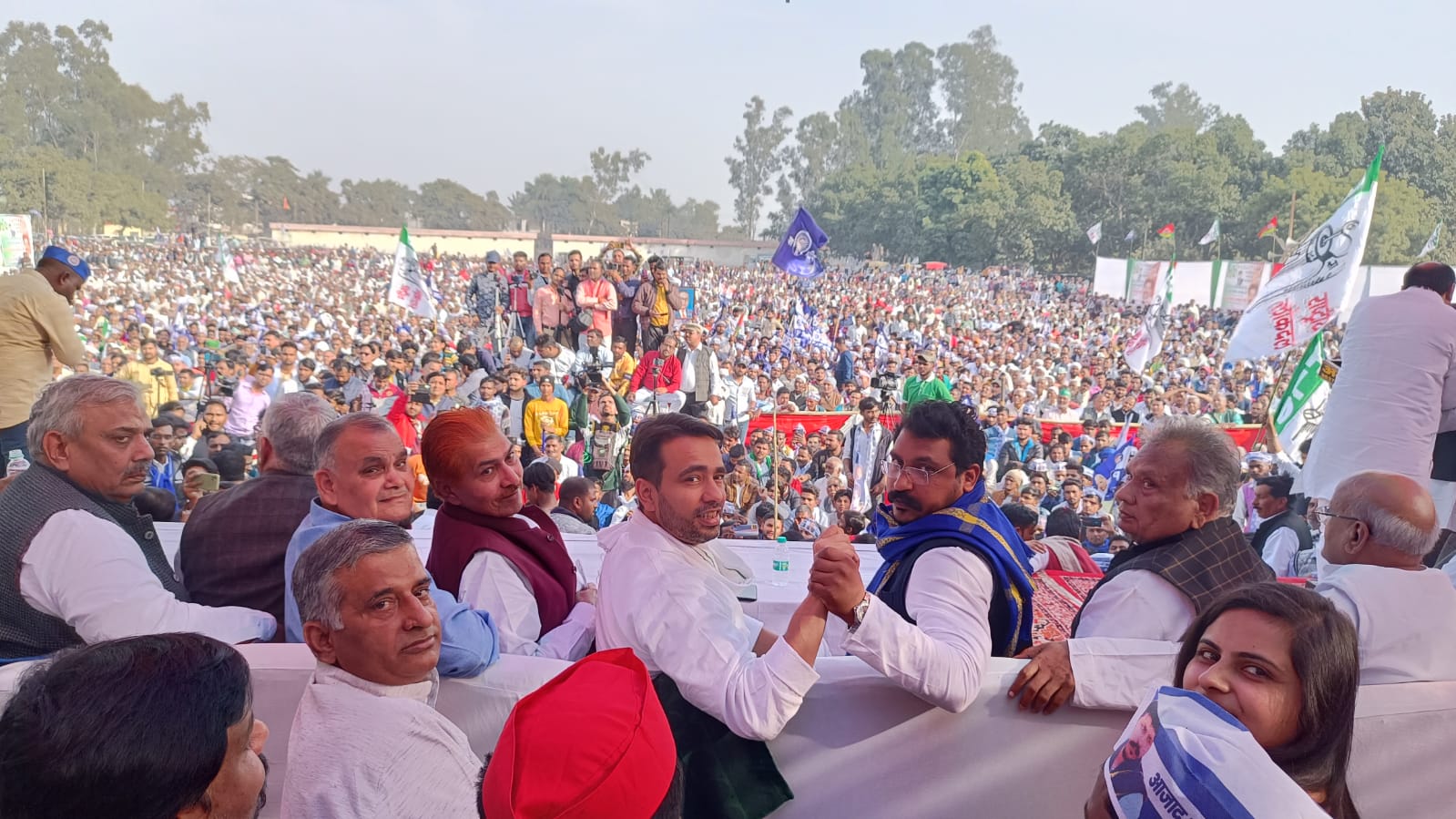
The politics of West UP is infamous for caste clashes between Jats and Dalits. And so, when Chandrashekhar Azad of Bhim Army shared the dais with RLD president Jayant Chaudhary on November 29, a political message was sent. But will it work?
Discussions on politics in the countryside of Uttar Pradesh (UP) can go on endlessly without any conclusive signal of the mood of the electorate.
RLD president Jayant Choudhary and Azad Samaj Party chief Chandrashekhar Azad at their joint rally in Khatauli. (HT Photo)
But the candid outpourings in the Jat-dominated Baraut village of Baghpat, before the trendsetting 2007 assembly elections, were an eye opener, when some Dalit voters, sipping tea at the residence of a Jat neighbour, said, “We don’t fear them (Jats). Our vote is for Mayawati, the Bahujan Samaj Party [BSP] leader who has given us both muscle and money power.”
The story of Dalit empowerment, which started in the early 1990s after the inception of the BSP, finally reached a revolutionary finish then, hitting headlines across the country.
Mayawati, riding a rainbow coalition of Dalits, Muslims, and Brahmins, became the chief minister of a majority government, breaking a 14-year-old coalition jinx in Uttar Pradesh.
The politics of West UP, infamous for caste clashes between Jats (landholders) and Dalits (labourers) also changed drastically after the Scheduled Castes acquired a political voice. They had to fear no one in making their political choices.
After the rise of the BSP on the scene, Jats and Dalits had their own preferred caste-centric parties — Rashtriya Lok Dal (RLD) of Chaudhary Ajit Singh and Kanshi Ram-Mayawati-driven BSP, respectively.
However, after the resurgence of the Bharatiya Janata Party (BJP) in 2014, the Opposition parties — the Samajwadi Party (SP), the BSP and the RLD — came together to contest the 2019 Lok Sabha election. While the caste arithmetic added to the winning percentage on paper, on the ground, the calculations went awry.
Alongside, small but aggressive caste groups emerged in the western region such as the All India Majlis-e-Ittehadul Muslimeen (AIMIM) and Bhim Army, mobilising the support of their own constituencies.
As Mayawati became more inactive, Chandrashekhar Azad of the Bhim Army appeared as a probable representative of Dalits. He managed crowds, but failed to mobilise votes.
Dalit activist Dr Satish Prakash of Meerut opined, “Dalits wanted Chandrashekhar to fight for their social issues, but he entered politics in a hurry.”
According to him, Mayawati still retains her hold on Jatavs, as only 5% of the sub-caste — Balmikis and Khatiks — have shifted to the BJP or other parties. The Balmikis and the Khatiks have never been BSP supporters. As the size of the landholdings shrunk and literacy grew, the acrimony between the Jats and the Scheduled Castes also started waning.
In this background, when on November 26, Chandrashekhar Azad shared the dais with RLD president Jayant Chaudhary at Khatauli in Muzaffarnagar district, where a by-election is scheduled on December 5, a political message was sent. Azad had earlier announced support for the SP-RLD alliance candidate Madan Bhaiya (a Gujar).
The seat fell vacant after the disqualification of BJP Member of Legislative Assembly Vikram Saini following his conviction in the 2013 Muzaffarnagar riots. His wife Rajkumari Saini (an OBC or Other Backward Classes) is now contesting against the RLD in a straight fierce contest where communal sentiments are pitted against caste calculations.
Jats and Gujars of the area generally don’t vote together. Thus, by fielding a Gujar and sharing the dais with Chandrashekhar Azad, RLD leader Jayant Chaudhary is constructing a coalition of several castes, including Dalits.
But many political experts are of the view that Mayawati’s message still counts in the region. The BSP is not contesting the by-poll, but can extend tacit support to either the BJP or RLD-SP alliance candidate. With no love lost between the SP and the BSP, the latter is likely to support the BJP. That’s what is being circulated in political circles.
However, the larger question is if the coming together of RLD and Bhim Army can change caste equations in the region where the communal sentiments have been high since the 2013 Muzaffarnagar riots. Chandrashekhar has quite a following among Dalit youths as they want their leader to be a firebrand. Mayawati, they feel, has over the years mellowed down.
The campaigning is also centred on communal vs caste sentiments. The alliance talks about harmony, the BJP candidate is playing the sympathy card as her husband has been convicted in the Muzaffarnagar riots. He had won the 2017 and 2022 assembly elections since the riots rocked the region.
Incidentally, the BJP candidate was the gram pradhan of Kawal, which was the epicentre of the riots.
On November 30, chief minister Yogi Adityanath, also recalled the killing of two Hindu youths in Muzaffarnagar’s Kawal village to slam the then SP government, whose partisan approach had led to the riots.
“Kawal ka bawaal, ye Samajwadi Party ka kalank hai (the problem of Kawal is a curse for the Samajwadi Party),” Adityanath said.
Both Anil Dubey and Prashant Kanojia of RLD are confident of mustering the support of all castes, including Dalits, as people want communal harmony.
Prashant Kanojia also believes the coming together of the RLD and Bhim Army will also help in reviving the old fabric of castes as Dalits supported former PM and Jayant's grandfather, Chaudhary Charan Singh, in the earlier days.
"The RLD does politics of farmers and, if labourers (Dalits) come forward to support them, it could create a winning combination for the RLD in the region," Kanojia earlier told HT.
The Khatauli constituency has over 3.12 lakh voters, including one lakh Muslims, 25,000 to 30,000 Gujars and Jat voters each, around 50,000 Dalit voters and nearly 30,000 Saini voters.
From her perch in Lucknow, HT’s resident editor Sunita Aron highlights important issues related to the elections in Uttar Pradesh

 E-Paper