Keeping up With UP | The development agenda of Yogi 2.0
From being a flagbearer of Hindutva politics in his first stint to pushing the development agenda in his second, Yogi Adityanath appears to be pushing for a change in the public perception of the state. Will it see dividends?
While addressing the Uttar Pradesh (UP) roadshow in Mumbai in the first week of January, Darshan Hiranandani, head of the Hiranandani group, one of India's largest real estate developers, shared his experience of doing business in UP. The group has set up a large data centre in the state.
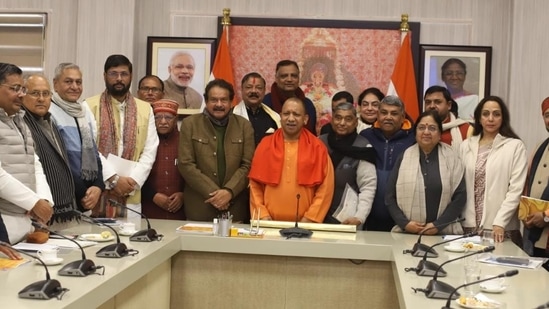
Uttar Pradesh CM Yogi Adityanath reviewed investment and development projects being implemented in Agra, Saharanpur, Azamgarh, Jhansi and Moradabad divisions with local MPs and MLAs in Lucknow on Tuesday. (Sourced)
Reeling out the timeline of the project, he said, “In the middle of the pandemic in August 2020, one of the largest tech companies approached us to give them data centre park capacity in the National Capital Region (NCR). In September, we approached three states and UP responded the fastest in 48 hours. As there was a lockdown, we finalised the location using drones in 30 days. In October, we were given a letter of allotment and in November, the C virtually conducted the ground-breaking ceremony, and in December, we signed the first contract with the same large tech giant. In early March, we received all permits. We intended to invest ₹1,600 crore in phases, which we have now expanded to ₹7,000 crore, of which investment of ₹6,500 crore, will be completed by mid-2023.”
What must have sounded like music to the ears of many was his claim that “there is no goonda problem, no local hafta lobby.” He referred to his father’s conversation with chief minister (CM) Yogi Adityanath who assured him, “Don’t worry, goondas are either in jail in UP or not there.”
As Memorandums of Understanding (MoUs) rain with promises of several lakh crores, UP, once described as a BIMARU state (an acronym for Bihar, Madhya Pradesh, Rajasthan and UP, often used to refer to the poor economic conditions within those states), can bask in the glory of its success in changing public perception of its work culture.
The challenge now lies in translating investment promises into realities. And while the real evaluation of the claims will be done in the years to come, the once-laggard state has created a climate for industrialisation in an otherwise agrarian state.
The CM's hard-selling of UP as a favoured destination for investments in the country’s financial capital Mumbai also helped secure MoUs worth ₹5 lakh crore. Seemingly miffed by the overwhelming response from corporate houses, Maharashtra deputy CM Devendra Fadnavis quipped, “Those who want to attract industries to their states or hold an industrial summit have no alternative but to come to Mumbai and that is the strength of our state.”
However, if the CM does succeed in securing the promised investments, it would be a big win for the state and also one for Yogi, who can then establish his claim for a position at the Centre.
From 2014 to today: UP's journey
The competition is high as the state vies with others and woos investors. But UP has certain advantages that other states lack. One crucial advantage is the formidable duo of Prime Minister (PM) Narendra Modi and Yogi. While the former remains popular across the country, the latter is increasingly being seen as a future party leader.
In 2014, PM Modi made two-fold promises to the people of the state: Hindutva and development. He was shifting his political base from an industrial state like Gujarat to an agrarian, backward state like UP. Now, Yogi is toeing this very line.
Unlike his first stint, when the Hindutva agenda eclipsed development, the CM is currently refraining from rabble-rousing or any kind of controversy. Surprisingly, the Hindu brigade is also silent. The CM’s emphasis on investments has changed the focus of the State machinery.
Yogi started his second stint by holding a third groundbreaking ceremony on June 2, 2022, and in less than a year, the state is hosting the Global Investors Summit in February, which will be attended by the PM, Union ministers, and dignitaries from India and abroad.
To build this climate of development and display the administration's hunger for growth, Team Yogi has held roadshows in 21 cities abroad and is currently covering eight states in India. This, along with his visits to almost every district of the state to woo investors. According to professor Shashikant Pandey, “The stability of both the national and state governments may convince industry players to invest in UP. Investments have gone up, but it will take some time to reflect in the state’s GDP (Gross Domestic Product).”
The state is equipped with land and labour, natural resources, and infrastructure, and is also seeing improved air and road connectivity across its length and breadth. The network of expressways and the expansion of aviation also help in two ways. It attracts investments to move away from the National Capital Region to the depths of UP — from the backward regions of Bundelkhand and Gorakhpur to developed areas like Agra and Meerut. Further, when the system starts supporting investment, then red-tapism is minimised.
“We have nearly zero human interference. The CM’s office will begin monitoring once you sign the memorandum of understanding (MoU). You need not go anywhere. No one will interfere in any work related to you. Even incentives will be transferred online as we have tried to minimise human interference,” CM Yogi promised in his nearly 22-minute address at the Mumbai roadshow.
However, the Opposition is not convinced.
Leader of Opposition in the UP assembly and Samajwadi Party national president Akhilesh Yadav said, “The state government is only making a din in the name of investor summits. The outcome will be zero. Where is the result of the previous summits? On previous occasions, too, the BJP government held summits with great pomp and show, and claimed MoUs worth lakhs of crores of rupees were signed. But nothing materialised on the ground. When domestic investments failed, the government sent ministers and officers on junkets to foreign countries."
Others claim that he is determined to emerge as a leader who is a blend of Hindutva and development.
UP's trajectory
UP’s political leadership was once shy of hobnobbing with the industrial lobby as they drew their political strength from the farming community. The state’s growth suffered most because of decades-long political instability (1990-2012) the Mandir-Mandal imbroglio, communal clashes and poor law and order. Successive governments, bogged down by communal issues and the survival of their governments, hardly displayed any appetite for investment and industrialisation.
There was a time when CMs of the state were reluctant to publicly shake hands with industrialists. ND Tiwari first threw open the CM’s bungalow for the industrialists in 1989. His exposure in New Delhi as finance and industry minister helped.
Thereafter, he started the Mandal-Mandir era in which investment and industries were not a priority. They were instead, a casualty of such politics.
In 2003, as a first, the swearing-in of Mulayam Singh Yadav was attended by the who’s who of the corporate world. Some industrialists came as friends of the late Amar Singh, while others came to explore investment opportunities. The UP Development Council was constituted, MoUs were signed, but they couldn't take off.
Then, when Mayawati formed a majority government in 2007, it was on the slogan of dignity and empowerment. Statues of legendary figures were installed in a big way.
In 2012, Akhilesh Yadav improved road connectivity by building Agra-Lucknow Expressway, introduced the Metro in Lucknow and brought in investments in the health and education sectors. Alas, family squabbles and the Muzaffarnagar riots threw a spanner in his efforts.
In 2017, when the saffron-robed Yogi moved from Gorakhnath math to the CM’s bungalow at Kalidas Marg, questions were raised about his administrative acumen, as he was a hardcore Hindu leader who brazenly wore his Hindutva ideology on his sleeves. And he did not dither from pursuing this agenda in his first stint, so much so that other Bharatiya Janata Party-ruled states began mimicking the UP model — which promoted a law against "love jihad", cow slaughter, public shaming of protesters who were against the Citizenship (Amendment) Act, and showering of petals on Kanwariyas. But after winning a second stint, Yogi seems determined to change his image and the image of the state.
Much water has flowed down the Ganga ever since politics acquired an aspirational overtone. Now, the chimes at Kashi, Mathura and Ayodhya are no more clamorous, raising fears of communal clashes and rioting. Instead, investors see business opportunities in the three mega temple cities as footfall increases due to the state's focus on development.
Is it too soon to say the paradigm has shifted? Perhaps. But there is a churn in UP, and the Opposition must take note.
From her perch in Lucknow, HT’s resident editor Sunita Aron highlights important issues related to Uttar Pradesh

 E-Paper