If a mere headscarf can disrupt public order, then who is responsible: The student who wears it or the law enforcement agencies responsible for maintaining the peace?
Two days before the Karnataka high court (HC) delivered its judgment upholding the hijab ban on students, India’s chief justice was in Hyderabad at the ground-breaking ceremony for a new arbitration centre. Photographs of the ceremony with Hindu priests conducting rituals are instructive of the pervasive role of religion in our secular life.
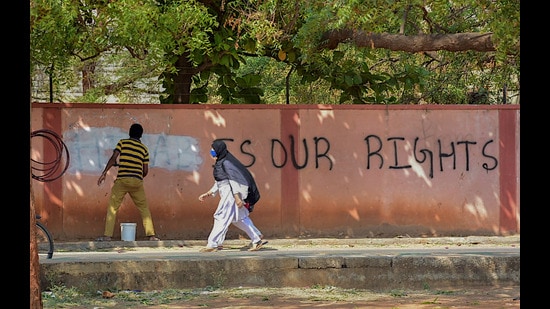
A hijab-wearing student walks past a worker painting a wall to conceal a pro-hijab slogan, Hospet, March 16, 2022 (PTI)
The three-judge bench of the Karnataka HC ruled that “wearing of hijab by Muslim women does not form a part of essential religious practice in Islamic faith.”
The statement ignores the ground reality for many students. Many first-generation learners, particularly Muslim girls, are able to go to school within the “safety of their religious practices”, says author and historian Rana Safvi. “Ideally there should be no purdah, but the parents and girls believe that it is a part of their religion,” she says. If it takes a head scarf to get a girl to school, so be it.
The judgment has been challenged in the Supreme Court. But there is a danger of two sorts of backlash, both of which are already in evidence.
The first is a generalised attack on Muslim women in hijab in public spaces. On March 16, a Mumbai-based dentist tweeted that his hijab-wearing wife, carrying a baby in her arms, was denied a seat on the local train when a man got up to offer it to her, but the passengers insisted that other women take it instead.
The second backlash is the adoption of hijab by an increasing number of women as a sign of their resistance to unchecked Islamophobia and majoritarianism.
At a time when Muslims feel persecuted by a growing radical Right-wing Hindutva movement, these girls are being pushed into a corner into adopting hijab in larger numbers as the only resistance within their means. Far from “emancipating” women, the judgment will result in greater numbers stepping forward to adopt visible symbols of their faith and identity which they now see as under threat.
The 129-page judgment alludes to a conspiracy where the Muslim girls are being “brainwashed”. It speaks in lofty terms of “a step forward in the direction of emancipation and more particularly, to the access to education.” It goes back to the history of the veil and refers to scholarly articles on the adoption of the hijab. But it is silent about the outrageous videos of women being forced to remove their burkhas and headscarves in what can only be seen as a virtual public stripping.
There is not one word in empathy with the girls being turned away from the gates of their schools and colleges by their teachers. Or being heckled by scores of saffron-wearing thugs shouting slogans at a solitary figure who walks towards her classroom.
If a mere headscarf can disrupt public order, then who is responsible: The student who wears it or the law enforcement agencies responsible for maintaining the peace?
Unfortunately, the judgment does not answer that question.
Namita Bhandare writes on gender and other social issues and has 35-plus years of experience in journalism. She has edited books and features in a documentary on sexual violence. She tweets as @namitabhandareRead More

 E-Paper