In the last 75 years, India has witnessed several policy reforms being stalled or delayed due to competitive politics. The case of Delhi’s new excise policy, launched in 2021, however, is a rare example of competitive politics leading to the rollback of progressive reform, reinstating a policy regime that promotes the sale of illicit liquor and leading to a loss of ₹1,300 crore to the state exchequer.
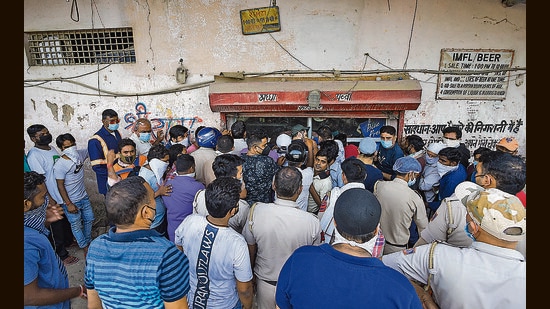
The majority of the liquor shops in Delhi were run by government corporations that pushed particular brands and offered an undignified store experience. As a result, consumers preferred buying from shops outside Delhi or through illegal channels (Amal KS/HT PHOTO)
To understand the genesis of Delhi’s new excise policy, one must understand the conditions under which the illicit sale of liquor flourishes. The first is when there is a complete prohibition on the sale of liquor, such as in Gujarat, or a partial ban by creating conditions preventing the legal sale of liquor in large parts of a state. The pre-2021 excise regime in Delhi was synonymous with partial prohibition: 134 wards — half of the Capital — had either none or one liquor shop, while some wards had as many as 27.
The second is a regressive tax regime, which creates incentives for illegal sales. Delhi’s old excise policy collected meagre annual licence fees of ₹8 lakh per liquor shop but imposed heavy excise fees on the sale of liquor, sometimes up to 300%. This created a big incentive to engage in the sale of non-duty paid liquor, which is a safety threat and leads to revenue loss.
The third is a policy regime dominated by sales through government-run shops. The majority of the liquor shops in Delhi were run by government corporations that pushed particular brands and offered an undignified store experience. As a result, consumers preferred buying from shops outside Delhi or through illegal channels.
Having inherited this regressive excise regime in 2015, the Aam Aadmi Party (AAP) government cracked down on the illicit sale of liquor. Since 2015, it has closed 3,977 illegal liquor shops. In addition, thousands of liquor bottles were seized yearly; 1.3 million bottles were seized between 2015 and 2017. But it was clear that a long-term solution lay in transitioning to a new, progressive excise regime.
Delhi’s new excise policy addressed all the flaws listed above.
First, it was premised on the principle that there should be an equitable distribution of liquor shops across the city while keeping the total to the existing number (849). Second, it rolled out a progressive tax regime by subsuming excise fees into licence fees and ensuring retail players bid for licences and paid their taxes upfront based on anticipated sales. This step eliminated any illegal sales. Finally, it marked an exit of government-run liquor shops, letting the private sector run shops and offer a modern retail experience.
The success of Delhi’s new policy could be gauged from the fact that the prices for retail licences jumped from ₹8 lakh per annum to ₹8 crore, and the total collections from the new policy, based on competitive bidding for licences, were projected to rise from an average of ₹6,000 crore per annum to ₹9,500 crore. The policy was welcomed by stakeholders and even held up as a model excise policy. That is before the politics took over.
Delhi’s new excise policy was drafted after public consultation, cleared by the Cabinet, vetted twice, and approved by Delhi’s lieutenant-governor (L-G) before it was notified. However, after the bidding for licences concluded and 48 hours before the rollout of the new regime in mid-November 2021, the then L-G, acting suo motu and without any consultation with the Delhi government, changed a crucial criterion in the policy. The change prohibited retail shops from opening in non-conforming areas of Delhi. This step made the new policy even more regressive than the old one, which allowed shops to open in non-conforming areas with the L-G’s approval.
This last-minute change in the Delhi excise policy re-imposed partial prohibition in many parts of the city, limiting the number of shops that could be legally opened and the licence fees due to the government. To make matters worse, the policy rollout, starting mid-November 2021, was met with stiff political opposition from some Bharatiya Janata Party (BJP) leaders, who did not allow many private retail shops to open even in conforming areas under the pretext that too many liquor shops were opening in Delhi. This happened even though, on a per capita basis, Delhi has a provision of one shop for every 22,700 people, a far cry from Noida (1:1,400), Bengaluru (1:1,700), and Gurugram (1:4,200), all in BJP-ruled states.
As a result, the number of retail shops that could open in Delhi by July was 468 — leading to a revenue loss of ₹1,300 crore. The ones that did open also faced continuous threats from local authorities, forcing many private owners to announce their exit. Faced with plummeting excise revenues and a Gujarat-like prohibition scenario in Delhi, the Delhi government was forced to revert to the old policy for six months as an interim measure.
Come September, Delhi will revert to the flawed old excise regime. The city’s residents must remember that the promise of a transparent excise regime was snatched away by competitive politics that undermined reform, even if it meant promoting the sale of illegal liquor and hurting state revenues — a politics of self-destruction.
Jasmine Shah is vice-chairperson, Dialogue and Development Commission of Delhi

 E-Paper