
 E-Paper



On Pakistan, India must wait and watch
Pakistan is in turmoil. But once the dust settles, Islamabad may reach out to New Delhi. India should be ready to respond positively, though cautiously

 Prefer HTon Google


Pakistan is now deep into its version of a polycrisis.
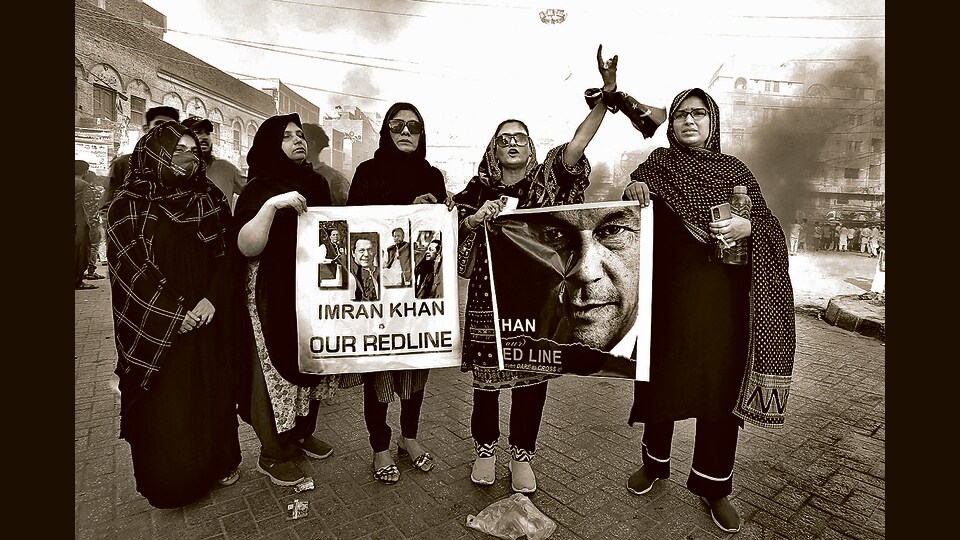
On May 9, former Pakistan prime minister (PM) Imran Khan was arrested by Pakistan Rangers as he was entering the Islamabad high court for a hearing in one of the dozens of cases pending against him. For a country facing a worsening economic crisis, bankruptcy and ruled by an unpopular government, the sudden arrest of its currently most popular political leader threatens to unleash a familiar cycle of violence and repression. Based on experience, there is an expectation that the Pakistan armed forces will eventually ride to the rescue, bringing a semblance of order, even economic revival.
However, the story could be different this time as one has witnessed the armed forces becoming targets of widespread anger and violence. The heavily guarded general headquarters in Rawalpindi has been attacked by violent mobs, setting fire to some buildings. Other military establishments have also been targeted. The unpopularity of the Shehbaz Sharif government has tainted the armed forces too. It is no longer possible for the Pakistan army to act as a neutral entity that rises above the squabbling and corrupt parties and be regarded as the sentinel of Pakistan’s security. Now it is being seen as an accomplice of a deeply corrupt and incompetent government, which is a significant change.
What could be the game plan behind this latest development? It is expected that general elections could be scheduled in October. Imran Khan’s party, the Pakistan Tehreek-e-Insaf (PTI) has the prospect of sweeping the polls, riding on his popularity. For the existing coalition of Sharif’s Pakistan Muslim League (PML) and Asif AIi Zardari’s Pakistan People’s Party (PPP) and, more importantly, the Pakistani army, that is an intolerable prospect. Imran Khan has been attacking the army, even accusing a senior officer of the Inter-Services Intelligence (ISI), Major General Faisal Naseem, of being responsible for several assassination attempts against him, including one in which he was wounded in the leg.
The army has rejected the allegations. Imran Khan’s arrest and possible conviction may disqualify him from contesting the forthcoming elections. Since the PTI has few credible and popular second-rung leaders, the party is expected to fragment. Some of its leaders, who have connections in the army, may well make peace with the powers that be. On the other hand, if popular demonstrations continue and intensify, a case could be made for deferring the elections. A third possibility is that if things get out of hand, the army assumes direct control of the government, Pervez Musharraf–style, and then hopes for the best.
All this domestic drama will play out against the backdrop of a challenging external environment. Relations with India continue to be tense. There may be a temptation to deflect attention with more shrill propaganda on Kashmir and renewed activity along and across the Line of Control (LoC). But the nature and intensity of Pakistan’s polycrisis is such that this deflection may not work. The external challenge is exacerbated by the fact that Pakistan playing midwife to the return of the Taliban in Afghanistan has turned out to be a bad bet. The Afghan-Taliban regime continues to harbour elements of the Pakistani Taliban, which has increased its hit-and-run attacks in Pakistani territory. Far from providing Pakistan with strategic depth against India, Afghanistan has become a security nightmare.
In the past, Pakistan could count on the support of its two powerful patrons, the United States (US) and China. Unfortunately, the US is no longer accommodating — it is not supporting the urgently needed International Monetary Fund (IMF) bailout, and China is reluctant to throw more money into a perennial sinkhole. Moreover, the wealthy Gulf countries, particularly Saudi Arabia, are no longer as generous as before. Nevertheless, it would not be in the interests of any of these countries to allow Pakistan to collapse into total dysfunctionality.
After all, Pakistan enjoys a strategic location and, more importantly, it is a nuclear weapon State. There may even be a quiet welcome to a military takeover. The prospect of Pakistan and Afghanistan becoming fused as a zone of endemic violence, economic distress, and political chaos may concentrate minds, and a rescue effort may follow, but Pakistan may pay a heavy price. Earlier, Pakistan was able to leverage its geopolitical value to the major powers, to retain some degree of independent agency. The space for this has shrunk. One possible fallout may be greater subordination to China, its only significant pillar of support. This is not good news for India.
What should be India’s reaction to the unfolding crisis in Pakistan? It can only wait and watch for the present because the situation remains unpredictable. The possibility of a more disturbed LoC must be considered seriously. One hopes that the ceasefire along LoC and the border continues to be scrupulously observed as it has been so far.
There is little that India can do to influence the course of domestic politics in Pakistan. So far, India has not figured in the domestic political discourse, and it would be best not to say or do anything that may change this situation. However, once the dust settles, Pakistan may attempt to increase its room for manoeuvre vis-à-vis its diminishing number of patrons. Improvement of relations with India may become a significant part of this compulsion. At that stage, India should be ready to respond positively, though cautiously.
Shyam Saran is a former foreign secretary and an Honorary Fellow, Centre for Policy ResearchThe views expressed are personal


