
 E-Paper



Succession, an Indian version
The appointment of D Purandeswari, NTR's daughter, as Andhra Pradesh BJP chief, highlights the unpredictable succession battles in regional political parties

 Prefer HTon Google


The struggle for political legacy is a recurring characteristic among regional political parties in India. The succession battle, which followed the death of Nandamuri Taraka Rama Rao, famously referred to as NTR, was no exception.
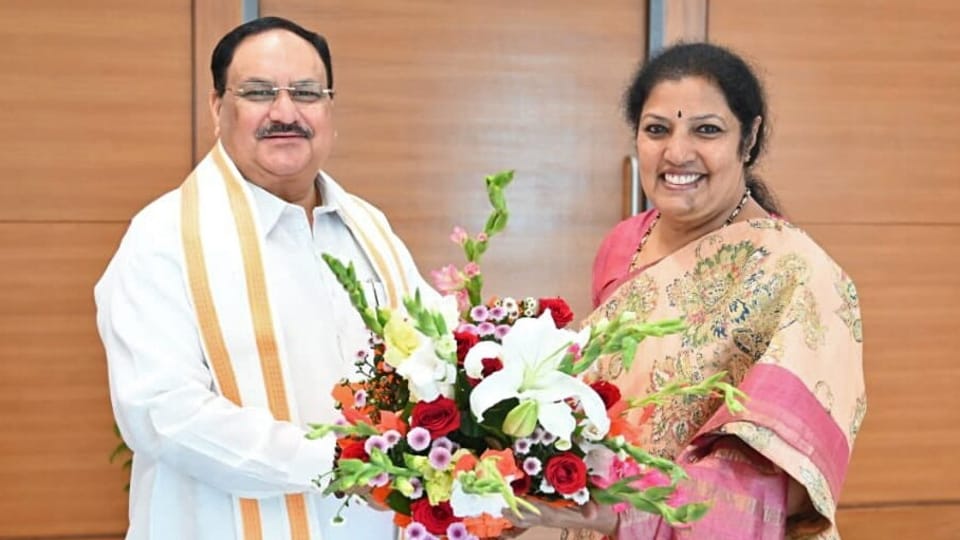
The very different political paths pursued by NTR’s family members are a telling reminder of how individual ambitions – and not ideology – dictate political careers – especially in a year when his birth centenary is being observed across Telugu-speaking states.
NTR's family members have since aligned themselves with diverse political parties, ideologies of which bear no resemblance to his original political beliefs.
The appointment of D Purandeswari, daughter of the founder of Telugu Desam Party (TDP), as the chief of Andhra Pradesh BJP, is the most recent example of this phenomenon.
NTR’s untimely death in 1996 was followed by a succession battle for his political legacy, involving various family members, including his second wife Lakshmi Parvathi, his younger son-in-law Nara Chandrababu Naidu, Purandeswari's husband and elder son-in-law D Venkateswara Rao, and son N Harikrishna.
Interestingly, Purandeswari wasn’t openly involved in the internal power struggle at that time even though her husband had emerged as a direct contender.
As the political battle ensued, neither Parvathi nor the other family members – who periodically attempted to seize NTR's political legacy – could browbeat Naidu. Naidu maintained a firm grip on the TDP, steadily leaving his contenders behind in the succession race.
As a direct result, those who couldn't secure leadership roles in the TDP opted for different political parties to pursue their individual political ambitions.
And, given their lineage – because of their proximity to NTR and seeming access to his legacy – political parties eagerly courted them as well.
For nearly all the family members who Naidu sidelined, it was, in turn, their antipathy against him that primarily dictated their political decisions as they charted their own paths.
In the process, most ended up with parties that NTR, in his time, did not approve.
The first one to chart an alternative route was the primary contender, Lakshmi Parvathi. She was unable to capitalise on the anticipated wave of sympathy in the Lok Sabha elections that followed NTR's passing in April-May 1996. From that point forward, the decline of her party was swift, as her NTR- TDP failed to secure any seat in the 1998 (Lok Sabha), 1999, and 2004 (assembly) elections. Parvathi later formed an alliance with YS Rajasekhara Reddy and the Congress Party, a party that her late husband had opposed throughout his life.
Following the division of Andhra Pradesh, she merged the remnants of her own party with the newly formed YSR Congress Party (YSRCP) led by YS Jagan Mohan Reddy.
At present, Parvathi, no longer the political player she once was, serves as the chairperson of the Telugu Academy in the Reddy government, persisting in her criticism of Naidu even after all these years.
Harikrishna, NTR’s son, played a significant role in the downfall of his father's government during the ‘95 palace coup. As it turned out, he later experienced a falling out with his brother-in-law, Naidu.
Taking a stance against Naidu's government, Harikrishna, along with his brother-in-law and Purandeswari's husband, Rao, founded their own party called Anna TDP in January 1999.
The party flopped: It received less than 2% of the votes polled in the elections of 1999. The humiliation was complete when Harikrishna himself lost in Gudivada (Krishna district), his father’s hometown.
Following this defeat, Harikrishna distanced himself from active politics for nearly a decade. However, he eventually re-joined the TDP when it transitioned into the opposition.
In 2008, Harikrishna – as it often happens in politics -- patched up with Naidu who then nominated him to the Rajya Sabha.
That saga came to an untimely end when Harikrishna met with a fatal road accident in 2018, August.
Separately, Rao’s political path too changed with time.
After actively participating in the palace coup against his father-in-law and assisting Naidu in assuming the position of chief minister, Rao, (Purandeswari’s husband), soon had a falling out with Naidu.
Rao, in fact, returned to NTR's camp while the patriarch was still alive. Following NTR's demise, he joined forces with NTR's second wife, Parvathi. That alliance was short-lived, as Rao quickly became disillusioned with Parvathi's political play during the Rajya Sabha elections in April 1996.
After severing ties with Parvathi, Rao opted to align himself with the BJP, possibly the first to directly to do so from the immediate family.
It was short-lived: He departed from the party after just a year to join Harikrishna's newly formed political party, Anna TDP.
Following the disappointing outcome of the Anna TDP in the 1999 elections, Rao took a hiatus from active politics, only to resurface in 2004 when he joined the Congress party. Rao contested and successfully won as a Congress MLA in the same year, and later in 2009 as well.
Even though he often changed political tact, Rao consistently opposed Naidu throughout his career.
In 2014, he announced retirement from politics but made a comeback in 2019 by joining forces with Naidu's rival, Jagan Mohan Reddy, and contested for the assembly on a YSR Congress Party ticket, though unsuccessfully.
Since then, his political life has mostly been dormant.
NTR’s son, N Balakrishna, who established himself as the patriarch’s successor in the Telugu film industry as a leading actor, remained aligned with Naidu, having supported him during the rebellion against his father in 1995.
He later joined electoral politics and won the assembly elections in 2014 and 2019 on the ticket of the TDP.
Balakrishna remains an active member of the TDP.
The political path of Purandeswari
The case of NTR’s eldest daughter Purandeswari is different from the rest of the clan – she waited for years after his death to emerge as a powerful politician in her own right though she charted a path her father would not approve of.
She was never in the limelight despite her illustrious background: Her sudden emergence as a politician was an unexpected development in this continuing family political drama.
Purandeswari entered the electoral arena as the Congress candidate for the Lok Sabha elections in 2004 when she was 45.
Her foray into politics was at the time seemingly aimed at preventing Naidu from becoming the sole inheritor of NTR's political legacy.
The Congress party welcomed the husband-and-wife duo even as their entry exposed the divisions within NTR's family.
Purandeswari emerged victorious in the elections and – by many accounts – proved to be an exceptional parliamentarian, gaining recognition and admiration.
Her rise within the Congress was sharp: Impressed by her capabilities, the Congress leadership appointed her as the state minister for human resources in the Manmohan Singh cabinet within two years.
During the 2009 general elections, she secured victory once again on a Congress ticket, and went on to hold portfolios in commerce, industry, and later textiles.
In about five years, the suave and well-spoken Purandeswari established herself as a respected figure in politics.
Bifurcation of Andhra Pradesh
In the midst of the upheaval caused by the bifurcation of Andhra Pradesh into Andhra Pradesh and Telangana in 2014, Purandeswari and her husband Rao parted ways with the Congress party.
She joined the BJP but was defeated in both the Lok Sabha elections of 2014 and 2019.
Serving as a BJP spokesperson in AP, she remained a constant source of opposition for Naidu, particularly after the TDP severed ties with the NDA government in the latter half of 2018.
In an unexpected turn of events, the BJP has now appointed her as the state party chief.
In recent times, her animosity towards Naidu and the TDP appears to have somewhat diminished while her criticism of the YSRCP government has grown more stringent.
Meanwhile, there are discussions in political circles within the state suggesting that the TDP might form an alliance with the BJP for the 2024 elections.
It would certainly be intriguing to observe how Purandeswari navigates such a situation.
Political opportunism trumps ideology
Interestingly, many of NTR's family members did not exhibit any marked attachment to his political ideology when it came to their own political careers.
Despite NTR's relentless fight against the Congress Party, it did not dissuade any of them, including his second wife Lakshmi Parvathi, from pursuing their own careers within the same party.
Furthermore, even the patriarch's refusal to align with the BJP following the Babri Masjid demolition did not deter his daughter Purandeswari from joining the party. Of course, even Naidu, who has been leading the TDP since 1995, has deviated multiple times from its original ideological positions.
Purandeswari's career path serves as a testament to personality-driven politics within regional parties. It also highlights how the BJP strategically capitalises on internal family divisions within these parties to weaken them.
This trend is not limited to Purandeswari alone, as recent events in the Shiv Sena and Nationalist Congress Party have shown.
Ramesh Kandula is the author of Maverick Messaiah: A Political Biography of NT Rama Rao. The views expressed are personal


