
 E-Paper



The Taste with Vir Sanghvi: Are shrimp and prawn the same thing?
The one difference most of us believe exists is bogus: Prawns are not necessarily bigger than shrimp. There are very small prawns and large shrimp too.


Do you know the difference between prawns and shrimp? Between crayfish and lobster? And do you know what a scampi is? What about a soft-shell crab? If you are confused, join the club. I am so confused that my head reels. But as I have started researching the mystifying world of seafood, I have come to the conclusion that it is not our fault. Everybody, including chefs and food writers, misuses these terms so often that the distinctions have been rendered meaningless. But in case you care enough (and frankly, there is no reason why you should), here is what I have learned about the differences between various kinds of shellfish.
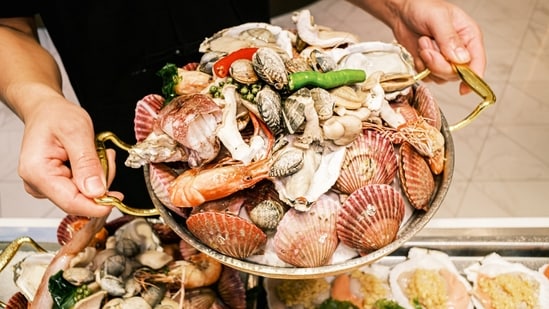
Let’s start with the big one. Are shrimp and prawn the same thing? Though this is not strictly correct, I am going to say, yes, they are; you can use the term interchangeably. The one difference most of us believe exists is bogus: Prawns are not necessarily bigger than shrimp. There are very small prawns and large shrimp too. (Also read: The Taste With Vir: Visiting Paris in August )
In biological terms, prawns and shrimp are indeed different but I don’t think they differ in any significant way from the point of view of anyone who wants to eat them: You can use them in the same way in all recipes. For what it’s worth, here is the scientific difference: Shrimp have plate-like gills while prawns have branching gills. Shrimp have claws on two parts of their legs while prawns have claws on three parts of their legs. And on and on it goes in a similar vein. Great for shellfish nerds but of no use to the rest of us.
Even within prawns, the distinctions can be confusing. Are tiger prawns the same as king prawns or jumbo prawns? Tiger prawns are huge. The so-called jumbo tiger prawn can be among the largest prawns in the world. It gets its name from the stripes on its skin and is much prized by fishermen in Asia.
However, the tiger prawn that you will find in India while big (like we imagine a lobster to be) is usually farmed. In the Far East, farmed tiger prawns are considered to have an inferior flavour and are shunned by gourmets. In India, we put so much masala on the wretched things that nobody can tell the difference and there is no farmed vs wild snobbery.
King prawns can be as large as big tiger prawns but are a different species with no stripes on their sides. Jumbo prawn is a loose term used to describe any large prawns. By itself, the term is largely meaningless except that you are unlikely to find a small prawn described as jumbo.
If you think prawns are confusing, wait till you get to lobster. The first thing to remember is that lobster is an umbrella term. It is not applied to any single fish and there are many kinds of lobsters and so-called lobsters.
The lobster that most western recipes are written for is what the French call a homard and its technical name is Homarus. You find Homarus Gammarus in Europe and Homarus Americanus in America. Within these two broad categories, there are many kinds of lobster. These are the lobsters which have the legendary sweet flavour and go well with butter.
There is another shellfish which looks like a homard but does not have claws. The French call this the langouste. This is not part of the homard family but is often described as lobster, especially in India. Its flesh does not have the soft sweetness of the homard and so it is not ideally suited to such classic dishes as lobster thermidor or lobster newburg. Or even to an American lobster roll. But it is used to make them anyway.
There are about 60 species of langouste all around the world and because people are forever being corrected when they refer to them as lobsters, such terms as ‘spicy lobster’ or crayfish or crawfish are employed. This causes enormous confusion because in France, the term crayfish refers to a completely different sweet-water fish.
Is the langouste worth the high prices people charge for it? In my opinion, no. Then there is the confusion between Dublin Bay prawns, langoustines and scampi. They are all exactly the same fish. To confuse matters further they are also called Norway lobsters though they are not members of the Homarus family.
They look like large prawns and can be very tasty though in my opinion, they taste as they look: more like prawns than lobster. Unfortunately, scampi, the Italian name for this fish, has been so abused in the western world that it is now meaningless. For many years, the Brits would call any dish of fried, battered shrimp 'scampi'. Sometimes they would use the term for fried monkfish.
In America, “shrimp scampi” refers to a dish consisting of shrimp cooked with butter, garlic and white wine. No real scampi are involved. So, if you see “scampi” on a menu, tread carefully. That leaves us with crabs. Many people will tell you that a soft-shell crab is a more expensive species of crab. It is not. It is a normal crab. From time to time, crabs outgrow their shells and shed them. During this time, a soft covering develops over their torso until the new shell grows. These are sold as soft-shell crabs in restaurants, often at exorbitant prices.
Can you blame me for being so confused? Anyone would be. And sometimes, I think that the confusion is deliberate, a trick devised by fishmongers and chefs to keep us paying more than we should. So, if you do like shellfish then it’s probably worth knowing all this stuff to make sure nobody can con you.


