It has been exactly a week since Russia’s President Vladimir Putin decided that invading another country was an acceptable way to resolve a political conflict with an unfriendly neighbouring government and a wider geopolitical and strategic dispute with the United States (US). It has also been a week since the world has had a chance to respond to this return to a mode of statecraft that international institutions, international law, and the written and unwritten rules of international political sought to avoid.
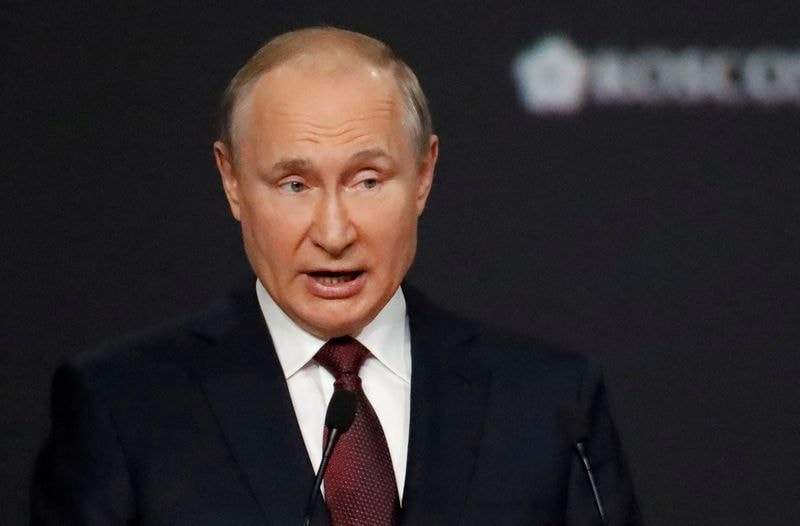
Given the nature and scale of financial and export control sanctions that the West has now imposed on Russia, Putin will do all he can to accelerate the creation of an alternative economic and technological paradigm. (Reuters)
Even before Putin’s decision, global systemic stability had been under tremendous strain due to a mix of factors — China’s strategic belligerence and predatory economic practices; the rise of political extremism and insularity in the US; the return to economic nationalism across geographies; the pandemic-induced devastation of lives and livelihoods; the stunning evolution of technology, for good and bad, which has redefined the idea of State sovereignty; slowing growth and rising inequality; and a climate crisis that States have woken up to but haven’t shown the political courage to truly address.
All these issues were difficult to resolve. But, from India’s perspective, there was at least a notional recognition that politically, dialogue was the preferred path to dispute resolution and trampling on State sovereignty to achieve civilisational dreams or extracting revenge for perceived humiliations wasn’t acceptable; economically, the world’s dense networks connecting the most powerful economies needed to be stable, while reducing dependence on China; and strategically, the world had to contend with the rise of a new power and find ways to tame its more aggressive and expansionist impulses.
What Putin has done, in one stroke, is shattered this global systemic stability.
For one, the complete rupture in US-Russia ties will have an impact in every theatre. Each global conflict is going to get harder to resolve; each issue that requires cross-border collaboration will become harder to navigate; smaller states will become more insecure; each country, as distant as it may be from the ravages currently underway in Ukraine, will have to reboot its economic calculations at least in the medium-term; and each State will be forced to make choices it does not particularly want to make between contending powers. But fundamentally, the sense that you are alone, that respect for sovereignty is not sacrosanct, and that you have to do all that is possible to protect your territory and your economy will govern the mind space of each political decision-maker. Global political stability, fragile at the best of times, will become more elusive.
Two, given the nature and scale of financial and export control sanctions that the West has now imposed on Russia, Putin will do all he can to accelerate the creation of an alternative economic and technological paradigm. For this, he needs his friends in Beijing, which makes China a valued interlocutor for the West at the moment too. Unlike Russia, which is now pretty much outside the global economic system, China remains a net beneficiary of the current global economic regime and will not walk away from it. But it is also at stage where it has been — through its own institutions, economic projects, currency and trading arrangements, and technologies — attempting to create its own economic universe. Depending on Putin’s endgame, within the constraints now imposed on him by the West, and Xi Jinping’s choices, which will be governed by the opportunities he sees in the current moment to further his expansionist ambitions while playing both sides, the world is staring at a major economic churn in the months and years ahead.
Three, Putin’s actions will have a profound impact on domestic politics, and thus the strategic outlook, of a range of countries in the West. This is most visible in Europe already, where close observers of the continent’s politics believe they are witnessing a turning point — the need to invest in hard power has dawned on capitals which somehow harboured the illusion that wars were a thing of the past. In the US, the strong bipartisan mood against Russia is back with a ferociousness that hasn’t been seen since the Cold War. Joe Biden, after the humiliating withdrawal in Afghanistan, has to show that the US, under him, remains a strong power with the tools to cripple Russia; notwithstanding Donald Trump’s praise of Putin’s genius, Republicans will attack Biden from an even more hawkish position, for having failed to prevent the invasion and seek to impose more severe penalties. This turn in the popular mood against Russia, aided by images of its aggression, will govern the political and foreign policy choices of western governments at least for the next few years.
The good news is that it will strengthen western unity — and yes, that’s good news since the alternative paradigms and alternative powers are not particularly attractive options. The bad news is it will force the West into making unreasonable demands of allies and partners and distract them from the real challenge — China. Either way, this western unity will not lead to stability on its own; it will add to the importance and power of one pole, but only one pole, in a far more fragmented world.
As a status-quoist power — rather than a revisionist power — India has benefited from global stability. Vladimir Putin’s action puts this order at risk. And that is why Delhi, over the past week, has been uncomfortable with Russian actions and taken a more critical stance. Forget American pressure; to guard its own principles and interests, Delhi needs to be acutely conscious of the perils of the path Russia has embarked upon and adapt its diplomatic and strategic position accordingly.
Prashant Jha is the Washington DC-based US correspondent of Hindustan Times. He is also the editor of HT Premium. Jha has earlier served as editor-views and national political editor/bureau chief of the paper. He is the author of How the BJP Wins: Inside India's Greatest Election Machine and Battles of the New Republic: A Contemporary History of Nepal.Read More

 E-Paper