
 E-Paper



Photo: Over 130,000 flee Bali fearing an eruption as Mount Agung rumbles
Warnings that Bali's Mount Agung volcano will erupt have sparked an exodus of over 130,000 people on the Indonesian island, a popular destination among tourists. Temporary shelters, supplies and warning systems have been put in place along with a 12km cordon around the volcano.
Updated on: Sep 29, 2017 12:02 PM IST

Share via


Copy link

1/10
 View Photos in a new improved layout
Updated on Sep 29, 2017 12:02 PM
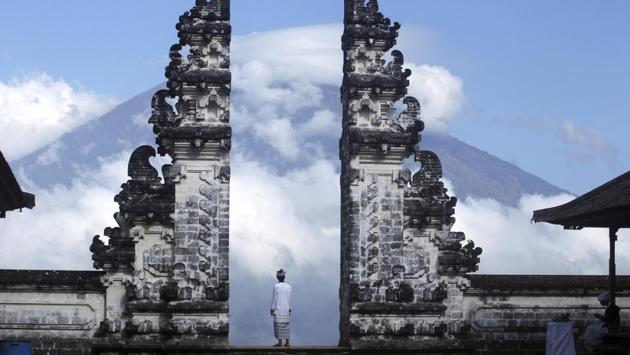
A Balinese man looks on from a temple in Karangasem as Mount Agung volcano is shrouded in clouds. The National Disaster Mitigation Agency’s command post in Bali said the number of evacuees has swelled to about 134,200 by Thursday evening fearing it will soon erupt. This is more than double the estimated population within the immediate danger zone, as people farther from the mountain join those fleeing. (Firdia Lisnawati / AP)
2/10
 View Photos in a new improved layout
Updated on Sep 29, 2017 12:02 PM
People await transportation to a temporary shelter at Sibetan village on September 28, 2017 in Karangasem regency. Volcanologists say the escalation in tremors indicates an eruption is more likely than not, but they can’t say with certainty when. Tectonic plates carry massive quantities of rock deep into the earth which melt into magma. The magma that feeds Mount Agung traps more gas, producing larger eruptions. (Ulet Ifansasti / Getty Images)
3/10
 View Photos in a new improved layout
Updated on Sep 29, 2017 12:02 PM
Volunteers erect a temporary tent at an evacuation center in Klungkung regency, Bali. Mount Agung has been at its highest alert level for a week. Those who have fled are scattered in more than 500 locations across Bali, taking shelter in temporary camps, sports centers and other public buildings. ‘The volcano is bulging, causing a large number of small cracks to form and the earth to vibrate,’ said David Boutelier, a geologist at Australia’s University of Newcastle. (Ulet Ifansasti / Getty Images)
4/10
 View Photos in a new improved layout
Updated on Sep 29, 2017 12:02 PM
Children rest next to donated supplies outside a temporary evacuation center at a sports arena in Klungkung, Bali. The exclusion zone currently extends as far as 12 kilometers from the crater in places. The local observatory reported a small plume most likely of water vapor after daybreak Friday, but no ash cloud. Agung, which dominates the landscape in the northeast of the island, last erupted in 1963, killing more than 1,100 people. It remained active for about a year. (Darren Whiteside / REUTERS)
5/10
 View Photos in a new improved layout
Updated on Sep 29, 2017 12:02 PM
A search and rescue team help farmers load their cattle into a truck, near Kubu, Bali. Thousands of cows were left behind in the rural communities where farming is an important livelihood, but local animal husbandry officials are arranging trucks to remove them. Agung, about 70 kilometers to the northeast of the tourist hotspot of Kuta, is among more than 120 active volcanoes in Indonesia. (Darren Whiteside / REUTERS)
6/10
 View Photos in a new improved layout
Updated on Sep 29, 2017 12:02 PM
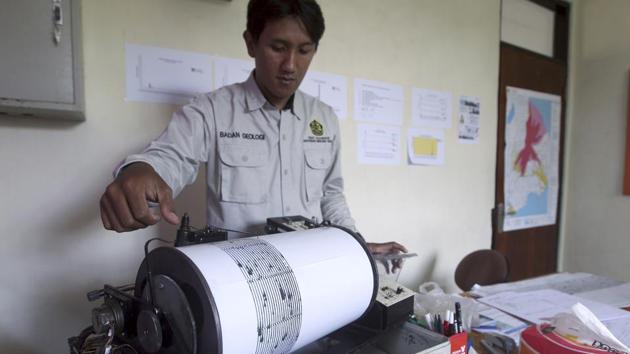
Disaster officials recorded over 800 volcanic earthquakes on Wednesday. Warning sirens were installed in several townships this week. Indonesia is located on the Pacific ‘Ring of Fire,’ an arc of volcanoes and fault lines, prone to seismic upheaval. ‘It could continue for the next few days or weeks, but an eruption could also happen any time given its condition is very critical,’ said Gede Swantika, head of volcanology at Indonesia’s Center for Volcanology and Geological Disaster Mitigation. (Firdia Lisnawati / AP)
7/10
 View Photos in a new improved layout
Updated on Sep 29, 2017 12:02 PM
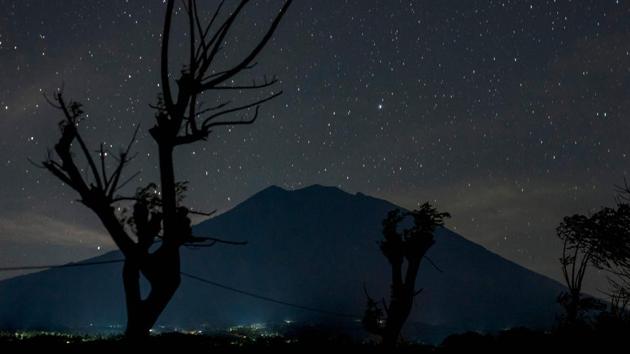
Indonesian authorities are also on standby to divert flights destined for Bali. ‘We could say that the chance of an eruption is very high, above 50 percent,’ said Swantika. Entering the exclusion zone would be extraordinarily risky. ‘I would not go now. The activity is too high and the risk much too large,’ Boutelier said. The pyroclastic flow, a rush of hot gas, ash and other volcanic material, would ‘kill everyone in its path in a few seconds,’ he added. (Bay Ismoyo / AFP)
8/10
 View Photos in a new improved layout
Updated on Sep 29, 2017 12:02 PM
Balinese citizens pray for safety near Mount Agung, in Amed, Bali. It’s possible the volcano could calm down, but it is unlikely without pressure being released in some way. Heather Handley, assistant Earth sciences professor at Sydney’s Macquarie University said there were signs of gas releases and earthquakes in 1989 and swelling of the volcano between 2007 and 2009 without any subsequent eruptions. But this time around, the buildup of activity is much more significant. (Darren Whiteside / REUTERS)
9/10
 View Photos in a new improved layout
Updated on Sep 29, 2017 12:02 PM
Indonesian President Joko Widodo (C) talks with children during a visit to a temporary shelter for people near Mount Agung. While there are stocks of food, water, medicines, and other supplies, evacuees fear they are in for a long wait that could disrupt livelihoods. Officials also noted there are around 30,000 cattle within the danger zone around the volcano and efforts are being made to move livestock, an important source of income for many residents. (Agus Suparto / HO via REUTERS)
10/10
 View Photos in a new improved layout
Updated on Sep 29, 2017 12:02 PM


