
 E-Paper



Photos: For Honduran deportees, going home spells return to brutality
For many Honduran deportees, home means a return to the brutality that sent them fleeing north in the first place. In the neighbourhoods where they grew up, corpses are dumped unceremoniously at construction sites, and carted off in body bags like loads of potatoes. Heavily armed police patrol from the back of pickup trucks, stopping to frisk pedestrians for weapons, drugs or other signs they belong to gangs. For these deportees, home is a neighbourhood ruled by murderous gangs who extort money and demand that young men join their ranks — killing those who refuse to obey.
Updated on: Aug 31, 2018 11:25 AM IST

Share via


Copy link

1/11

 View Photos in a new improved layout
Updated on Aug 31, 2018 11:25 AM
Family members of slain Ronald Blanco clean his blood from the alleyway of the Japon neighborhood where the Barrio 18 gang operates Tegucigalpa, Honduras. For many Honduran deportees, going back home means a return to the brutality that sent them fleeing north in the first place. (Esteban Felix / AP)
2/11
 View Photos in a new improved layout
Updated on Aug 31, 2018 11:25 AM
Police investigators use a body bag to keep dry in the rain, as a colleague recovers a body in a construction area in San Pedro Sula. In the neighbourhoods where they grew up, corpses are dumped unceremoniously at construction sites, and carted off in body bags like loads of potatoes. (Esteban Felix / AP)
3/11
 View Photos in a new improved layout
Updated on Aug 31, 2018 11:25 AM
Clothing is displayed for sale at the Comayaguela market where military police patrol in Tegucigalpa. Heavily armed police patrol 24/7, stopping to frisk pedestrians for weapons, drugs or other signs they belong to gangs. For many deportees, home is now ruled by murderous gangs who extort money and demand that young men join their ranks — killing those who refuse to obey. (Esteban Felix / AP)
4/11
 View Photos in a new improved layout
Updated on Aug 31, 2018 11:25 AM
15-year-old Jus, who did not want to give his last name for security reasons, works on composing songs at the shelter where he lives that takes in deported migrant youths who cannot return home due to high violence in their communities, in Tegucigalpa. Jus was deported from Guatemala as he tried to make his way to the US after his father was murdered by a gang. (Esteban Felix / AP)
5/11
 View Photos in a new improved layout
Updated on Aug 31, 2018 11:25 AM
A mat explains different human rights at the shelter. Here, stories echo each other. Alexis, 18, arrived two years ago after being deported from Mexico. Gangsters threatened him because he wouldn’t join them. Finally his mother said he had to run. Salm, 14, left home after gang members threatened to kill him for refusing to join. He was in a shelter in Nicaragua for a while, but was then sent back. (Esteban Felix / AP)
6/11
 View Photos in a new improved layout
Updated on Aug 31, 2018 11:25 AM
Larissa and her husband eat lunch on his break in Yojoa. The Mara Salvatrucha gang, also known as MS-13, came for their 14-year-old son, aiming to recruit him, but when he refused they beat him up, kicking him in the face and breaking his nose. The family failed to migrate to the US and was deported from Mexico, but will try again. Three of Larissa’s cousins died young after being recruited by gangs. (Esteban Felix / AP)
7/11
 View Photos in a new improved layout
Updated on Aug 31, 2018 11:25 AM
A woman breaks down crying on the perimeter of a crime scene where her only son Javier Antonio Santos, 18, was killed during a shootout with military police, in the Chamelecon neighborhood of San Pedro Sula. The two youths who died in the shootout were alleged by police to be MS-13 gang members, while the mother cried that he was not. (Esteban Felix / AP)
8/11
 View Photos in a new improved layout
Updated on Aug 31, 2018 11:25 AM
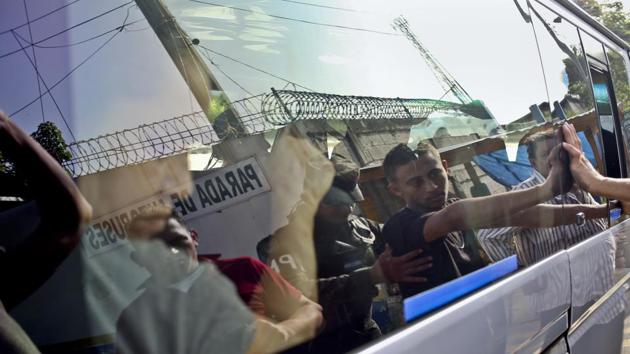
Military police frisk and search passengers travelling on public bus, to search them for weapons or signs that they belong to a gang. Many deported families no longer have a home. They sold everything to pay for a trip north and now find themselves without shelter — and the additional burden of a debt they cannot pay. (Esteban Felix / AP)
9/11
 View Photos in a new improved layout
Updated on Aug 31, 2018 11:25 AM
People watch the gay beauty contest coined “Our Beauty” at a disco club in Tegucigalpa. LGBTI organizations in Honduras have denounced at least 40 murders of their community since the start of 2017, with most being victims of gunfire. (Esteban Felix / AP)
10/11
 View Photos in a new improved layout
Updated on Aug 31, 2018 11:25 AM
Child migrants travelling with their parents line up to get on a bus destined for Guatemala City as they make their way to the US, in San Pedro Sula. In 2018, the Honduran Migration Consular Observatory (CONMIGHO) counted 5,488 minors deported back to Honduras from the US, Mexico, Europe and Central America. (Esteban Felix / AP)
11/11
 View Photos in a new improved layout
Updated on Aug 31, 2018 11:25 AM


