
 E-Paper



New traffic plan at Pune’s SPPU junction from October 1
According to Gadgil, programme director, Parisar, the intention behind the new traffic plan is to make walking on the footpath safer.


Trial for the new traffic plan at the Savitribai Phule Pune University circle to ensure smooth movement of vehicles and safety of pedestrians will begin from October 1. Under the new plan, the SPPU junction will undergo a structural change with the Pune Municipal Corporation (PMC), traffic police department, city activists Ranjit Gadgil and Prashant Inamdar working together to improve the functioning of the area to manage traffic better and ensure pedestrian safety.
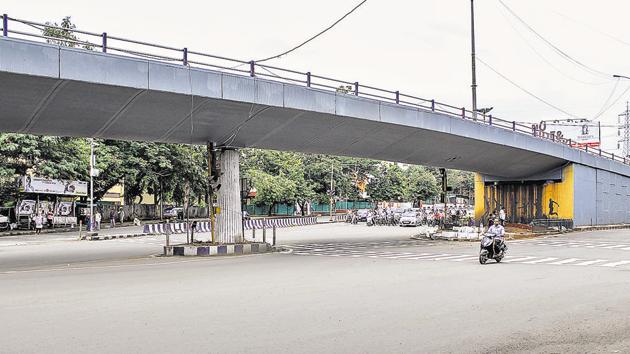
According to Gadgil, programme director, Parisar, the intention behind the new traffic plan is to make walking on the footpath safer.
“The objective is to make the junction compact to increase safety of vehicle riders and pedestrians. Currently, the University chowk is wide. It takes a long time for a commuter to cross the junction,” Gadgil.
Gadgil, who has been involved in the initial stages of the design evaluation, said, “It is critical that people realise that the design is not expected to improve the current traffic congestion, which can only be reduced when public transport is improved and people shift from private vehicles.”
Rajendra Raut, head of PMC road department, said, “We are taking a temporary or a short term traffic measure on the University chowk. We plan to make some rectifications on the road during the trial. We are hoping to begin this trial by October 1.”
The trial will be conducted for a week and will be closely monitored to find any flaws in the design to make changes before the design is finalised.
Based on a proposal from the World Resources Institute (WRI), which has signed a road safety MoU with the Government of Maharashtra, the Savitribai Phule Pune University junction was planned to be re-designed. The basic purpose of the redesign is to make the junction compact so as to reduce time taken by vehicles to pass through the junction, to reduce distance to be crossed by pedestrians, thus allowing them to cross safely, eliminate movement of traffic around the flyover pillars to increase safety of vehicles, especially two-wheelers.
According to officials, the discussion for the new plan was on since the last six months and then with meetings between the traffic department of the Pune police and PMC. Later, the design for the new traffic plan was finalised before holding a trial to see how it will work.
“The pillars of the flyover are right in the middle of the junction but with the new geometrical design, the pillars will no longer be in the middle of the junction. So the plan is to move the stop lines further ahead, ideally you want the roads to come at right angles; that is a nice angle from a traffic planners’ point of view,” pointed out Gadgil.
According to deputy commissioner of police, Ashok Morale, “During the seven-day trial, we will make structural changes and study how it will impact traffic on the roads from Pashan, Baner and Aundh.”
Road safety has been a big issue for the government. According to the latest report from the ministry of road transport and highways - in road accidents in India in 2016, 1,50,785 people were killed and almost 5 lakh people were injured last year. Fatalities have risen 31% in the last 10 years, making India’s roads the least safe in the world. Two-wheeler users (44,366) and 15,746 pedestrians were killed, together accounting for 40% of the total fatalities. The Supreme Court appointed committee for road safety has been issuing strict orders to the state governments to take steps to improve road safety, including re-design of streets and junctions.


