
 E-Paper



Senior housing supply to rise from 25,000 to 1 lakh units by 2030; new launches in Tier II/III cities and temple towns
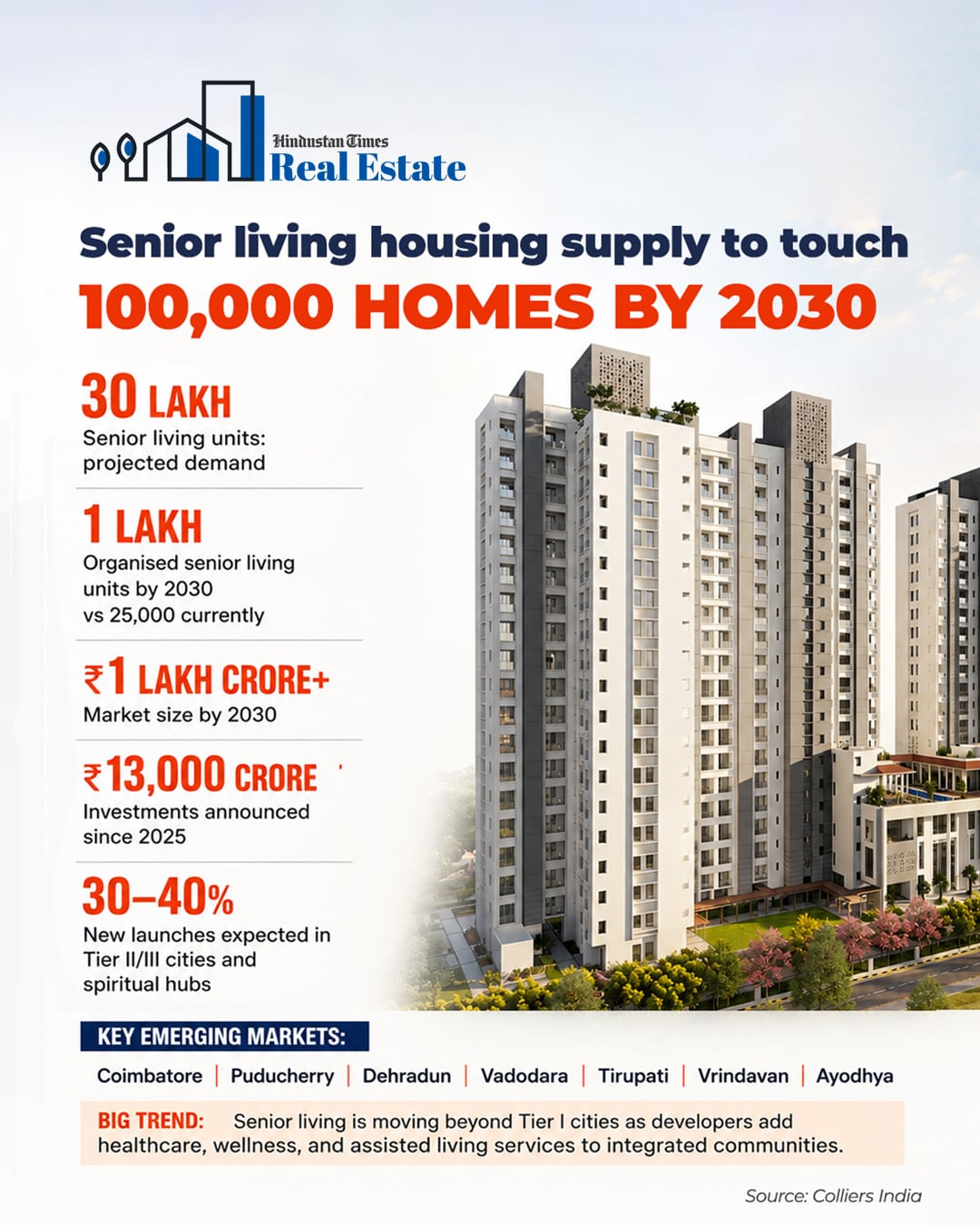
Senior housing demand to hit 30 lakh units by 2030; Nearly 30-40% of new launches in Tier II/III cities and spiritual hubs Tirupati, Ayodhya and Vrindavan

 Prefer HTon Google


Senior housing market in India is expected to touch nearly 30 lakh units by 2030, driven by changing demographics and evolving lifestyle preferences. Organised supply could rise from around 25,000 units currently to 1 lakh units by 2030, with 30-40% of new project launches likely to come up in Tier II and III cities and spiritual hubs, a report by Colliers India said on Aug 18.

While Tier I cities currently account for the bulk of organised senior living stock, the segment is steadily expanding into Tier II and III cities. Coimbatore, Puducherry, Dehradun and Vadodara, along with spiritual destinations such as Tirupati, Vrindavan and Ayodhya, are emerging as attractive senior housing markets. These locations offer lower living costs, improving healthcare infrastructure, relatively affordable real estate and a slower pace of life and are expected to account for around 30–40% of new project launches by 2030, it said.
More than ₹13,000 crore of investments have been announced since 2025 and are expected to be deployed towards senior living projects over the next three to four years. Developer-led investments account for the majority of the planned capital deployment, while strategic partnerships between developers and healthcare service providers are also gaining traction, it said.
Select institutional investors are forming joint venture platforms with real estate developers to expand their senior living portfolios across key markets, the report said.
Senior living population expected to double by 2050
India’s elderly population, those aged 60 years and above, is projected to more than double from around 170 million currently to over 340 million by 2050. This demographic shift is expected to substantially increase demand for senior living and care facilities.
The report noted that demand for senior living units is projected to reach nearly 30 lakh units by 2030, compared with an estimated current demand of 20-22 lakh units. However, organised senior living inventory is only around 25,000 units, translating into a penetration rate of about 1.3%.
Also Read: DLF aims to create a 'meaningful' offering for seniors in Gurugram, says Aakash Ohri, MD
Aggressive expansion by senior living operators and developers is expected to take organised inventory to around 1 lakh units by 2030, raising penetration to approximately 4%, it said.
The senior living market is currently valued at around ₹30,000 crore, nearly 70% higher than in 2024. With demand rising and investor interest strengthening, the market is expected to exceed ₹1 lakh crore by 2030, nearly quadrupling from current levels, it said.
Regulatory reforms to strengthen senior living ecosystem
The regulatory framework for senior living in India is expected to strengthen further following renewed emphasis on model guidelines for senior living projects originally issued by the Ministry of Housing and Urban Affairs in 2019.
The guidelines, along with mandatory Real Estate Regulatory Authority (RERA) compliance, are expected to improve standardisation, transparency, operational efficiency and accountability across senior living projects, the report noted.
States such as Haryana and Maharashtra have already taken steps towards establishing dedicated guidelines or policies for senior living projects, signalling the growing need for greater regulatory oversight.
Also Read: DLF, other real estate firms set eyes on senior living projects in Gurugram
“With a rapidly expanding elderly population and rising demand for professionally managed senior housing and care solutions, the market presents significant long-term growth opportunities. In fact, on the supply side, India’s organised senior living inventory is expected to quadruple over the next three-four years and become a trillion-rupee market by 2030. Moreover, increasing policy support, growing investor participation and collaboration among leading developers and healthcare operators are likely to redefine senior living offerings across the country,” said Badal Yagnik, Chief Executive Officer and Managing Director, Colliers India.
“Growing capital commitment towards senior living projects reflects the conviction of developers and investors in the segment’s long-term growth potential. With leading developers and operators announcing more than ₹13,000 crore in investments since 2025, we are likely to witness acceleration in fund deployment in senior living projects over the course of the next three to four years. The senior living market is set to witness a stronger development pipeline across categories, including independent living and assisted living formats,” said Vimal Nadar, National Director and Head of Research, Colliers India.
Developers add senior living clusters to integrated townships
India’s senior living landscape is gradually shifting from standalone developments towards integrated living and care ecosystems. Across independent and assisted living formats, 1, 2 and 3 BHK units continue to dominate. However, developers are increasingly incorporating dedicated senior living clusters within villas, large mixed-use developments and integrated townships, the report noted.
Such projects allow senior residents to access shared amenities, social spaces, healthcare facilities and community activities within a larger development. Going forward, developers are likely to broaden their offerings to cater to specialised requirements such as dementia care, emergency support, rehabilitation and wellness services.
Operator-led models could also gain traction as real estate developers partner with local healthcare providers, creating new investment opportunities across both established and emerging senior living markets, the report added.


