
 E-Paper



Astronomers discover exoplanet that behaves like long theorized Planet Nine
The exoplanet called HD106906 b occupies an unlikely orbit around a double star 336 light-years away. It was first discovered in 2013 with the Magellan Telescopes at the Las Campanas Observatory in Chile’s Atacama Desert.

 Prefer HTon Google


The National Aeronautics and Space Administration (Nasa) and European Space Agency’s Hubble Space Telescope have helped astronomers and astronauts identify a bizarre exoplanet that behaves a lot like the long hypothesised ‘Planet Nine’. Planet Nine is a planet hypothesised by astronomers to be the farthest planet in our solar system, beyond our farthest known planet, Neptune.
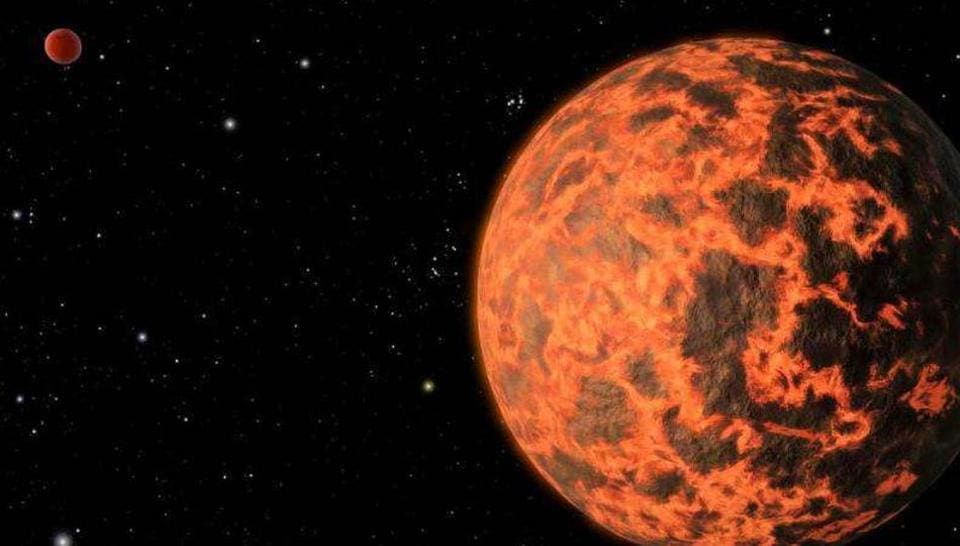
According to a study published in the Astronomical Journal, the exoplanet outside our solar system shares similar characteristics to that of Planet Nine. The exoplanet called HD106906 b occupies an unlikely orbit around a double star 336 light-years away. It was first discovered in 2013 with the Magellan Telescopes at the Las Campanas Observatory in Chile’s Atacama Desert.
However, for scientists to pinpoint the Jupiter-like planet’s orbit, the Hubble Space Telescope was required to collect accurate measurements of its motion over 14 years. For the first time, astronomers have been able to measure the motion of a massive planet that is orbiting very far away from its host stars and visible debris disc.
The exoplanet is very far from its two host stars, over 730 times the distance of the Earth from the Sun. One trip around its suns takes 15,000 years. Hubble scientists also found that the planet’s extreme orbit is very inclined, elongated and external to a dusty debris disc that surrounds its twin stars. The debris disc itself is extraordinary, presumably due to the planet’s gravitational pull.
“To highlight why this is weird, we can just look at our own solar system and see that all of the planets lie roughly in the same planet. It would be bizarre if, say, Jupiter just happened to be inclined 30 degrees relative to the plane that every other planet orbits in. This raises all sorts of questions about how HD 106906 b ended up so far out on such an inclined orbit,” Meiji Nguyen, the lead researcher of the University of California, Berkeley, was quoted as saying by the Tribune.
The reason theorised for the planet’s distance from its stars and strange orbit is that it was formed much closer to its stars, about three times the distance that Earth is from the Sun. Drag within the system’s gas disc caused the planet’s orbit to decay, forcing it towards its twin stars. However, the twin stars’ gravitational force flung it out onto an extreme orbit that almost launched the planet out of the system.
Till date, however, astronomers are yet to find conclusive evidence of the existence of Planet Nine in our solar system.


