
 E-Paper



'Make way for king of solar system': What makes new NASA view of Jupiter special
The two images have been captured by NASA Webb Telescope, which is said to be the world's largest space telescope.

 Prefer HTon Google


A new view of Jupiter in infrared light has been captured by NASA’s James Webb Telescope. The two images lend clues to the planet’s inner life, the US space agency has said. Two moons, rings, and distant galaxies are visible in the images.
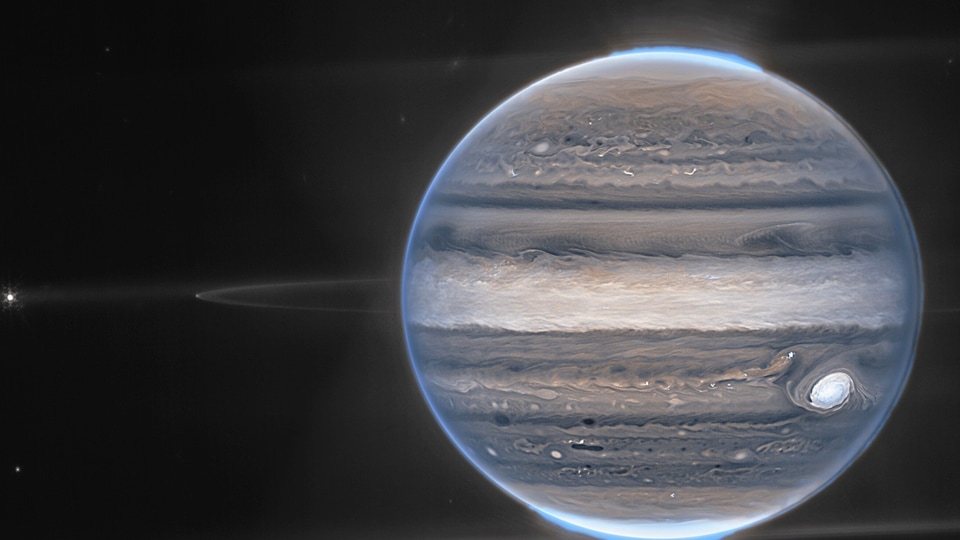
In a statement, planetary astronomer Imke de Pater, professor emerita of the University of California, Berkeley, further shared: “We hadn’t really expected it to be this good, to be honest. It’s really remarkable that we can see details on Jupiter together with its rings, tiny satellites, and even galaxies in one image.”
"Make way for the king of the solar system!" read a post on Twitter account of NASA Webb Telescope, which prides itself in being the world's most powerful space telescope. "New Webb images of Jupiter highlight the planet's features, including its turbulent Great Red Spot (shown in white here), in amazing detail. These images were processed by citizen scientist Judy Schmidt," it further added. What's special about The Great Red Spot? It is a famous storm, according to space agency, so big it could swallow Earth. It appears white in these views, "as do other clouds, because they are reflecting a lot of sunlight," the statement underlines.
Interestingly, Schmidt has no formal educational background in astronomy. 10 years back, a contest by the European Space Agency had sparked her passion for image processing.
Further shedding light on the two photographs, NASA shared that the two images "come from the observatory’s Near-Infrared Camera (NIRCam)." The camera is said to have three specialised infrared filters that showcase details of the planet. "Since infrared light is invisible to the human eye, the light has been mapped onto the visible spectrum," it adds.
Experts are already at work to process new details about the solar system's largest planet.


