
 E-Paper



'For years I've craved to sleep under open skies; I'm doing that': Vinesh Phogat
Vinesh Phogat on the big fight and what it takes to stand up to the establishment


It's another hot afternoon in the capital with temperatures touching mid-30s. The ground throbs each time a metro train passes underneath even as protests of all sorts -- from pending MNREGA dues to the proposed privatisation of Delhi Metro -- rage at Jantar Mantar. Breathless TV reporters thurst their mics on anyone who is willing to speak. Politicians arrive in hordes, pose for pictures, speak with rehearsed rage. From a distance, it appears a dystopian milieu, a microcosm of disparate worlds cobbled together on a 100m stretch. At the centre of it is the 5'3" frame of India's most decorated female wrestler and one of the most sought-after faces of the protest.
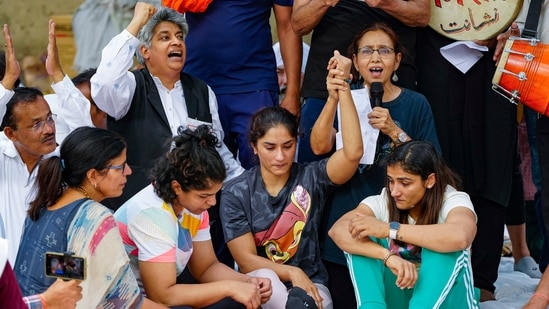
Years of staying in the limelight has meant that the sight of flashbulbs and TV crew doesn't intimidate Vinesh Phogat anymore. She breezes through one interview after another with easy elegance and rustic charm, repeating her stance and retaining her poise. She poses for pictures with kids who casually walk into the protest site to get clicked with their hero, obliges random selfie seekers, and when the mood hits her, tears into the senior SAI official that the ministry sends to negotiate.
"By God, my head is spinning," she says as dusk descends on another hectic day of protest. "But it is a small price to pay for what I believe is the fight for justice and respect."
Her gall to call out Brij Bhushan Sharan Singh -- Wrestling Federation of India (WFI) president and a six-time Member of Parliament from UP's Kaiserganj -- is astonishing. Singh is, what they call in UP's badlands, a 'bahubali' (strongman) politician. With limitless money and muscle at his disposal and a slew of criminal cases against his name, it takes special courage to even consider taking him down. There is, for starters, an imminent possibility of a career being ended on a whim. There's also a genuine threat to life -- Vinesh has, over the past few days, repeatedly spoken about feeling threatened by the sight of unknown men keeping a watch on her house in Sonepat.
"Courage is not born one day. It is something you get from your family. I was raised to be this way. This is who I am," she says.
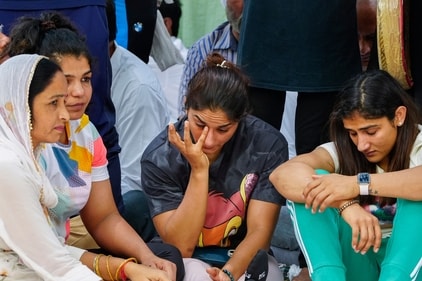
Vinesh credits her parents -- father Rajpal Phogat and mother Premlata -- to instil two values that she believes form the core of her being. "I learnt empathy from my father and courage from my mother. That is what has shaped my life. My father was a Haryana Roadways employee. We came from a lower-income group with little means. On days when my father had enough money to buy fruits for us and if he saw a beggar on the street, he would give away the fruits. He taught me to think about the lesser fortunate," she recalled.
Phogat senior was murdered due to a family enmity in 2004 when Vinesh was barely 10. The responsibility to raise three kids -- Vinesh is the youngest sibling -- fell on Premlata who decided to let her children follow their dreams.
"You asked me where I draw my courage from? It's a deep yet simple question at the same time. My mother, through her actions and sometimes through her words, has taught me what courage means. She was still only 32-33 when she was widowed. There were men around who thought a young widow was a loose woman. Our society is still full of such disgusting people."
"As we grew up, I developed a very strong bond with my mother. Very early in my life, she told me the difference between a good touch and a bad touch. She told me what it means when a man looks at you a certain way. We were so hopeless as a society that she told me not to smile on the road because random boys might feel I am interested. When you come from such a society, either you try to be evasive and get along or you decide to speak up."
Vinesh did decide to speak up early. Her earliest memory of putting across her point dates back around 20 years when she fronted up to her school teacher who had punished her for falling asleep in the class.
"I must be in Class 4 or 5. I would go to the mud pits early in the morning to train before heading to school. Once, I simply nodded off in class. After the teacher had punished me, I asked him, 'Sir, do you even know or did you bother to check why I fell asleep? Do you know how hard I train every morning because I want to build a life for myself?"
From that innocuous afternoon in Balali to the high noon of the wrestlers' protest in the heart of the capital, Vinesh insists that little has changed in the way she looks at life. As her stature grew among the wrestling fraternity, she became the voice of young girls within the federation, something that Singh didn't approve of.
"It's not just the current issue. Vinesh has spoken for the wrestlers on all kinds of issues, from travel, training, trials, competitions, coaches...The federation always thought of her as a problem. From threatening to cut her training and exposure trips to ruining her career to blatant intimidation, they have tried everything," Somveer Rathee, Vinesh's husband and a former Greco-Roman national champion, said.
"She is a woman of rare courage. People call her 'muhfat' (blunt), but we take immense pride in that trait. We need more 'muhfat' ladies in our society," added Rathee.
Vinesh scoffs at the compliment, but after a considered pause, credits her mother for teaching her to say things as she sees them. "I have seen her argue for us. When I decided to pursue wrestling, she was my biggest support. She fought the barbs and prejudices and as a kid, I just picked those traits."
"It is more than a mother-daughter relationship, it is a bond of two grown-up, strong women. She understands what I say and what I don't. Right from the first few instances (of sexual harassment) that I came to know, I have shared everything with her." Except, of course, the decision to go on a sit-in. "As much as she wants me to fight the good fight, she would have tried her best to dissuade me from taking this step. Any mother would, especially when you are fighting the might of Brij Bhusan. She came to know of this when she switched on the TV. When we spoke, she wished me luck and told me how brave I was."
The road from the podium to the pavement has been rocky, but Vinesh is traversing it with little trouble. The only thing she misses during the sit-in is her training. "It is the best stress buster; any athlete will tell you that," she says. In the stillness of the night when the crowds and camera retreat and Vinesh is left in the company of her conscience, she is often left grappling with multitudes of thoughts.
"Of course, I think where this fight will take us. I think of the next competition. I think of home too."
"And as far sleeping on the pavement is concerned, it doesn't affect me one bit. I have seen worse, and I have stayed in the best hotels in the best cities. For years, I have craved to sleep under open skies and look at the stars. Well, it is happening now. I fall asleep while gazing at the stars, I wake up to the song of birds. What regrets can I possibly have?" she says.


