
 E-Paper



From OGs PT Usha, Shiny, Vandana Rao to Gen Zs Vithya, Kiran Pahal: India’s women quarter-milers Asia’s track queens
This generation could run towards Asian supremacy after Shiny’s generation walked, and built the foundation of a solid legacy for Indian quarter-milers.

 Prefer HTon Google


When Vithya Ramraj charged to the dazzling anchor leg run that kept even a sizzling Salwa Eid Naser at bay in the women’s 4x400m relay final in Nagoya, a sexagenarian sitting in front of a TV screen in Kerala on Tuesday night felt like she was running once again.
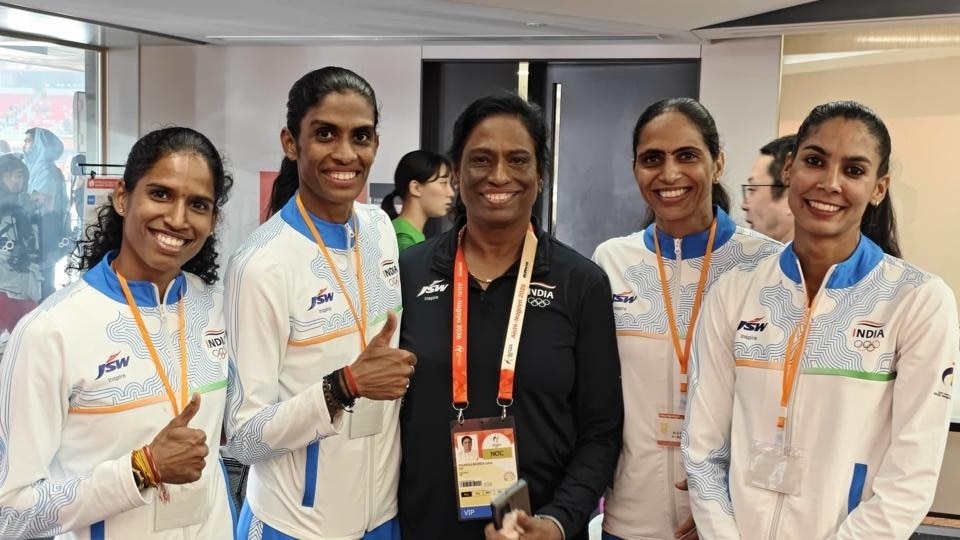
“I was so thrilled. When she was running in that last stretch, I thought I was running again, like the old times,” Shiny Abraham Wilson told HT on Wednesday morning.
Shiny was one of the OGs, as Gen Z calls it now. From the famed golden quartet that scripted Indian athletics’ only top finish at the 2026 Asian Games, two are Gen Zs: Vithya and Kiran Pahal. Prachi Choudhary is 29 and MR Poovamma, the oldest, is 36.
Deep Dive

This generation could run towards Asian supremacy after Shiny’s generation walked. And not just walked, but built the foundation of a solid legacy for Indian quarter-milers that stood tall for years, dipped a touch, and resurrected its hold at the continental stage.
PT Usha, Shiny, Vandana Rao and MD Valsamma were the trendsetters who won India’s first Asian Games gold medal in the women’s 4x400m relay in the 1986 Seoul edition. Four decades later, after five more top-of-the-pile finishes from the 2002 to 2018 Asian Games, the fabulous four of 2026 brought back the gold after the Hangzhou silver three years ago.
“We were the leading country in this event, and these girls have done a fantastic job of putting India back up there,” Shiny, now 61, said over the phone.
It’s symbolic, and almost fitting, that Indian women delivered two creditable individual medals from one-lap races (Vithya 400m hurdles bronze and Prachi 400m bronze) at the Nagoya City Mizuho Park Athletic Stadium in the presence of PT Usha. India’s legendary sprinter and current Indian Olympic Association (IOA) president could gleam with pride when Vithya broke her 42-year-old 400m hurdles national record.
Also Read | Asian Games 2026: Full medal tally, India’s medal winners and complete list of medals
“... There is no greater reward for an athlete than to see the next generation go beyond the boundaries we once set,” Usha posted on X when Vithya broke the record.
On the women’s relay gold, the Indian track legend had this to say: “Watching our incredible 4x400m women’s relay team storm to a Gold medal finish brought back a flood of memories. I could feel every single stride, every heartbeat, and every ounce of grit out there on the track. Decades ago, we ran to show the world what Indian women could do. Today, these champions ran to rule the world. To see them standing on top of the podium, hearing our national anthem resonate through the stadium — there is no greater emotion for an athlete.”
And there was no greater woman trailblazer on the track than Usha, who fell 0.01 seconds short of a podium finish at the 1984 Los Angeles Olympics in the 400m hurdles clocking 55.42 seconds, a national record that stood until Vithya broke it on Monday. Two years later, Usha made the 1986 Seoul Asian Games her very own, bagging a hat-trick of individual titles in the 200m, 400m and 400m hurdles. Usha, Shiny, Vandana and Valsamma combined to end Japan’s reign in the women’s 4x400m relay since the event was introduced in the Asian Games in 1974.
The quartet not just broke a nation’s monopoly, but also the Games record. Their timing of 3:34.58 pipped Japan (3:39.77), who had beaten India for gold in the previous 1982 Games in New Delhi, and China (3:41.59).
“I remember we had a huge lead for first place, and were about 30-40 metres ahead at the finish line,” recalled Shiny, who also won the 400m silver in Seoul. “That medal, and the timing, underlined our status as the best in Asia at that time.”
That status had its early writing at the 1985 Asian Championships in Jakarta, where India took the gold, beating Japan again.
“Hard work, a lot of hard work,” said Shiny, rather simply, when asked what went behind making the Indian female quarter-milers so good back then.
“In the previous year itself (1985), we were breaking national records. Athletes like Usha and I were reaching world-class level then. And we could sense that we are creating a bit of a gap between us and the rest of the Asian nations.”
That gap bridged over the next three Asian Games editions, with China beating India for gold in 1990, 1994 and 1998. And it widened again over the next five.
India’s women quarter-milers set the pace and won consecutive gold medals through the 2002 Busan and 2018 Jakarta and Palembang games. Poovamma was part of the 2014 and 2018 packs – also featuring the likes of Tintu Luka and Hima Das – that brought home the gold.
Bahrain was a rising threat in the event, and leapt to gold while pushing India to silver in Hangzhou. Prachi and Vithya were two from the current lot who returned with the feeling of coming second-best in Hangzhou. Three years on, that feeling kept them motivated, as did the fact that no Indian track and field athlete had won gold in Japan heading into the final day of events.
“Everybody has been saying that there was no gold medal in athletics, so we were motivated to win the gold for the country,” Prachi was quoted as saying by PTI in Nagoya. “I was part of the relay team when we got silver the last time. At that time, we thought that we will win a gold medal in the Asian Games the next time.”
When that time came, in the final few seconds that mattered, Salwa threatened to make the near-impossible possible again with her anchor leg burst. Kiran, Poovamma, Prachi and Vithya collectively ensured that one of India’s strongest legacies in track and field in Asia was back to where it belonged.
“I am so, so happy that we have won the gold again,” said Shiny.


