
 E-Paper



Volodar Murzin: Former world rapid champion, still waiting to arrive
The Russian spokeabout playing on the Prodigy board at GCL, his hopes of switching federations, and growing up in the shadow of an abusive father

 Prefer HTon Google


There is perhaps something a bit strange about already having become a world champion and still being treated like a boy who might one day arrive.
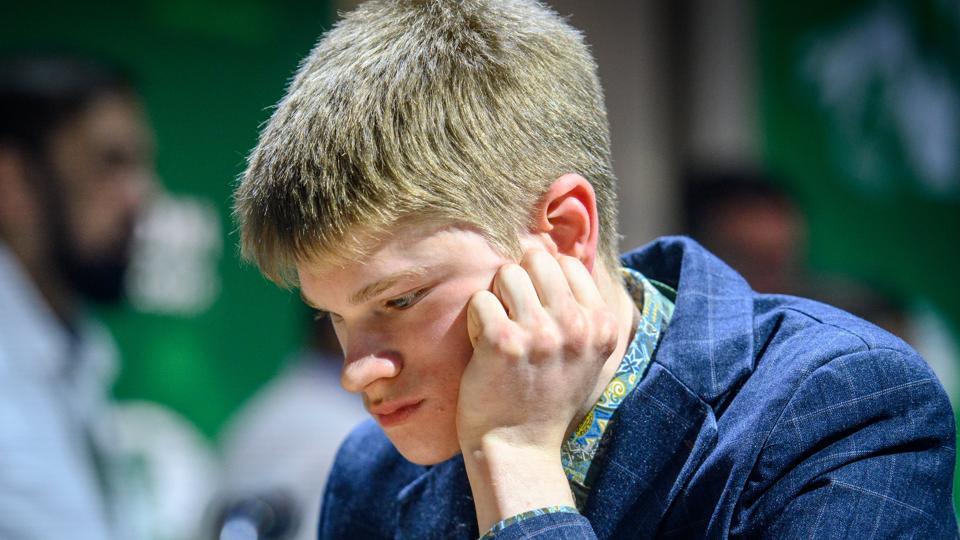
Volodar Murzin knows the feeling. He won the World Rapid Championship in 2024, ahead of top players like Fabiano Caruana, Hikaru Nakamura and Jan-Krzysztof Duda. At 18, he was the second youngest to do so. The title brought invitations, confidence and the comforting knowledge that stronger players could no longer intimidate him quite so easily. “I started to trust myself more.”
The boy-who-might-one-day-arrive label though remains. It’s his third successive year at the Tech Mahindra Global Chess League on the Prodigy board. He’s with the Alpine APL Pipers side, which has Magnus Carlsen as its Icon player.
Perhaps ratings are partly to blame. Murzin is around 2650 in classical chess, not yet among the game’s elite, and he knows what that means in a chess world increasingly crowded with teenagers who arrive with extraordinary ratings attached to their names.
“I’m not worse than those on the Superstars team (in the GCL) because I have higher ratings than some of them,” he says, smiling. “I hope it will change soon.”
There is no angst in the way he says it. His targets are straightforward, even if not easy—2700, the top 10, eventually the classical World Championship.
He is dealing with more pressing challenges, however, like not being able to get visa clearance or play many tournaments, since his Russian nationality is an obstacle.
“I want to change my federation. I have no contact with the Russian federation and receive no support from them.” He has reached out to other national federations, he says. “Right now, I can’t play Bundesliga. Some other tournaments too. If I change federation, I can play more tournaments in Europe.”
Murzin grew up in the shadow of an abusive father. Chess was both a gift and a torment. His father called it the “devil’s game” and stopped him from travelling to tournaments for two years. “I lost lot of time. It was huge damage.”
This was around the time he was chasing his third and final grandmaster norm. He occasionally searches for the right English words to convey his thoughts, and the memories arrive in staccato phrases. It makes what he endured feel like a punch to the gut.
Also Read: LIV Golf bankruptcy filing: Which top golfers are owed? Will the league return?
“I remember sitting at the computer and playing. He made me play. Till four. Sometimes five. I was tired. Very tired. I had school in a few hours. He was angry, wanted to punish me.”
Assault was the norm in the household. Murzin and his four sisters would have raw eggs smashed on their heads by their father. If he objected, his head could be slammed against the wall. His father once hit his older sister with a shovel.
Chess arrived as a saviour when he was 11. His victory in the U-12 European Youth Championship led to an invitation from Sergey Nesterov’s Prof Chess Club in Khimki. His mother, Ekaterina, saw this as an opportunity to save her children. She left their home in Nizhny Tagil and took him and his sisters along, travelling more than 1,700 km to Khimki.
Abusive fathers, Murzin says, aren’t uncommon in Russia. “I know friends who have gone through similar experiences. But they don’t tell anyone since they feel it won’t change anything. They still live with their fathers.”
“But my mother ran away,” he says in appreciation of her courage. “I want to forget that he exists in my life. I want to remove him formally as my father. I don’t think it can be done in Russia. We are free now. But I don’t know what troubles he can cause us in the future.”


