E-Paper



Will West Bengal’s real Trinamool please stand up?
The existential crisis in the Trinamool Congress (TMC) — till recently the third-largest Opposition force in Parliament — is at once familiar and unprecedented

 Prefer HTon Google


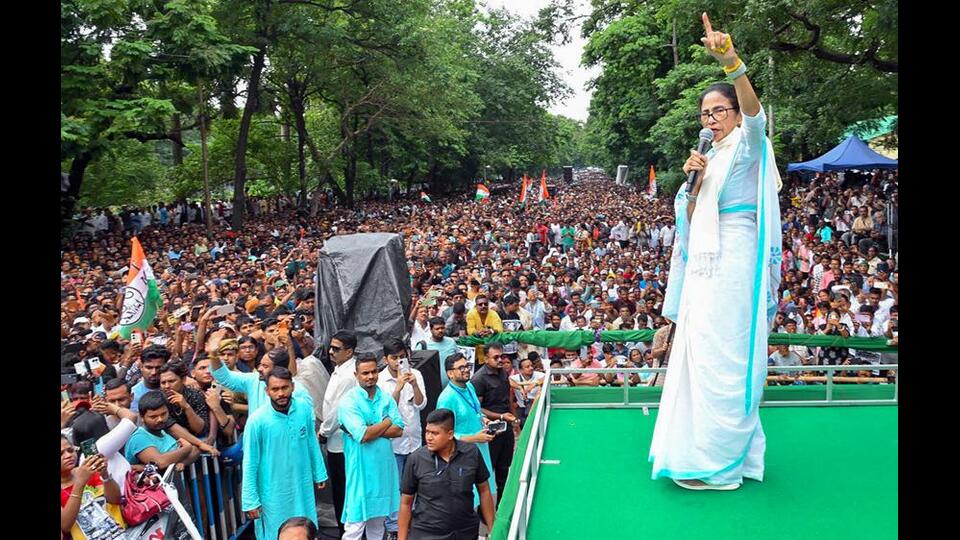
Only a very naïve observer of Indian politics will believe that a first-time turncoat MLA is independently leading a rebellion that has stripped one of India’s tallest regional politicians of the party she founded nearly three decades ago and the election symbol she once famously sketched to announce her break from the Congress. The existential crisis in the Trinamool Congress (TMC) — till six months ago the third-largest Opposition force in Parliament — is at once familiar and unprecedented. Other Opposition parties have haemorrhaged support after a string of losses, and shrunk into shadows of their former selves, but the TMC’s poly-crisis is farcical on a whole new level. A majority of its Lok Sabha members overnight joined a nondescript party that didn’t net even 1,000 votes in the only election it ever fought — only for one lawmaker to claim that this little-known outfit was merely a pitstop on the way to the Bharatiya Janata Party (BJP). Meanwhile, a majority of its assembly legislators rebelled against party general secretary Abhishek Banerjee, but not quite against the party, and elected a separate leader who is now recognised as the leader of the Opposition in the assembly. And in the Rajya Sabha, some TMC members have resigned, been promptly renominated by the BJP, and returned to the Upper House. All this is happening after an assembly election whose victor explicitly declared that no defector would be admitted or allowed to whitewash their sins. The cordial relations between the new government and the various shades of TMC rebels suggest that the commitment is being honoured largely in the breach.
There are two related but independent questions here: one about the law and the position of institutions in an electoral democracy, the other about the toxic political economy of Bengal. At the heart of dubious political manoeuvres that have blighted our democracy in recent years lies a single question: What is the real political party when there is a defection or a split, and who gets to claim the original name and symbol? The lack of clarity on these questions has transformed the electoral maps of Maharashtra and West Bengal.
Under paragraph 15 of the Election Symbols (Reservation and Allotment) Order, 1968, the Election Commission of India(ECI) applies a triple test to decide whichfaction of a party deserves the name and symbol: whether a faction has violated the party’s aims and objectives, whether it has adhered to the party’s constitution, and which faction commands a majority of the party’s elected legislators and organisational wing. In both the Sena and NCP cases, the third test proved decisive.
But the first two tests are subjective, and for the third, it is unclear what settled procedure ECI uses to determine organisational majority. Moreover, the order predates the controversial Tenth Schedule of the Constitution, which curbs political defections and sets out only a narrow path for rebelling lawmakers to escape disqualification. Legal experts have noted that inherent tensions between the symbols order and the Tenth Schedule remain unresolved. In the Sena, NCP, and TMC cases, for example, disqualification petitions against rebel lawmakers were pending before assembly speakers even as ECI proceeded to determine which faction was the real inheritor. With no clear sequence or priority between the two processes, chaos is inevitable. What if one faction wins at ECI and is then disqualified? Can disqualification petitions even stand once a rebel faction is adjudicated the real party? That ECI orders and speakers’ decisions have largely aligned suggests that far too much discretionary power has been handed to speakers or chairpersons of Houses, who are ultimately political functionaries — not to mention that it structurally disadvantages Opposition parties fighting internal rebellions. The TMC’s case might add a further absurd layer, with the possibility of separate proceedings in Parliament and the assembly over the same party.
The Supreme Court’s landmark 2023 Shiv Sena decision complicated matters further when it junked the first test, and said it was not necessary for ECI “to rely on the test of majority in the legislature alone”, even arguing that in the Sena case, it was “futile to assess which group enjoys a majority in the legislature”. Clearly, in addition to the Nabam Rebia questions already referred to a larger bench, the court must clear the air on these conundrums sooner rather than later. Last month, a bench comprising Chief Justice of India Surya Kant and justices Joymalya Bagchi and V Mohana observed that there must be clearly defined criteria to determine the majority in a political party when rival factions stake claim. The court must consider framing such guidelines at the earliest. Parties are meant to be born and die on electoral battlefields. A Sena without a Thackeray, an NCP without Sharad Pawar, or a TMC without Mamata Banerjee are legitimate eventualities. But the instrument of their political demise must be popular will.
Unfortunately, reasonable political consensus is elusive. As with the Tenth Schedule — which has instrumentalised perverse incentives for defection rather than checked them — every party believes it will grab power soon, and so stands to benefit from chaos and opacity. This is why many parties continue to be run as personal fiefs, with effete internal democracy and rubber-stamp constitutions.
Such an eventuality is particularly stark in Bengal, where the Opposition space has been aggressively obliterated over the past 30 years. Political violence and the casual deployment of every lever of government to arm-twist the Opposition have seeped into the state’s political fabric. The party now crying victim was accused of large-scale violence in local body polls to intimidate Opposition candidates into withdrawing and then grabbing one nondescript municipality in Purulia amid two suspicious deaths. It boasted about turning a parliamentary constituency in south Bengal virtually Opposition-free. Today, a high-profile bypoll might effectively go uncontested because one candidate was persuaded to withdraw and another was arrested by the police in a 20-year-old case — ironically linked to an agitation that made the careers of both Mamata Banerjee and Suvendu Adhikari — hours after receiving the former’s support. With only days to go for campaigning to close, the second candidate finally secured bail on Tuesday. Grassroots strongmen have changed their colours, college governing panel chairs have changed hands, as have heads of Durga Puja committees.
A new, popular chief minister appears determined to stamp out a bitter rival. History is depressingly repeating itself in Bengal.
The views expressed are personal