
 E-Paper



ISRO, Indian Navy advance to phase 2 of Gaganyaan Crew Module Recovery trials
ISRO and Indian Navy have begun second phase of recovery trial operations for India's Gaganyaan mission, simulating recovery procedures for the crew module.

 Prefer HTon Google


The Indian Space Research Organisation (ISRO) and the Indian Navy have entered the second phase of the Gaganyaan mission's crew module recovery trial operations. Harbour trials were carried out on Thursday at the Naval Dockyard, Visakhapatnam, using a Crew Module Mockup (CMRM) to simulate mass and shape conditions accurately.
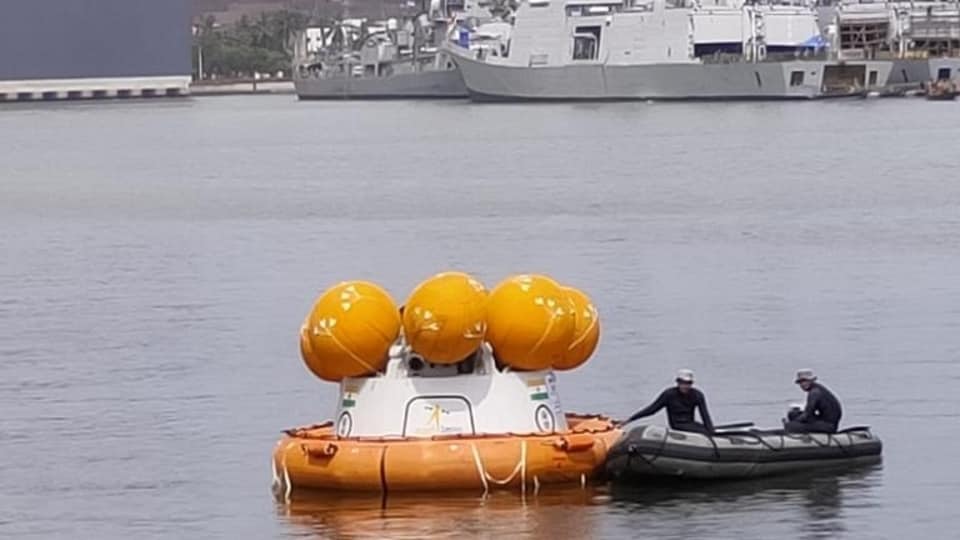
"The trials were conducted at the Eastern Naval Command in Visakhapatnam, using a mass and shape simulated Crew Module Mockup (CMRM). This mockup was a crucial component in the testing process, ensuring that the recovery procedures accurately simulated conditions," the Indian space agency said in a statement.
Gaganyaan is India's ambitious project aimed at demonstrating human spaceflight capability. The mission plans to launch a three-member crew into a 400km orbit for a three-day mission and safely bring them back to Earth, landing in the Indian sea waters.
During the recent trials, various recovery stages were simulated, including the attachment of the recovery buoy, towing, handling, and lifting of the crew module onto the ship deck. These procedures followed the recovery sequence, showcasing the teams' preparedness, ISRO said.
The statement released by ISRO also added that the fine-tuning of Standard Operating Procedures (SOPs) based on experiences from phase-1 trials at the Water Survival Training Facility (WSTF) in Kochi was undertaken to ensure a seamless and safe recovery process
Earlier on Wednesday, ISRO successfully conducted the Gaganyaan Service Module Propulsion System (SMPS) test at IPRC, Mahendragiri. This involved five liquid apogee motor (LAM) engines and sixteen reaction control system (RCS) thrusters, providing thrust for various orbital manoeuvres and abort scenarios during the ascent phase.
There are three missions under Gaganyaan before the manned mission happens. The first mission will be unmanned, the second one would carry a robot on board and, finally, there will be the manned mission. The mission is expected to begin at the end of 2024.
After the successful launch of the Chandrayaan-3 mission, all eyes are set on the soft landing attempt scheduled for August 23. The third lunar exploration will provide valuable input also for the Gaganyaan mission.


