E-Paper



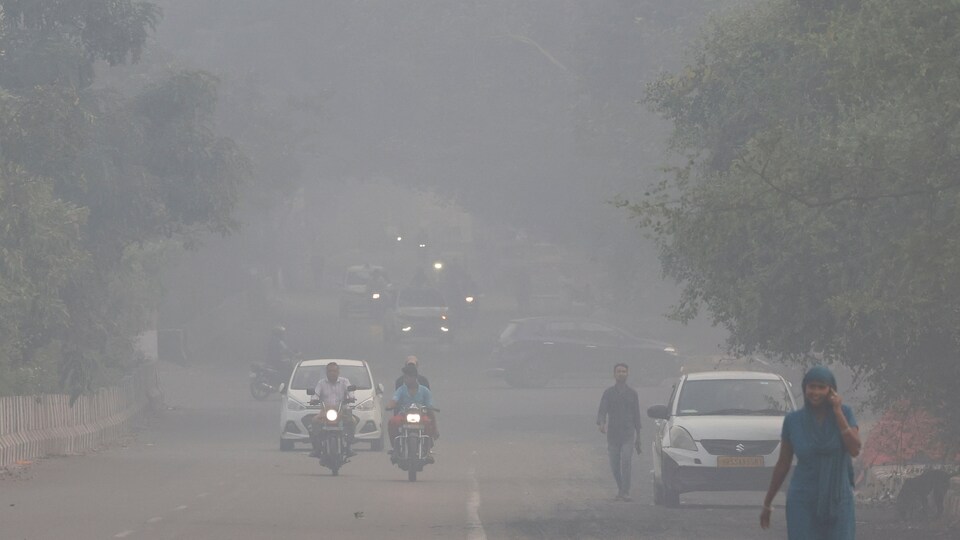
Delhi chokes under thick post-Diwali smog as citizens say ‘we’re gasping, not living’
Citizens in Delhi shared their frustration on social media as thick smog covered the city following Diwali celebrations and firecracker use.

 Prefer HTon Google


Delhi woke up to a blanket of smog on Tuesday morning, a day after residents across the National Capital Region (NCR) celebrated Diwali with firecrackers. The pollution levels spiked sharply, with thirty-four of the city’s thirty-seven monitoring stations recording air quality in the ‘red zone’, indicating ‘very poor’ to ‘severe’ conditions. A video shared by news agency PTI captured hazy visuals of India Gate and Kartavya Path, depicting the worsening visibility across central Delhi.
(Also read: Employee shares office Diwali gift options, internet reacts: 'You guys are getting gifts')
Watch the clip here:
Citizens react on social media
As the city choked under smog, social media users took to X to express their concern and frustration. One user wrote, “Delhi’s smog-filled sky tonight, October 20, 2025. The haze blankets the city, with lights struggling to shine through.” Another commented, “Clean air isn’t a privilege, it’s policy. Yet, India chokes on inaction yearly.” A third user remarked, “Delhi’s air isn’t fog—it’s smog. AQI beyond limits. We’re gasping, not living.”
The outpouring of reactions continued, with one user writing, “My throat is choked. My throat is seriously burning.” Another added, “Delhi’s AQI exceeds 1000 in some areas, surpassing the maximum limit. I can literally feel the smog in my eyes and throat. But who cares?”
Check out the posts here:
AQI levels hit ‘very poor’ and ‘severe’ marks
According to the Central Pollution Control Board (CPCB), Delhi’s overall Air Quality Index (AQI) at 6:05 am stood at 347, categorised as ‘very poor’. The 24-hour average AQI, recorded at 4 pm on Monday, stood at 345. The CPCB defines AQI between 301 and 400 as ‘very poor’ and 401 to 500 as ‘severe’.
As per the SAMEER app, three monitoring stations—Bawana (418), Jahangirpuri (404), and Wazirpur (408)—recorded AQI levels above 400, marking ‘severe’ air quality. In contrast, a few areas such as DTU (242), IGI Airport - T3 (294), and Sri Aurobindo Marg (209) remained in the ‘poor’ category.
NCR regions also suffocate under smog
Neighbouring cities mirrored the same grim picture. Noida recorded an AQI of 324, while Ghaziabad stood at 326, both falling in the ‘very poor’ category. The Commission for Air Quality Management (CAQM) had already enforced Stage II of the Graded Response Action Plan (GRAP) across Delhi-NCR on Sunday.
Earlier, on October 15, the Supreme Court had permitted the sale and use of green firecrackers between specific hours during Diwali. However, the aftermath of the festival has once again pushed Delhi and its surrounding regions to the brink of hazardous air conditions.