E-Paper



Rahul Gandhi banks on youth outreach in Congress’s former bastion Prayagraj
Political observers believe the issues raised in Prayagraj could resonate well beyond the city, particularly among the youth in eastern Uttar Pradesh

 Prefer HTon Google


Ahead of the 2027 Uttar Pradesh assembly elections, Leader of Opposition in the Lok Sabha Rahul Gandhi’s decision to hold the ‘Chhatron Ki Goonj’ programme in Prayagraj is being seen as a concerted attempt by the Congress to reconnect with students and young voters while seeking to regain lost political ground in the state.
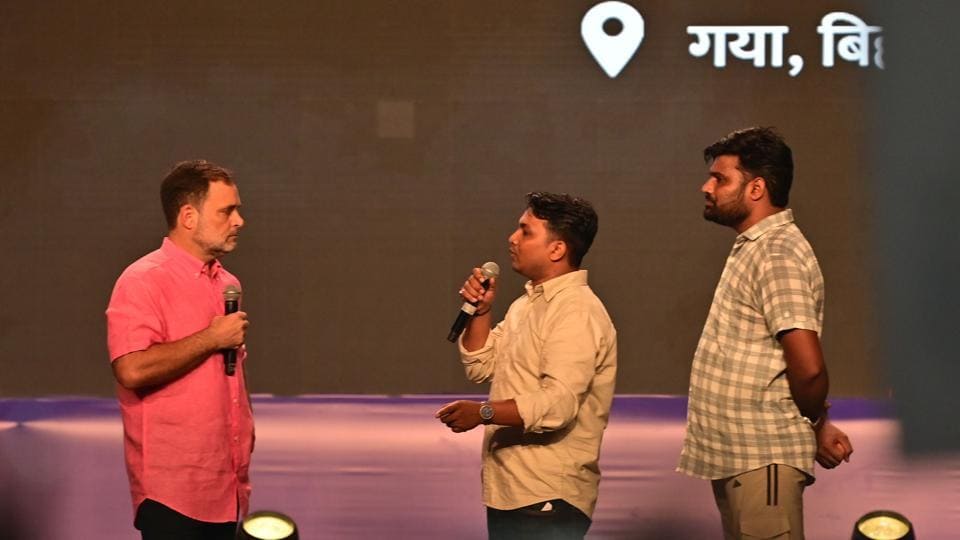
The choice of Prayagraj is significant. The city, formerly known as Allahabad, has been a stronghold of the Congress since the pre-Independence era and has produced several prominent leaders of the party. At the same time, it is one of the biggest hubs for competitive examination aspirants in Uttar Pradesh. Students from across Purvanchal and other parts of the state come here to prepare for government jobs and other competitive examinations.
Political observers believe that the issues raised in Prayagraj could therefore resonate well beyond the city, particularly among the youth in eastern Uttar Pradesh.
The event venue (KP College ground) falls under the Allahabad parliamentary constituency, where Congress candidate Ujjwal Raman Singh won in 2024, helping the party reclaim it after 40 years. The adjacent Phulpur seat in Prayagraj district is with Praveen Patel of the BJP.
During Saturday’s programme, Gandhi focused on issues such as alleged benefits being extended to select business groups, privatisation of public sector companies, paper leaks and shrinking employment opportunities. His emphasis on these issues appeared aimed at tapping into concerns that have featured prominently in recent youth-led and Gen-Z protests.
The Congress is likely to seek to turn this youth outreach into a sustained political campaign ahead of the 2027 assembly elections, with an eye on rebuilding its organisational and electoral base in Uttar Pradesh, claim political analysts.
Prayagraj has also been a traditional political battleground for mobilising young voters. In 2014, when Narendra Modi was projected as the BJP’s prime ministerial candidate, he addressed a large rally at Parade Ground on May 4 and made a direct appeal to young voters. Urging them to think about their age and future, Modi had said that while five wasted years may not matter much to a 75-year-old, the loss of five years between the ages of 18 and 28 could affect an entire lifetime.
Gandhi’s Saturday outreach, political observers said, reflected a similar attempt to place youth concerns at the centre of the political narrative, though with a different set of issues and political messaging.
Prof MP Dubey, a former political science teacher at Allahabad University and former vice-chancellor of Uttar Pradesh Rajarshi Tandon Open University, said Prayagraj attracts young people from across Purvanchal who come to the city to prepare for competitive examinations and build their careers.
“Prayagraj has historically been a Congress stronghold and remains an important centre for young people from across eastern Uttar Pradesh. This is why choosing the city for the Congress campaign is significant,” he said.
Dubey said young people today also act as influencers whose views can travel from cities to villages and small towns through social media and personal networks. The Congress initiative, he said, could therefore be viewed as an attempt to reclaim some of the political space it has lost in Uttar Pradesh.
Arpana Chaudhary, assistant professor in the political science department of Allahabad University, said political parties could not afford to rely solely on social media-driven campaigns.
“Facebook and reels cannot divert voters from real electoral issues. People are concerned about what is changing on the ground and how seriously political leaders are addressing their problems,” she said.
The challenge for the Congress, however, will be to convert the concerns expressed by students into sustained political engagement and, eventually, electoral support. If the party succeeds in keeping its youth outreach alive until 2027, the impact could extend beyond the assembly polls and shape its strategy for the 2029 Lok Sabha elections as well, analysts maintain.