
 E-Paper



Worst outbreak in two years in China, Germany hit
The lockdown of Jilin province comes a day after China placed 17.5 million residents of the southern city of Shenzhen, a technology and business hub, in a lockdown for at least a week over a rise in cases.

 Prefer HTon Google


China on Monday sealed off the northeastern province of Jilin with over 24 million people following a sharp rise in Covid-19 cases, the first time an entire province has been cut off since the unprecedented lockdown of the central province of Hubei and its capital, Wuhan, in 2020, where the virus was first detected in late 2019.
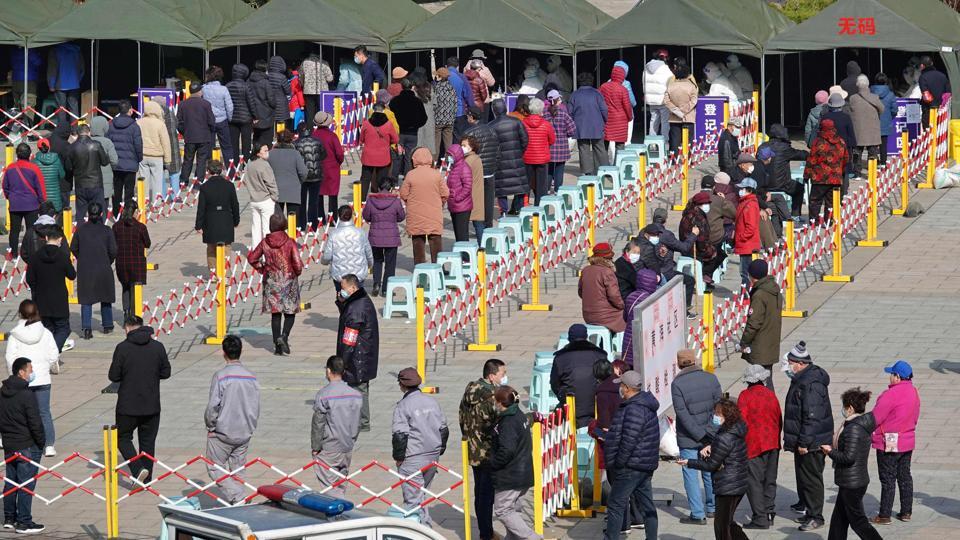
The lockdown of Jilin province comes a day after China placed 17.5 million residents of the southern city of Shenzhen, a technology and business hub, in a lockdown for at least a week over a rise in cases.
China’s authorities are scrambling to control a country-wide surge in cases with mass tests, lockdowns and travel restrictions with new infections being reported from Shanghai in the east to Shenzhen in the south besides clusters in Beijing and in populous provinces like Zhejiang.
Mainland China reported 1,337 new domestically transmitted Covid cases on March 13, the national health commission (NHC) said on Monday.

Overall, 2125 cases including asymptomatic ones were reported on Monday for Sunday.
That brought the total this year to more than 9,000, compared with 8378 in 2021, according to Reuters calculations.
People in Jilin province, which borders Russia and North Korea, have been asked not to leave or travel, particularly those in the provincial capital of Changchun and the eponymous city of Jilin.
Jilin province reported 895 locally transmitted Covid-19 cases, and 131 asymptomatic carriers on Sunday.
Of the newly confirmed infections, 453 were reported in the city of Jilin, and 430 were reported in the provincial capital Changchun, a city of over nine million people already undergoing a lockdown.
Local authorities have conducted multiple rounds of mass nucleic acid testing and built makeshift hospitals to contain the latest outbreak, official news agency Xinhua reported.
China has followed a strict “zero-Covid” policy, which has lately been tweaked to “dynamic zero” policy, which essentially aims to stamp out outbreaks and chains of transmission through mass testing, tracing contacts, quarantine and lockdowns.
The fast spreading Omicron variety, however, has put a question mark on China’s existing anti-Covid policies.
The city of Shanghai, for example, is experiencing a serious outbreak, the worst since 2020.
“Shanghai has suspended long-distance bus services, shut down entertainment venues, and placed hundreds of residential compounds, university campuses, and office buildings on lockdown as the city grapples with its most serious Covid-19 outbreak since the pandemic started two years ago,” the Sixth Tone website reported on Monday.
It has logged over 700 infections - 89% of them asymptomatic - since the first case in the current wave was detected on March 1.
The total number of confirmed Covid-19 cases reported on the mainland, both local and imported, had risen to 116,902 by Sunday. There were 8,531 patients still under treatment on Sunday, of whom eight were in severe condition. A total of 4636 patients have died of the virus on the mainland since the outbreak of the disease in late 2019.
Germany: Infections surge to record levels
Germany’s coronavirus infection rate hit a record for the third straight day on Monday, with the renewed surge prompting the country’s top health official to issue a grim warning.
Covid-19 cases climbed to 1,543 per 100,000 people over seven days, continuing its steady rise since the beginning of March, according to data from the RKI public-health institute.
The outbreak shows signs of worsening and causing “many deaths”, health minister Karl Lauterbach said on Sunday in a tweet. Daily deaths from the virus are still around 250 to 300 people.
The rising infection numbers are due in part to the spread of the even more infectious BA.2 sub-variant of the Omicron strain, which now accounts for about half the Covid cases in Germany, according to the RKI.
France lifted most Covid-19 restrictions on Monday, ending the need for face masks to be worn in the majority of public places and allowing the unvaccinated back into bars, restaurants and cinemas.
With inputs from agencies


