Donald Trump has beef with India for buying oil from Russia. But the American president’s tariffs totalling 50% on many Indian exports—set to come into force later this month—are not just about geopolitics. Agriculture and dairy have been the most contentious issues in India’s talks with America, which broke down this month. And it is over farming that India’s equally combative prime minister, Narendra Modi, has chosen to fight back. “India will never compromise on the wellbeing of its farmers, dairy and fishermen,” he thundered in Delhi on August 7th, a day after Mr Trump’s announcement.
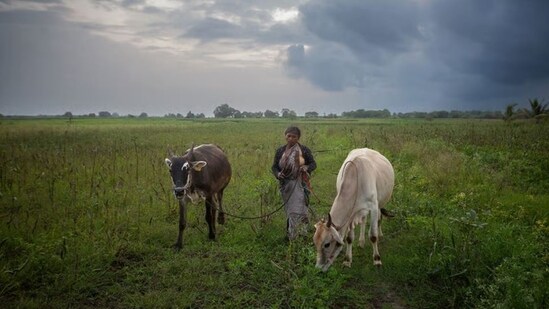
For nearly three decades it has been the world’s biggest producer and is now the source of about a quarter of the global total. (Photograph: Getty Images)
For Hindu-nationalist politicians like Mr Modi, the dairy industry has particular importance (the cow is sacred in Hinduism). But it is also a source of national pride, seen as a poverty-alleviating triumph of enlightened policymaking, technological advance and international co-operation. India is a milk superpower. For nearly three decades it has been the world’s biggest producer and is now the source of about a quarter of the global total. Yet, from the point of view of India’s trading partners, notably America, the industry seems to sum up all that is wrong with India. It is grossly inefficient, subsidised, polluting (all that methane) and heavily protected by high tariff barriers and a perplexing lattice of arcane non-tariff ones.
Can these diametrically opposed views be reconciled? The answer matters a lot to India’s trade diplomacy. It is not just America that complains about access to the Indian market. It is a sticking-point in negotiations with the European Union, too, and was one of the thorniest issues in the negotiations leading to a free-trade agreement with Britain signed last month. It may also have been the main reason why India pulled out of a big regional trade deal in 2019.
Indian dairy still basks in the glow of a “white revolution” launched in 1970. At the time Indians already had more cattle than any other country, but they consumed an average of about 100 millilitres of milk a day, far below recommended nutritional standards. Some of that had to be imported. By the turn of the century India had virtually doubled the availability of milk per person. Dairy practices had been modernised and the cross-breeding of cattle had boosted yields. A network of tens of thousands of co-operatives had been established, improving distribution and logistics, financed by the sale of skimmed milk powder and butter donated by the European Economic Community, the EU’s forebear.
Yields have continued to improve this century, but the structure of the industry remains unchanged. “White Revolution 2.0”, launched by the government last year, aims not to reform but expand it, with co-operatives increasing milk procurement by 50% over five years. Production will still depend on tens of millions of smallholders—families with a cow that grazes on their plot, produces dung and urine to be used as fertiliser, and provides milk for the family, sometimes with a surplus to sell.
Himanshu (who goes by one name), a professor of economics at Jawaharlal Nehru University in Delhi, points out that Mr Modi and Mr Trump are both very “pro-farmer”. But their farmers, including dairy farmers, could hardly be more different. India has about 200m cattle, of which the United States Department of Agriculture estimates 62m are dairy cows. Yet the average “herd” consists of fewer than four, and the average landholding of just one hectare. A number widely used is that 80m families have one or more cows or buffaloes. America has just 24,000 dairy farms, with an average herd size of about 390.
Co-operatives guarantee Indian farmers a buyer for their milk, and pay them bonuses when prices rise. A handful have become big national organisations—notably Amul, from Gujarat, home state of Mr Modi and his powerful cabinet minister, Amit Shah. So vaunted is the success of the agricultural co-operative system that in July Mr Shah unveiled plans to extend it to other businesses such as tourism, taxis and green energy.
Proud as Indians are of their cows and their dairy farmers, they have to admit that both are, by international standards, woefully unproductive. The average American cow produces about seven times as much milk as her Indian competitor. India protects its dairy farmers with import tariffs comparable to those Mr Trump is now imposing on Indian exporters: 40% on most butter and cheese and 60% on powdered milk. Without these protections, says Shashi Kumar, boss of Akshayakalpa, a privately owned organic-dairy business in southern India that works with 2,200 small farmers, “smallholder farms will collapse”.
It is not just tariffs that Mr Trump’s negotiators object to. India excludes imports of all genetically modified crops except cotton, and in dairy there is a ban on what has become known as “non-veg milk”—with a requirement that imported dairy products be certified to come from cows that had not been fed animal products such as bonemeal. The ban is often decried as a non-tariff barrier dressed up in politically correct Hindu-nationalist clothes. Vijay Sardana, a lawyer and agri-economist, points out it was in fact introduced in 2003, when he drafted the law in response to the BSE (mad-cow disease) scare in Europe.
Still, the perception that the Indian government will use any available tactic to protect its farmers is probably justified. Harish Damodaran, the agriculture editor of the Indian Express, a newspaper, points out that twice in four years India’s farmers have fended off attempts at reform. In 2021 their prolonged, angry protests in Delhi forced Mr Modi to repeal three laws introducing sensible deregulatory reforms. Mr Trump’s effort to impose change through diplomacy may prove equally fruitless.
Get the latest headlines from US news and global updates from Pakistan, Nepal, UK, Bangladesh, Russia and US Iran war Live, get all the latest headlines in one place on Hindustan Times.
Home/World News/Cow’s Milk, As Well As Russian Oil, Fuels The US-India Trade War

 E-Paper