
 E-Paper



Harvard student journal censors article criticising Pro-Khalistan movement
It was written by Indian student Zyna Dhillon, who was described as a staff writer and Associate Editor for the Review, though even that bio has now disappeared from its online presence

 Prefer HTon Google


Toronto: The editors of a Harvard University student publication on international affairs have censored a critique of the pro-Khalistan movement and how it has adversely impacted relations between Canada and India.
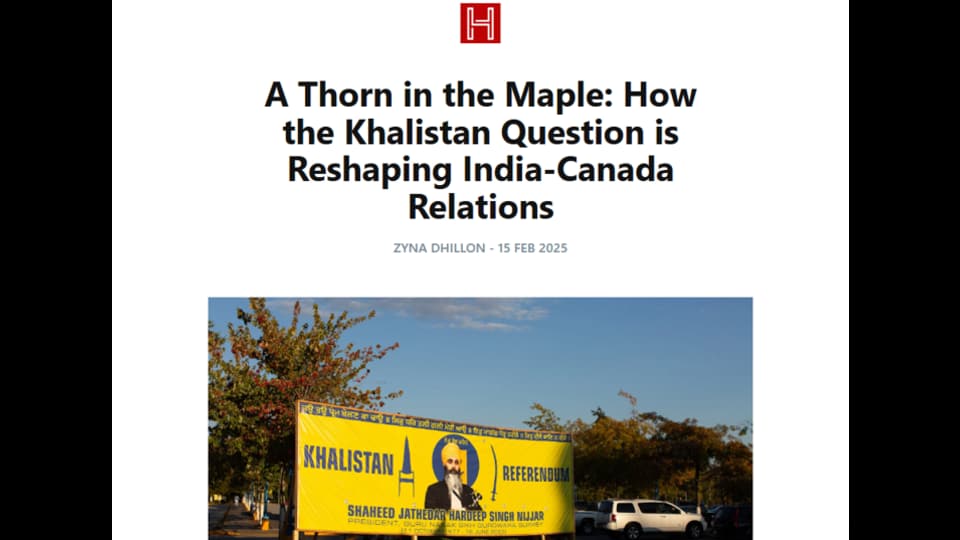
The article, “A Thorn in the Maple: How the Khalistan Question is Reshaping India-Canada Relations” appeared online on the website of the Harvard International Review on February 15. After criticism from several persons, including pro-Khalistan elements, the article was yanked by its editors.
It was written by Indian student Zyna Dhillon, who was described as a staff writer and Associate Editor for the Review, though even that bio has now disappeared from its online presence. Dhillon is from Amritsar in Punjab.
“I think the HIR buckled down under pressure and the decision to remove the article was, in my opinion, a knee-jerk reaction,” Dhillon said, in a statement, according to the student publication Harvard Crimson.
The Crimson reported that a week later she had been asked to “make changes” in the article by HIR’s editors-in-chief after complaints were received, including from Harvard’s Sikh chaplain Harpreet Singh.
The editors said the article had an “opinionated style of journalism rather than the analytical reporting” HIR published. They sought changes including “removing Indian Government statistics on deaths caused by Sikh militants, which they wrote could not be independently verified, and adding a sentence confirming whether Khalistan supporters had harassed Indian diplomats in Canada,” the Crimson reported.
Dhillon refused, and told the Crimson, “They seem to think that me presenting the Khalistan movement in a certain way is a matter of my opinion, rather than what is like the actual situation on the ground.”
The article, a copy of which is with the Hindustan Times, was largely a recap of the pro-Khalistan movement in the context of Canada.
“Far removed from its supposed “homeland,” the Khalistan movement’s distant locus has now placed it at the heart of a diplomatic standoff between India and Canada,” it said.
It noted that the movement “became a violent insurgency” in the 1970s and 1980s. It alluded to the fact that it was responsible for the worst-ever incident of terror in Canadian history, with the bombing of Air India flight 182, the Kanishka, in 1985 claiming 329 lives. It also referred to the violent invasion of the of the Hindu Sabha Mandir in Brampton on November 3 by pro-Khalistan radicals.
“Much of the support for the Khalistan movement today comes from a growing segment of Canada’s Sikh diaspora,” it said, though adding only a “minority” of them backed it. It provided the Canadian and Indian perspectives on the movement.
While India considers it a terrorist movement, Canada often sees such activity though the lens of freedom of expression. Bilateral ties collapsed in 2023, when Canadian Prime Minister Justin Trudeau stated in the House of Commons on September 18 that there were “credible allegations” of a potential link between Indian agents and the killing of pro-Khalistan figure Hardeep Singh Nijjar in Surrey, British Columbia, three months earlier. In October last year, India withdrew six diplomats and officials from Canada after Ottawa asked New Delhi to waive their immunity so they could be interrogated in relation to violent criminal activity in the country. India also expelled six Canadian diplomats.
The article said, “Some also attribute Trudeau’s stance to the support his Liberal Party gets from Sikhs in Canada as well as the New Democratic Party (NDP) led by Jagmeet Singh (himself a Sikh) whose backing had helped sustain Trudeau’s minority government to such an extent that its withdrawal is believed to have contributed to Trudeau’s fall.
“Middle powers like India and Canada must unite to strengthen and stabilize a much-needed multipolar world order. As India and Canada bridge their diplomatic differences, the signboards in Punjabi that continue to welcome visitors to Canada remind them of their shared ties and the need to find common ground,” Dhillon’s piece concluded.


