E-Paper



‘Kurdistan forming’: Experts say Kurds' invasion could change course of US-Iran conflict
Conflicting reports about Kurdish Iranian dissident groups based in northern Iraq, preparing to launch a potential operation in Iran, have surfaced

 Prefer HTon Google


Conflicting reports about Kurdish Iranian dissident groups based in northern Iraq, preparing to launch a potential cross-border operation in Iran, have surfaced this week. Experts believe that the invasion could change the course of the US-Iran conflict, days after the death of Supreme Leader Ali Khamenei. Kurdish officials told The Associated Press that Iraqi Kurds are ready to support the US. In its latest update on the matter, Iran's Tasnim news agency said on Thursday its reporters in three border provinces denied reports of armed militants crossing into Iran from Iraq.
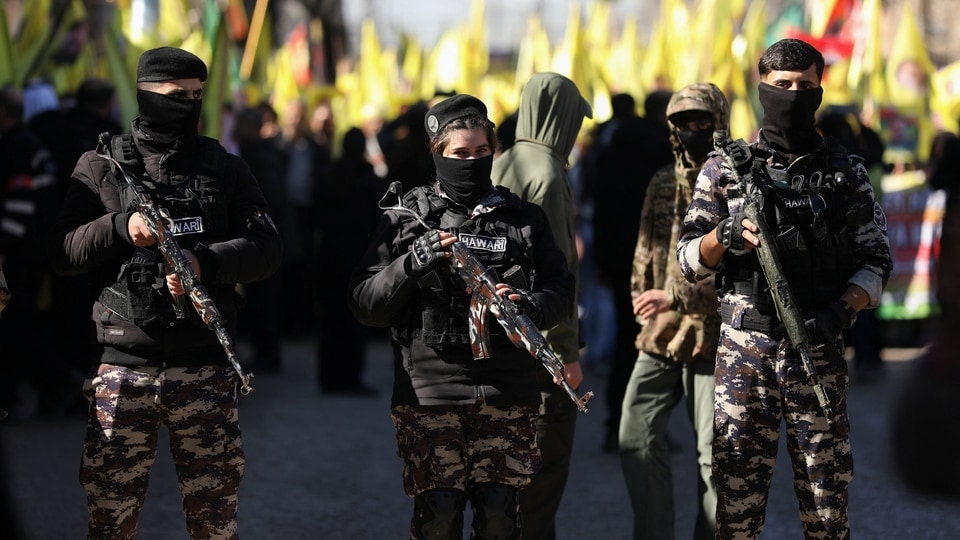
Are Iraqi Kurds planning to invade Iran?
Khalil Nadiri, an official with the Kurdistan Freedom Party, or PAK, which is based in northern Iraq, told AP on Wednesday that some of their forces had moved to areas near the Iranian border. He added that opposition group leaders were contacted by American officials, to discuss the operation.
Defense Secretary Pete Hegseth told reporters Wednesday: “None of our objectives are premised on the support or the arming of any particular force. So, what other entities may be doing, we’re aware of, but our objectives aren’t centered on that.”
Who are the Kurds?
The Kurds are an ethnic group, primarily inhabiting a mountainous region spanning southeastern Turkey, northern Iraq, northwestern Iran, and northern Syria. The Kurdish groups are widely seen as the most well-organized segment of the fragmented Iranian opposition and are believed to have thousands of trained fighters.
Experts say what the Kurds' involvement in the US-Iran conflict could mean
Hewa Khalid, a Kurdish studies expert at Indiana University, told The New York Post that the future of the conflict could be determined by what the Kurds demand. “The Kurdish groups see what’s happening now as an opportunity in Iran to unite and stand for self-determination."
"The future depends on who comes to lead Iran and how they respond to the demands of the Kurds. We could see a Kurdistan operating within Iran, or you could see the next Yugoslavia,” Khalid warned.
Kurdish fighters previously supported the US against Saddam Hussein in Iraq. The group also took on Islamist insurgents and helped the fight against the Islamic State in Syria.
However, experts say that Kurdish forces alone are not enough to overthrow the Iranian regime.
“If the regime is still stable after this, Iran will go after the opposition, and that would be bad for the Kurds. We’ve already seen Iran’s security forces show that they are willing to fire at Iranians," Jon Alterman, a Middle East expert at the Center for Strategic and International Studies (CSIS), told The Post.
Kurds were planning to join conflict even before US-Israel attack
Even before the US and Israel launched strikes against Iran, the PAK had claimed attacks on the paramilitary Revolutionary Guard in retaliation for Tehran’s violent crackdown on protests. But no troops were involved, as per AP.
If the Iranian and Iraqi Kurdish groups were to join the war, it would be the first entry of a significant ground force into the battle. The Kurdish groups have battle experience from the fight against the Islamic State group.
Iraqi Kurds hesitant to join the fray
Three Iraqi Kurdish officials told the AP that a call took place Sunday night between President Donald Trump and Masoud Barzani and Bafel Talabani - the heads of the Kurdistan Democratic Party, or KDP, and the Patriotic Union of Kurdistan, or PUK, the two main Kurdish parties in Iraq - to discuss the situation in Iran.
One of the officials said Trump had asked the Iraqi Kurds to militarily support the Iranian Kurdish groups in operations in Iran and to open the border to allow the Iranian Kurdish groups to move freely back and forth.
When asked about the call and reports that Trump has sought military support for Iranian Kurdish groups, White House press secretary Karoline Leavitt said: “He did speak to Kurdish leaders with respect to our base that we have in northern Iraq,” but denied that Trump had agreed to a specific plan.
The Iraqi Kurdish official said the Iraqi Kurds were concerned that getting directly involved in the conflict would draw a harsh Iranian response.
(With AP inputs)