
 E-Paper



Myanmar earthquake toll nears 3,000: How long can trapped victims survive?
A 7.7 magnitude earthquake hit Myanmar on Friday, one of the deadliest quakes of the region, leaving behind a massive trail of destruction.

 Prefer HTon Google


The death toll from a massive earthquake in Myanmar rose to 2,719 on Tuesday, with the 4,521 others injured and over 400 persons missing, junta chief Min Aung Hlaing said, adding that the toll is expected to go up to 3,000.
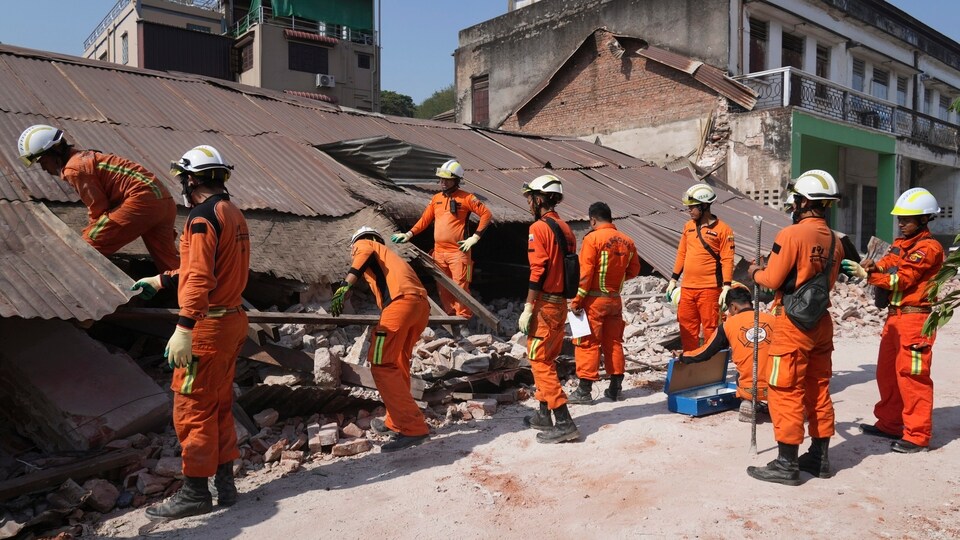
Earlier in the day, the country held a minute's silence to honour the victims of the devastating quake that shook it last week.
A 7.7 magnitude quake rocked Myanmar on Friday, affecting the neighbouring countries including China, Thailand, Vietnam and some parts of India. The incident left behind a massive trail of destruction, damaging several buildings and roads.
With the clock ticking, how long can trapped victims survive?
Not just the weight or pressure of the debris, survival chances of trapped people also depends on weather and access to water and air.
Experts have reportedly said that if the injuries are not too severe, victims can survive for a week or more and that is assuming the weather is not too hot or cold.
Most of the rescues take place within 24 hours after a disaster as the chances of survival reduce with each passing day after that, they said.
Geophysicist Victor Tsai of Brown University noted that the chances of survival of trapped victims are more if they are in a rubble-free pocket, preventing major injuries while they await rescue, for example a sturdy desk. This space is called a survivable void space, a report from The Associated Press said.
ALSO READ | ISRO's satellite images show Myanmar earthquake catastrophe | See pics
Meanwhile, emergency response expert Dr Joseph Barbera, an associate professor at George Washington University, noted that the odds of a person's survival decreases if any kind of fire, smoke or hazardous chemicals get released during building collapse.
Beyond that point, water to drink and air to breathe are the two most crucial factors as days pass on. "You could survive a while without food. You could survive less without water," Barbera said.
The role that temperature plays is, inside affects survival chances and that of the outside can affect the rescue missions.
Barbera further added that vital medical care might be significant for survivors before they are pulled out from under the rubble because otherwise, the toxins build up from crushed muscles could make them go into shock.
After Japan was hit by earthquake and tsunami in 2011, a teenage boy and his 80-year-old grandmother were found alive after nine days trapped in their flattened home. The year before, a 16-year-old Haitian girl was rescued from under earthquake rubble in Port-Au-Prince after 15 days.
Aid groups, rescue ops
Though aid groups from across the globe, including India, arrived in the worst-hit areas of Myanmar, they said that there was an urgent need for shelter, food and water.
The United Nations Office for the Coordination of Humanitarian Affairs said, "In the hardest-hit areas ...communities struggle to meet their basic needs, such as access to clean water and sanitation, while emergency teams work tirelessly to locate survivors and provide life-saving aid."
Meanwhile, International Rescue Committee, said that all these necessities were needed in places such as Mandalay, near the epicenter of the quake, where 50 preschoolers and two teachers were killed when the quake hit their school.
ALSO READ | WHO seeks $8 million in 30 days after earthquake leaves Myanmar in need of aid
An IRC workers in Mandalay said in a report, "Having lived through the terror of the earthquake, people now fear aftershocks and are sleeping outside on roads or in open fields. There is an urgent need for tents, as even those whose homes remain intact are too afraid to sleep indoors."
Myanmar has also been embroiled in civil war since the junta seized power in a coup in 2021, complicating aid groups' efforts to reach those injured and made homeless by one of the deadliest quake in the region.
ALSO READ | Myanmar earthquake: Thailand investigates Bangkok skyscraper collapse over China firm link
Challenges for aid workers have been intensified due to the junta's tight control over the communication networks and the damaged roadways.
In Bangkok, where rescuers are still running against time to find those trapped inside a skyscraper that collapsed during the earthquake, the odds of finding survivors are getting lengthened by the minute. A volunteer rescue leader, cited by Reuters, said, "There are about 70 bodies underneath ... and we hope by some miracle one or two are still alive."
So far, 13 deaths at the building site have been confirmed, with 74 others still missing. The national death toll of Thailand, meanwhile, stands at 20.


