
 E-Paper



North Korea launches first ICBM since days of ‘fire and fury’
The last time North Korea conducted such a test, in November 2017, China and Russia supported a U.S.-led effort to impose crippling sanctions on the country.


North Korea launched its first intercontinental ballistic missile in more than four years, as Kim Jong Un finally abandoned a testing freeze that had underpinned an unprecedented wave of talks with the U.S.
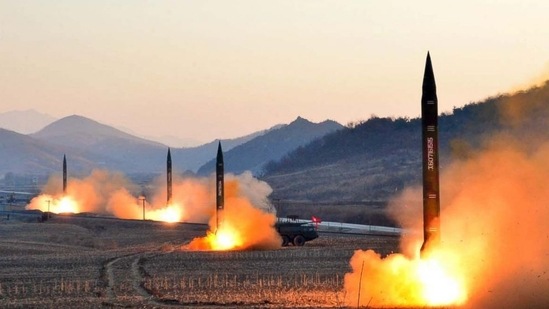
The missile was launched from the Sunan area outside Pyongyang on Thursday, reaching an altitude of 6,200 kilometers (3,900 miles) and traveling a distance of 1,080 kilometers, South Korea’s Joint Chiefs of Staff said. That’s higher and farther than North Korea’s last ICBM test in November 2017, suggesting that Kim had successfully launched a long-anticipated weapon believed to be capable of carrying multiple nuclear warheads.
North Korea typically doesn’t comment on its tests until the next day. The country has described recent rocket tests from the same area as efforts to launch a satellite.
Read more: North Korea fires multiple rocket launcher, says South Korea
South Korean President Moon Jae-in “strongly condemned” the launch, which he said violated both United Nations resolutions and Kim’s promise to hold off such tests. The self-imposed testing freeze helped de-escalate a crisis four years ago in which former President Donald Trump threated to unleash “fire and fury” against North Korea and ultimately paved the way for talks between the two leaders.
The last time North Korea conducted such a test, in November 2017, China and Russia supported a U.S.-led effort to impose crippling sanctions on the country. Such an effort appears unlikely as Beijing and Moscow fight against a sanctions campaign over Russia’s invasion of Ukraine.
“I believe they have completed the creation of the Hwasong-17, the so-called ‘monster missile,’” said Yang Moo-jin, professor at the University of North Korean Studies in Seoul. “They would pick two reasons for scrapping the moratorium: no further change of stance from Washington and a firm belief that denuclearization will only lead to destruction based on what they are seeing from Ukraine crisis.”
North Korea rolled out the Hwasong-17 at an October 2020 military parade. The weapon appears to be the world’s largest road-mobile ICBM and designed to carry multiple warheads and overwhelm missile defense systems.
Japanese Prime Minister Fumio Kishida, who was in Brussels to attend Group of Seven meetings Thursday, called the test “outrageous” and said his country would consult with the U.S. and South Korea on a response.
The projectile landed inside Japan’s exclusive economic zone, about 150 kilometers off the coast of Hokkaido prefecture, Japan’s defense ministry said. The rocket was aloft for about an hour.
Also read: North Korea fires 'unidentified projectile' but launch fails
North Korea often uses its missile launches for political purposes and the latest test comes after neighbor South Korea elected conservative Yoon Suk Yeol to be its new president. Yoon riled North Korea on the campaign trail by saying a preemptive strike would be justified if an attack by the neighbor seems imminent -- setting the stage for further friction when he takes office in May.
The president-elects transition team called the launch a “grave provocation.”
South Korea’s military said in a statement that it test-fired missiles including a surface-to-surface missile, a ship-to-surface missile and an air-to-surface missile shortly after the North Korea launch Thursday. The South has said previously that it had the capability to strike and destroy the site of a missile launch as well as its command and support facilities at any time.
China Foreign Ministry spokesman Wang Wenbin called for restraint. “We hope that all parties can keep in mind the big picture of peace and stability of the peninsula, stick to the right direction of dialogue and consultation, and work together for the political settle of the peninsula issue,” Wang told a regular news briefing in Beijing.
Concerns have been mounting that North Korea was looking to end its freeze on ICBM tests, after South Korea and the U.S. detected signs of an imminent ICBM launch. North Korea fired off projectiles from a multi-rocket launcher Sunday.
North Korea also appears to be undertaking construction work at its main nuclear weapons test site for the first time in about four years, according to an analysis of satellite imagery.
On March 16, North Korea fired a suspected ballistic missile from an the Sunan area, near Pyongyang’s international airport. South Korea’s military believes the test ended in failure with the missile exploding before reaching an altitude of 20 kilometers, Yonhap said.
The latest launch comes after the U.S. announced new penalties against North Korea after determining that a pair of purported satellite launches by Kim’s regime in the past few weeks were used to test systems for a long-anticipated new ICBM.
The U.S. had said earlier that North Korean launches on Feb. 26 and March 4 that were also from the area around the Pyongyang airport were intended to test elements of an ICBM that weapons experts believe could be armed with multiple warheads.
North Korea’s last test of an ICBM was in November 2017, when it fired a Hwasong-15 with a range that experts said could strike all of the U.S. mainland. It was a major breakthrough in Kim’s efforts to deliver a nuclear weapon to any American city.


