
 E-Paper





Follow the latest breaking news, major developments and agenda-setting stories from India and around the world with the newsdesk at Hindustan Times. Operating round the clock, the desk brings together experienced editors, reporters and correspondents to deliver fast, accurate and contextual reporting across subjects that influence public policy, governance, business, society and international affairs. The HT News Desk covers politics, elections, government policies, the economy, business and markets, science and technology, the environment, law and order, infrastructure, education, climate issues and geopolitics, while closely tracking developments across states, institutions and global capitals. The team also leads coverage of major breaking news events, policy announcements, court proceedings, natural disasters, public emergencies and significant international developments. Reports published by the newsdesk are based on information gathered from reporters on the ground, official statements, government agencies, court records, regulatory filings, recognised institutions and other authoritative sources. Stories undergo editorial scrutiny and verification processes to ensure accuracy, fairness and relevance, and are updated as events evolve and additional information becomes available. Whether covering a key political decision in New Delhi, an economic policy shift affecting millions, a landmark court ruling or a major global event, the HT News Desk aims to provide readers with reliable, fact-based journalism that delivers not only the latest developments but also the context and analysis needed to understand their wider implications.
 Trending News
North Korea’s ‘new missile’ has unprecedented range: Experts
The North Korea, which has carried out two atomic tests and dozens of missile launches since the beginning of last year, says it needs atomic weapons to defend itself against the threat of invasion.


North Korea said on Monday it had successfully tested a new type of rocket in its latest missile launch, as analysts said it showed an unprecedented range that brought US bases in the Pacific within reach.
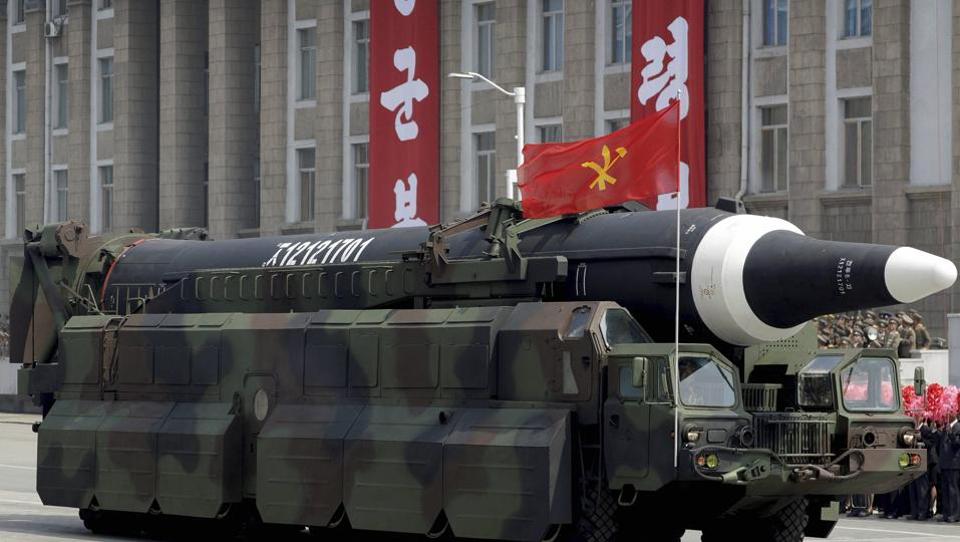
Sunday’s launch was of a “new ground-to-ground medium long-range strategic ballistic rocket” named the Hwasong-12, the official Korea Central News Agency (KCNA) said.
Leader Kim Jong-Un personally oversaw the test, it said, and “hugged officials in the field of rocket research, saying that they worked hard to achieve a great thing”.
The isolated North is under multiple sets of United Nations sanctions over its nuclear and missile programmes, which have triggered global alarm.
The missile was launched on an unusually high trajectory, with KCNA saying it flew to an altitude of 2,111.5 kilometres and travelled 787 kilometres before coming down in the Sea of Japan (East Sea).
That suggests a range of 4,500 kilometres or more if flown for maximum distance, analysts said.
Aside from space launches, Jeffrey Lewis of the Middlebury Institute of International Studies in the US told AFP: “This is the longest range missile North Korea has ever tested.”
On the respected 38 North website, aerospace engineering specialist John Schilling said it appeared to demonstrate an intermediate-range ballistic missile that could “reliably strike the US base at Guam” in the Pacific.
“More importantly,” he added, it “may represent a substantial advance to developing an intercontinental ballistic missile (ICBM)”.
The North says it needs atomic weapons to defend itself against the threat of invasion and has carried out two atomic tests and dozens of missile launches since the beginning of last year.
Its goal is to develop a missile capable of delivering a nuclear warhead to the continental United States -- something President Donald Trump has vowed “won’t happen”.
Tensions between the two reached a peak in recent weeks, with Washington saying military action was an option under consideration and Pyongyang issuing threats of its own, sending fears of conflict spiralling.
Trump later appeared to hold open the door to negotiations, saying he would be “honoured” to meet Kim and called him a “smart cookie”.
Last week the South elected a new president, Moon Jae-In, who advocates reconciliation with Pyongyang and said at his inauguration that he was willing “in the right circumstances” to visit the North to ease tensions.
But he slammed the latest missile test as a “reckless provocation” after holding an emergency meeting with national security advisers.


