E-Paper



Russian envoy to India defends country’s growing ties with Pakistan
Ambassador Nikolay Kudashev’s remarks, made at an event organised by the think tank Ananta Aspen Centre, come against the backdrop of growing pressure from the West, especially the US, on Pakistan to crack down on terrorists operating from its soil and to curb widespread terror financing.

 Prefer HTon Google


Russia’s envoy to India on Monday defended his country’s burgeoning relationship with Pakistan, calling for a “realistic” approach to regional security and stability and saying Islamabad’s “credibility” in the war on terror had increased.
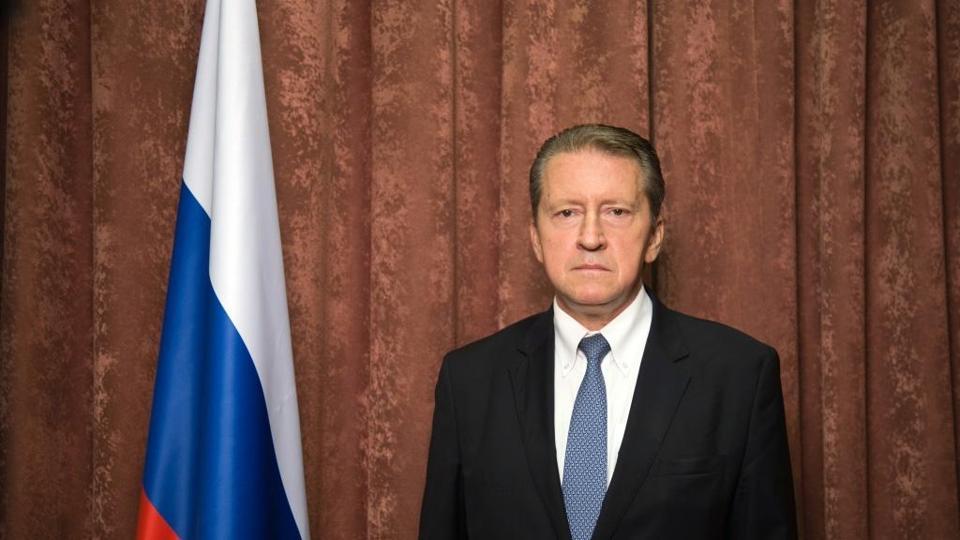
Ambassador Nikolay Kudashev’s remarks at an event organised by the think tank Ananta Aspen Centre, come against the backdrop of growing pressure from the West, especially the US, on Pakistan to crack down on terrorists operating from its soil and to curb widespread terror financing.
“In my take…after this country joined the Shanghai Cooperation Organisation, after this country started to take serious measures to curb the financing of terror, the credibility of Pakistan is growing and there is no reason, no sense to deny its wish, its will to be a part of regional and global efforts to fight terror, to search for stability and to enhance economic integration,” he said during the question and answer session.
Earlier in his speech, Kudashev said Russia is “open for contacts with every country” to ensure regional stability. Without naming Pakistan or the US, he also said “excessive pressure” on any of Afghanistan’s neighbours would “just antagonise them and make numerous problems even more complicated”.
“The problems of Afghanistan are impossible to resolve without taking on board every neighbouring country,” he said.
“There should be a realistic and comprehensive approach to the issues of common interest rather than a geopolitical one. We are open to contacts with every country, especially if it would help to ensure the regional stability, which, on the other hand, also remains largely dependent on constructive relationship between New Delhi and Islamabad,” he added.
However, Kudashev said several times that Russia’s ties with Pakistan could not be compared to the strategic partnership with India, which is one of the leading players in the Asia Pacific and Eurasia.
Problems between India and Pakistan should be resolved diplomatically in line with the Simla Agreement and the Lahore Declaration, and Russia would support such a dialogue if requested by both sides, Kudashev said.
The envoy also stated Russia’s support for a dialogue between the Afghan government and the Taliban, describing it as the “only way forward for the sake of lasting national reconciliation”. The need for a unified approach towards the Taliban was guiding Russia’s developing relations with Pakistan, he said.
Though Russia remains the largest supplier of hardware to India’s military, accounting for some 60% of the armament of the three services, New Delhi has kept a wary eye on the growing defence relations between Moscow and Islamabad. Pakistan recently received four Mi-35 gunship helicopters ordered from Russia under a $153 million deal and the two countries have conducted joint military drills in the past two years.
Kudashev also spoke of the extensive cooperation between Russia and India, including defence cooperation that would last for many decades, the development of the hypersonic Brahmos Mark II cruise missile and collaboration on the Kudankulam nuclear power plant, for which Moscow has offered its latest reactors.