
 E-Paper



UAE halts all trade dealings with Iran after escalation, missile alerts in Dubai
The UAE remains firmly committed to safeguarding the integrity of the international financial system, the foreign ministry says.

 Prefer HTon Google


The United Arab Emirates has suspended all trade, commercial exchanges and financial transactions with Iran “until further notice”, the country’s foreign ministry said on Wednesday.
UAE foreign ministry communications director Afra Al Hameli said the decision was taken in light of “regional escalations that undermine regional and international peace and security”.
“In light of regional escalations... all trade, commercial exchanges, and financial transactions with Iran have been halted until further notice,” Al Hameli said. She also said the UAE would continue to protect the international financial system and follow international law and global standards.
Deep Dive

UAE alleges missile attack by Iran
The announcement came after the UAE said two ballistic missiles had been fired towards the country from Iran. Both missiles fell into the sea -- one landed within UAE territorial waters and the other outside them, according to the defence ministry.
The ministry later claimed the missiles were intended to target maritime traffic.
ALSO READ | Dubai residents receive missile alert for first time in weeks, UAE warns citizens
Iran denies missile attack
Iran denied firing missiles at the UAE. Iranian foreign ministry spokesman Esmail Baghaei said on Telegram that all regional parties should refrain from making “baseless accusations”.
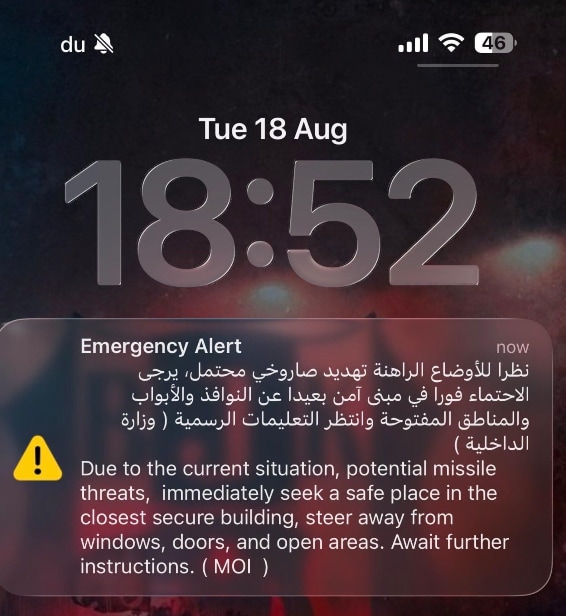
Residents in Dubai received a missile threat alert on Tuesday as UAE air defence systems responded to incoming missiles. The interior ministry declared the situation safe shortly afterwards.
The incident came after recent Iranian strikes allegedly targeting UAE-linked ships in the Strait of Hormuz.
The UAE last confirmed an attack by Iran in May, when Tehran launched multiple strikes on US military bases in the country in response to Donald Trump's war on Iran. Earlier that month, Iran fired 15 missiles and four drones towards US bases in the UAE.
Later in May, the UAE said a drone targeting a nuclear power plant on its territory had been launched from Iraq, where Iranian-backed militias were based.
ALSO READ | After 2 ADNOC tankers attacked in Strait of Hormuz; UAE blames Iran, calls it ‘flagrant violation’
Tensions in Strait of Hormuz
The escalation has also affected shipping through the Strait of Hormuz, a key oil artery. Two Abu Dhabi National Oil Co. vessels were struck while transiting the waterway last week on Thursday. Another was hit on Friday evening, according to UAE state-run WAM news agency.
Before the ongoing US war on Iran, about a fifth of the world’s oil and liquefied natural gas passed through the Strait of Hormuz. Traffic through the waterway has since fallen sharply after Tehran closed the vital energy route following the US and Israeli assassination of Supreme leader Ayatollah Ali Khamenei and missile attacks on the country.
Iran has also targeted tankers and commercial vessels attempting to bypass the closure.
The US-Israeli war on Iran began on February 28 after the two countries bombed Tehran. Iran has since been retaliating with missile strikes on US bases in the Gulf.


