E-Paper


‘It’s a new world…': Top Trump lawyer John Sauer clashes with Justice Roberts over birthright citizenship
The top Trump lawyer, Solicitor General John Sauer, and Chief Justice John Roberts got into a heated exchange

 Prefer HTon Google


The top Trump lawyer, Solicitor General John Sauer, and Chief Justice John Roberts got into a heated exchange during the Supreme Court's hearing on birthright citizenship on Wednesday. The 51-year-old argued that there is a ‘new world’ before Justice Roberts interjected.
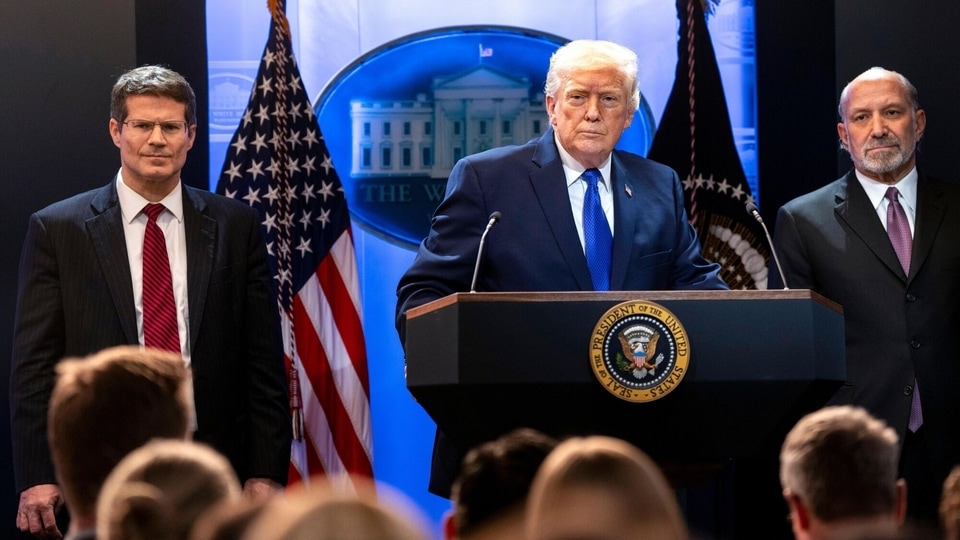
John Sauer vs Justice Roberts
Sauer said 'it's a new world in which billions of people are now a flight away' from the US.
Chief Roberts quickly responded to Sauer, by saying, "It's a new world, but the same Constitution"
Sauer further added that ‘no one knows for sure’, referring to the scope of ‘birth tourism’.
Read More: Trump claims Iran has asked for ceasefire: ‘Will consider when Strait of Hormuz is open'
This came as the Supreme Court began hearing arguements over Trump's order to end birthright citizenship for children born in the US to someone in the country illegally or temporarily.
The birthright citizenship order, which Trump signed on January 20, 2025, the first day of his second term, is part of his Republican administration’s broad immigration crackdown. The president was in attendance for Wednesday's hearing.
Administration defends limits on citizenship
Sauer’s argument focused on the concept of allegiance and permanent residence. He told the court that the 14th Amendment’s citizenship clause was never intended to apply broadly to all individuals born on US soil.
He explained that the provision ‘was adopted just after the Civil War to grant citizenship to the newly freed slaves and their children, whose allegiance to the United States had been established by generations of domicile here’.
It did not, he added, ‘grant citizenship to the children of temporary visitors or illegal aliens who have no such allegiance’.
Sauer also maintained that Trump’s executive order would apply ‘only prospectively’.
Read More: Trump ‘considering pulling out of NATO’ after setback from allies in Iran war: Report
Justices raise concerns over scope
The administration’s position, however, faced resistance from both conservative and liberal justices.
Justice Sonia Sotomayor warned that the logic behind the argument could have far-reaching consequences, suggesting it might allow a future president to strip citizenship from individuals born in the United States years later.
Chief Justice Roberts questioned whether existing exceptions to birthright citizenship, such as children of diplomats or foreign invaders, could reasonably be expanded to cover undocumented immigrants. He said it was unclear how those limited examples could be applied to ‘a whole class of illegal aliens’.
He added he was not sure ‘how you get to that big group from such tiny and idiosyncratic examples’.
Justice Neil Gorsuch also raised doubts, noting there was little historical discussion supporting Sauer’s reliance on domicile. Justice Elena Kagan echoed that concern, saying part of the administration’s argument rests 'on some pretty obscure sources'.
14th Amendment
The debate returned to the origins of the 14th Amendment. Justice Clarence Thomas questioned whether immigration had played any meaningful role in those discussions, asking, “How much of the debates around the 14 Amendment had anything to do with immigration?”
Opponents of the administration’s view pointed to long-standing precedent. The 1898 Supreme Court ruling in United States v. Wong Kim Ark established that a child born in the US to foreign parents is a citizen.
In that decision, Justice Horace Gray wrote that the 14th Amendment ‘affirms the ancient and fundamental rule of citizenship by birth within the territory’, including children born to resident aliens.
Birth tourism and modern concerns
Chief Justice Roberts also pressed Sauer on modern concerns such as ‘birth tourism’, where individuals travel to the US to give birth so their children obtain citizenship.
Asked about the scale of the issue, Sauer acknowledged uncertainty, stating that ‘No one knows for sure’, while referencing ‘media estimates’.
What’s at stake
While birthright citizenship is firmly established in the US, it remains uncommon globally, with most countries relying on the principle of jus sanguinis, citizenship based on parental nationality.
(With AP inputs)