
 E-Paper



Missed the big bright supermoon? The rare event returns sooner than you think
The next supermoon of the year is scheduled for November, followed by another in December.

 Prefer HTon Google


The first supermoon of the year lit up the sky on Monday night across parts of the world as skywatchers witnessed a full moon closest to the autumn equinox. Also known as the Harvest Moon, the moon appeared up to 14 per cent bigger and 30 per cent brighter than the faintest moon of the year, according to NASA.
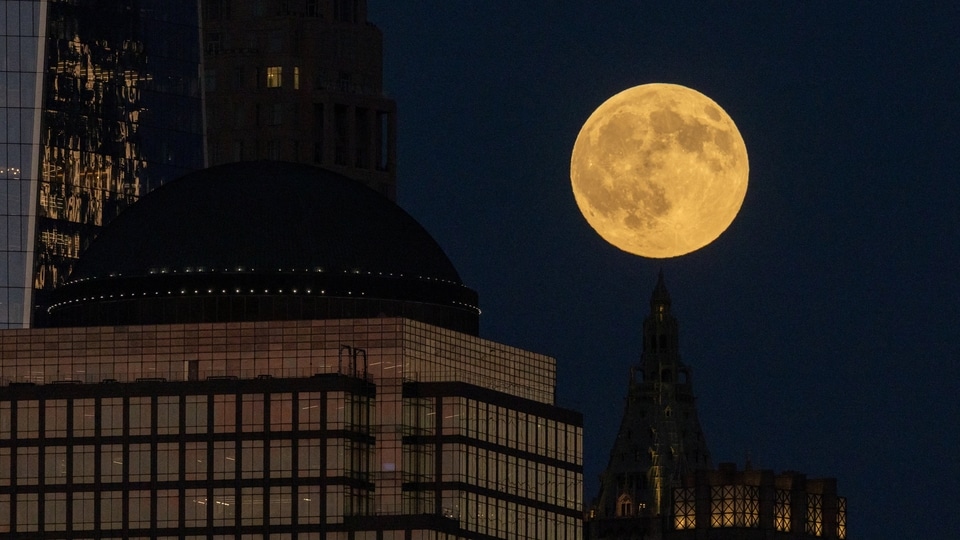
In India, the supermoon was seen across the country on the evening of October 6 and into the early hours of October 7. The full moon phase was predicted to occur at 11:48 pm EDT on October 6 (9:18 am IST on October 7).
Notably, the next supermoon of the year is scheduled for November, followed by another in December. This would be further followed by two lunar eclipses in 2026: a total eclipse across much of North America, Asia and Australia in March, and a partial eclipse in August across the Americas, Africa and Europe.
The best time to view a supermoon is when it’s near the horizon, where a phenomenon known as the moon illusion makes it appear even larger and more striking.
The supermoon happens when a full moon is closer to Earth in its orbit. This makes it look bigger and brighter. It is 14 per cent bigger and 30 per cent brighter than when it is farthest from Earth.
According to Space.com, this is also called the harvest moon. In the past, farmers would use the moonlight to harvest the last of the summer crops before the weather changed.
A supermoon can appear up to 14 per cent larger in the sky and shine up to 30 per cent brighter.
“Supermoon” is not an official astronomical term, but it generally refers to a full moon that comes within at least 90 per cent of its closest approach to Earth, known as perigee.
During the Harvest Moon period, the moon rises earlier than usual each night, making evenings unusually bright.
Although the moon will look bigger during this supermoon, it will not be the largest of the year. The biggest will occur on November 5 during the ‘Beaver Moon’.


